

Os narcisos são tóxicos para os cães?
Atualizado: junho de 2026
Narcisos: a flor alegre — e tóxica — da primavera
Os narcisos estão entre as primeiras flores da primavera, e as suas flores amarelas e brancas brilhantes são uma visão bem-vinda após longos invernos. São plantados aos milhões em jardins por toda a América do Norte, a Europa e não só, e surgem de forma fiável em ramos de flores de corte, vasos no peitoril da janela e paisagens exteriores todas as primaveras. A sua ubiquidade, combinada com o facto de os cães passarem mais tempo ao ar livre precisamente quando os narcisos estão em flor e a ser plantados, cria um risco significativo e regularmente subestimado.
Os narcisos pertencem ao género Narcissus, que engloba mais de 50 espécies e milhares de variedades cultivadas. Todas elas são tóxicas para os cães. O principal composto tóxico é a lycorine, um alcaloide isoquinolínico que causa vómitos ao irritar diretamente o trato gastrointestinal e ao desencadear o centro do vómito no cérebro. Os compostos tóxicos adicionais nos narcisos incluem:
- Galanthamine — um inibidor da colinesterase que afeta o sistema nervoso
- Narcissi macroside e outros alcaloides fenantridínicos
- Cristais de oxalato de cálcio — presentes em algumas partes da planta, acrescentando irritação oral imediata à toxicidade mediada pela lycorine
Este perfil tóxico de múltiplos compostos torna o envenenamento por narcisos mais complexo do que as exposições a plantas com uma única toxina, e mais propenso a produzir uma gama diversificada de sintomas que afetam múltiplos sistemas do organismo.
O bolbo: exponencialmente mais perigoso
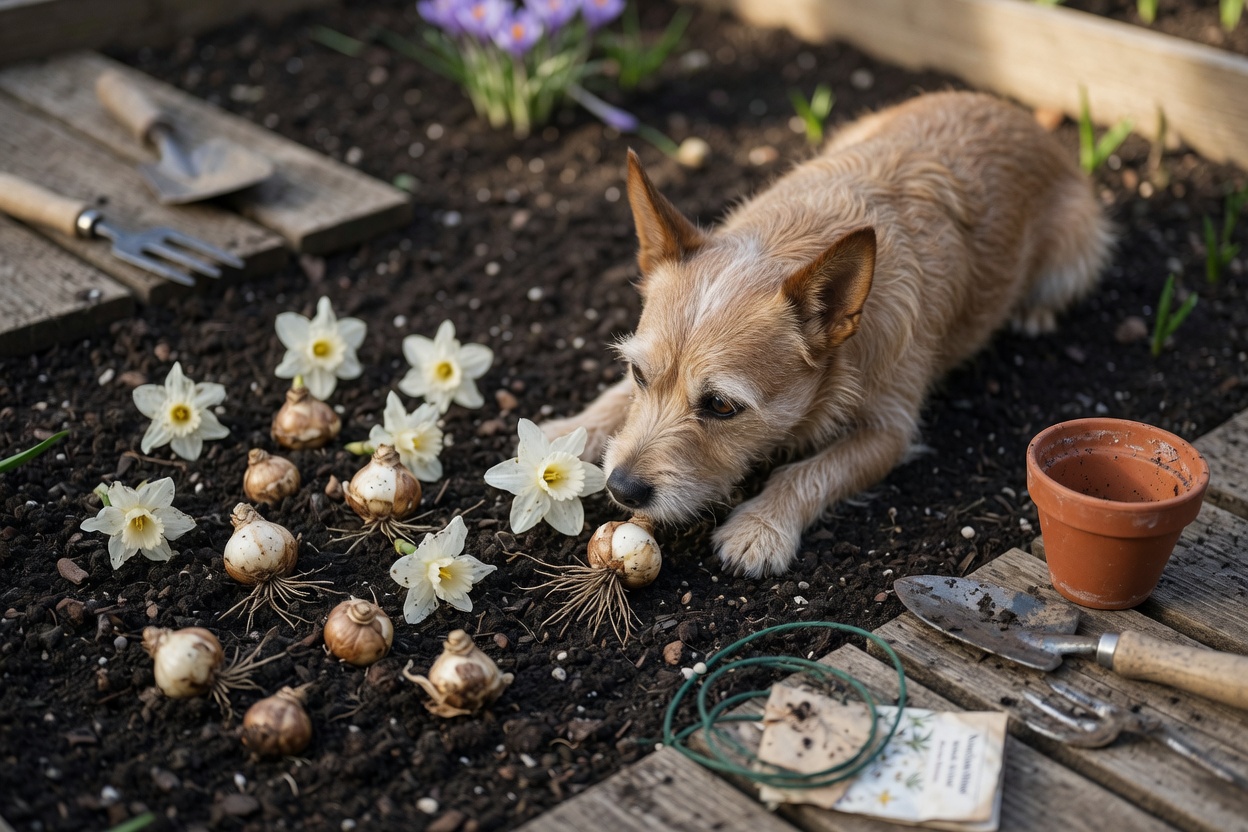
Todas as partes da planta do narciso são tóxicas — as flores, os caules e as folhas contêm lycorine e alcaloides relacionados. Mas o bolbo contém estes compostos em concentrações muito superiores às do resto da planta. A ingestão de bolbos é o cenário que os veterinários observam com mais frequência e levam mais a sério.
Os cães deparam-se com bolbos de narciso em vários contextos:
- Durante a plantação na primavera — os jardineiros podem deixar os bolbos temporariamente acessíveis, e os cães podem desenterrá-los
- Durante a plantação no outono — quando os bolbos estão a ser armazenados ou plantados para a primavera seguinte
- De zonas de armazenamento — garagens, anexos de jardim e caves onde os bolbos são armazenados podem ser acessíveis aos cães
- De canteiros recém-cavados — os cães que cavam podem desenterrar bolbos plantados
- De matéria vegetal caída ou descartada — durante a limpeza do jardim
Um único bolbo grande pode produzir toxicidade significativa num cão pequeno. Vários bolbos — que um cão com acesso sem supervisão a um saco de bolbos para plantação pode facilmente consumir — podem causar doença grave e multissistémica que requer intervenção veterinária intensiva.
Sintomas de envenenamento por narcisos nos cães
O perfil de sintomas da toxicidade por narcisos nos cães é abrangente, refletindo os múltiplos compostos tóxicos envolvidos. Os sintomas podem aparecer entre 15 minutos e algumas horas após a ingestão, embora isto dependa da quantidade consumida e da parte da planta que foi comida.
Sintomas gastrointestinais (os mais comuns):
- Vómitos profusos — muitas vezes o primeiro e o mais dramático sinal; a lycorine estimula especificamente o centro do vómito
- Diarreia grave — pode ser aquosa e conter muco ou sangue
- Salivação excessiva e baba
- Dor abdominal — o cão pode ganir, proteger a barriga ou adotar uma postura de dor (cotovelos no chão, traseiro elevado)
- Náusea sem vómito — ânsias, lamber os lábios
Sintomas sistémicos (mais graves):
- Tensão arterial baixa (hipotensão) — o cão pode parecer fraco, trémulo e relutante em levantar-se
- Tremores ou tremor muscular
- Arritmias cardíacas — batimento cardíaco irregular que só pode ser detetado por auscultação ou ECG
- Letargia extrema e fraqueza — o cão pode colapsar ou ser incapaz de andar normalmente
- Depressão respiratória — respiração superficial ou laboriosa em casos graves
- Convulsões — raras, mas documentadas em ingestões significativas
Os efeitos cardiovasculares — tensão arterial baixa e arritmias — são os aspetos da toxicidade por narcisos com maior probabilidade de se tornarem potencialmente fatais. Um cão que parece «ter apenas um mal-estar de estômago» depois de comer narciso pode desenvolver complicações cardiovasculares ao longo das horas seguintes, sem sinais de aviso óbvios para um observador sem formação.
Isto é uma emergência: contacte o seu veterinário imediatamente
Dado o potencial de envolvimento cardíaco, a ingestão de narcisos — especialmente a ingestão de bolbos — deve ser tratada com urgência. Contacte o seu veterinário imediatamente, mesmo que o seu cão esteja apenas a apresentar sintomas ligeiros. Não adote uma abordagem de esperar para ver. Contacte o ASPCA Animal Poison Control Center através do (888) 426-4435 se o seu veterinário habitual não estiver disponível.
Quando ligar, indique:
- A parte da planta comida (flor, folhas, bolbo)
- Uma estimativa da quantidade consumida
- O peso corporal do seu cão
- A hora aproximada da ingestão
- Os sintomas atuais
O tratamento veterinário pode incluir vómito induzido (se a ingestão foi recente e o cão ainda não estiver a vomitar — o vómito induzido pela lycorine por vezes significa que a descontaminação é menos eficaz), carvão ativado, suporte com fluidos IV, monitorização e gestão cardíacas, e medicamentos antináusea. A maioria dos cães que recebem cuidados veterinários atempados recupera, mas o prognóstico piora significativamente com o tratamento tardio ou com ingestões de grande quantidade.
A água do vaso e as flores de corte: não as ignore
Os narcisos de corte libertam alcaloides para a água do vaso no prazo de horas após serem colocados no recipiente. Os cães que bebem dos vasos de flores — um comportamento surpreendentemente comum — podem ingerir uma dose significativa de toxina. Da mesma forma, os caules dos narcisos de corte exsudam, quando cortados, uma seiva pegajosa e leitosa que contém alcaloides concentrados. Esta seiva pode causar irritação da pele em humanos (conhecida como «comichão do narciso») e é tóxica se for lambida pelos cães.
Mantenha os ramos de narcisos de corte fora do alcance, deite fora a água do vaso de imediato e lave as mãos depois de manusear narcisos de corte, antes de acariciar o seu cão.
Proteger o seu cão durante a época dos narcisos
- Supervisione o seu cão de perto no jardim durante a primavera, quando os narcisos estão em flor
- Isole com uma cerca os canteiros que contenham narcisos ou utilize canteiros elevados a que os cães não consigam aceder
- Guarde os bolbos em recipientes selados e elevados que os cães não consigam alcançar nem derrubar
- Nunca deixe bolbos desenterrados ou divididos sem vigilância em locais acessíveis
- Mantenha os ramos de narcisos de corte em superfícies altas e deite fora a água do vaso diariamente
- Tenha em atenção que todas as espécies de Narcissus — incluindo jonquilhas, paperwhites e narcisos — são igualmente tóxicas
Pontos-chave
- Os narcisos são tóxicos para os cães — todas as espécies e variedades de Narcissus, incluindo bolbos, folhas, flores e água do vaso.
- Os bolbos contêm a maior concentração de lycorine e outros alcaloides; a ingestão de bolbos é o cenário mais perigoso.
- Os sintomas incluem vómitos, diarreia, dor abdominal, tensão arterial baixa, tremores e, potencialmente, arritmias cardíacas.
- O envolvimento cardíaco torna a toxicidade por narcisos potencialmente fatal — trate todas as ingestões com urgência.
- Contacte o seu veterinário imediatamente ou o ASPCA Poison Control através do (888) 426-4435 se o seu cão ingerir qualquer parte de um narciso.
- Os períodos de plantação na primavera e de armazenamento de bolbos criam as janelas de maior risco — supervisione os cães de perto durante estes períodos.
Referências
- Lampe KF, McCann MA. AMA Handbook of Poisonous and Injurious Plants. American Medical Association, Chicago, 1985. Referenciado em: Marvell SI, Smith LJ. "Narcissus toxicity: management and outcomes." Veterinary Record. 2008. PMID: 18708413
- Evidente A, Kireev AS, Jenkins AR, Romero AE, Steelant WF, Van Slambrouck S, Hamel E. "Biological activities of structurally diverse Narcissus alkaloids." Phytochemistry. 2009 Jun;70(8):1032-8. PMID: 19464714