
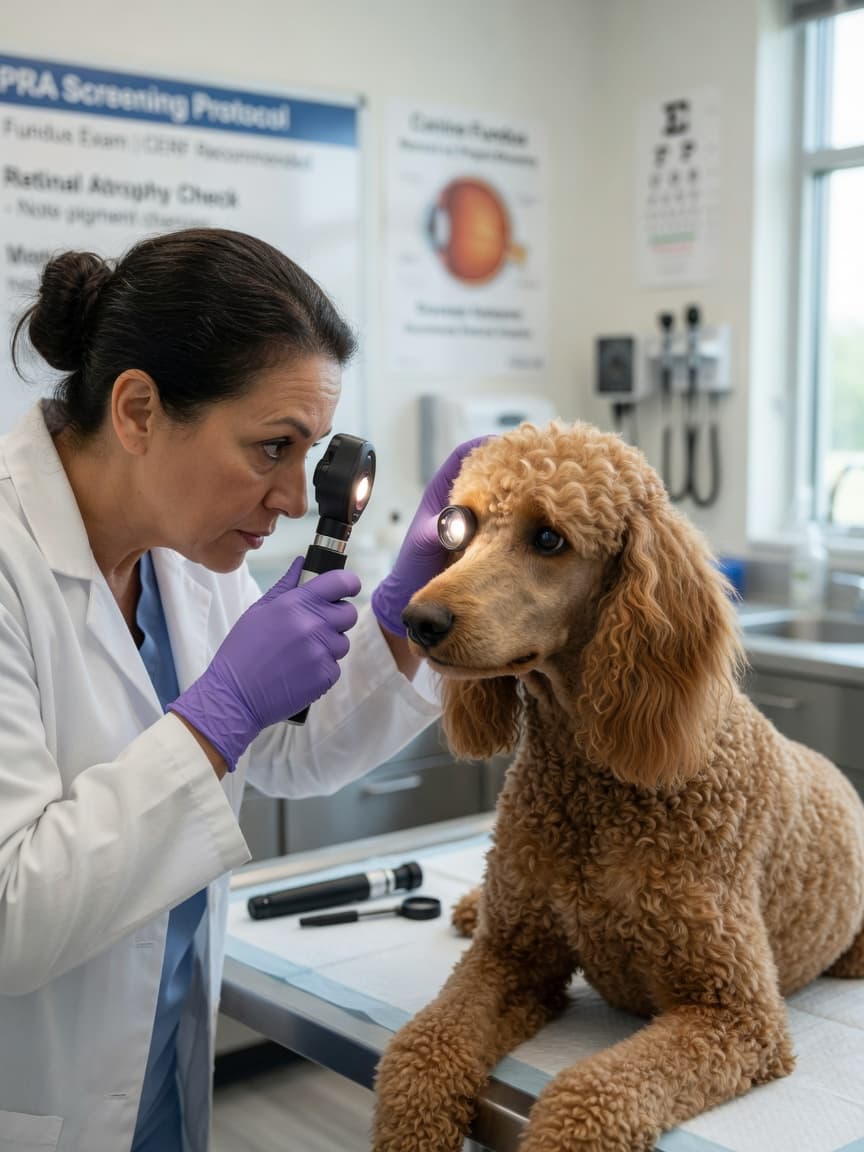
Santé du Caniche : affections courantes selon la taille (Toy/Nain/Grand)
Mise à jour juin 2026
- Espérance de vie : Toy 12 à 18 ans, Nain 13 à 15 ans, Grand Caniche 12 à 15 ans
- Principaux risques pour la santé : atrophie rétinienne progressive, maladie d'Addison, dysplasie de la hanche (Grand Caniche), luxation de la rotule (Toy/Nain), adénite sébacée
- Tests génétiques recommandés : test ADN PRA-prcd, test ADN vWD, dépistage OFA hanches/coudes (Grand Caniche), évaluation des rotules (Toy/Nain)
Les Caniches comptent parmi les races canines les plus anciennes et les plus intelligentes, et ils existent en trois variétés de taille distinctes — Toy, Nain et Grand Caniche — chacune présentant un profil de santé légèrement différent. Bien que les trois partagent le même héritage génétique, leurs différences de taille font que certaines affections se regroupent par variété. Les Grands Caniches font face aux problèmes des races de grande taille, comme la dysplasie de la hanche et le syndrome dilatation-torsion de l'estomac, tandis que les Caniches Toy et Nains sont plus sujets aux préoccupations des petites races, comme la luxation de la rotule et les maladies dentaires. Ce que les trois variétés partagent, c'est une susceptibilité commune à toute la race à l'atrophie rétinienne progressive, à la maladie d'Addison et à l'adénite sébacée.
Les problèmes de santé les plus fréquents chez le Caniche
Dans les trois variétés, l'atrophie rétinienne progressive (ARP) est la plus importante affection oculaire héréditaire. La maladie d'Addison — un déficit en hormones surrénaliennes — est nettement surreprésentée chez le Caniche par rapport aux autres races. L'adénite sébacée, une affection cutanée inflammatoire qui détruit les follicules pileux, touche principalement les Grands Caniches. L'épilepsie, la maladie de von Willebrand (un trouble de la coagulation) et le syndrome dilatation-torsion de l'estomac (SDTE chez les Grands Caniches) constituent d'autres préoccupations spécifiques à la race. Les maladies dentaires touchent toutes les variétés, mais elles sont particulièrement lourdes chez les Caniches Toy, dont la petite cavité buccale provoque un encombrement dentaire.
Atrophie rétinienne progressive (ARP)

L'ARP provoque la mort progressive des cellules photoréceptrices de la rétine, entraînant d'abord une cécité nocturne puis, à terme, une cécité totale. Chez le Caniche, la forme prcd-ARP est la plus fréquente ; elle est due à une mutation bien caractérisée du gène PRCD, ce qui rend le test ADN simple et très fiable. Les chiens atteints sont homozygotes (prcd/prcd), tandis que les porteurs (N/prcd) sont cliniquement normaux. Les éleveurs responsables testent tous leurs reproducteurs et n'accouplent jamais deux porteurs entre eux. Les signes précoces d'ARP comprennent une réticence à entrer dans des pièces sombres, le fait de se cogner contre des objets la nuit et une dilatation des pupilles en faible luminosité. Bien qu'il n'existe actuellement aucun traitement, les chiens atteints s'adaptent remarquablement bien à des environnements familiers. Une supplémentation en antioxydants (dont la lutéine et la zéaxanthine) est parfois recommandée par les ophtalmologues vétérinaires pour ralentir la progression.
Maladie d'Addison (hypocorticisme)

La maladie d'Addison est parfois surnommée « la grande simulatrice », car ses symptômes — léthargie, vomissements, diarrhée, manque d'appétit et faiblesse — peuvent imiter des dizaines d'autres affections. Elle résulte d'une destruction à médiation immunitaire du cortex surrénalien, entraînant un déficit en minéralocorticoïdes (aldostérone) et en glucocorticoïdes (cortisol). Les Grands Caniches font partie des races présentant la prédisposition génétique la plus élevée. L'affection est plus fréquente chez les femelles jeunes à d'âge moyen, bien que tout âge et tout sexe puissent être touchés. Une « crise addisonienne », déclenchée par un stress ou une maladie, peut engager le pronostic vital et se manifeste par un effondrement et un choc cardiovasculaire. Le diagnostic est confirmé par un test de stimulation à l'ACTH, et la maladie se gère à vie par une substitution en minéralocorticoïdes (injections de pivalate de désoxycortone ou comprimés de fludrocortisone) et une supplémentation en glucocorticoïdes à faible dose. Une fois stabilisés, la plupart des Caniches atteints vivent une vie normale et complète.
Préoccupations propres à la taille : Grand Caniche, Nain et Toy
Les Grands Caniches partagent le risque des grandes races de dysplasie de la hanche — les données de l'OFA suggèrent qu'environ 12 % sont touchés — ainsi que la dilatation-torsion de l'estomac, le même syndrome de ballonnement potentiellement mortel observé chez le Berger allemand et le Dogue allemand. Une gastropexie prophylactique au moment de la stérilisation mérite d'être discutée avec votre vétérinaire si vous possédez un Grand Caniche. Les Caniches Nains sont particulièrement sujets à la luxation de la rotule (rotule qui se déplace) et à la maladie de Legg-Calvé-Perthes, une nécrose avasculaire de la tête fémorale qui provoque une boiterie aiguë chez les jeunes chiens de moins d'un an. Les Caniches Toy partagent ces problèmes articulaires des petites races et souffrent en outre de collapsus trachéal, une affection responsable d'une toux chronique en « cri d'oie », et d'hypoglycémie durant la période du chiot si l'alimentation n'est pas soigneusement gérée.
Adénite sébacée
L'adénite sébacée (AS) est une affection inflammatoire dont la fréquence est unique chez les Grands Caniches, où elle toucherait jusqu'à 50 % de la population selon certaines études, bien que de nombreux cas soient subcliniques. Le système immunitaire attaque les glandes sébacées de la peau, provoquant leur atrophie. Il en résulte des squames, une perte de poils et un pelage terne, débutant généralement sur la tête et le dessus du cou. Le diagnostic nécessite une biopsie cutanée au trépan de 4 mm. Le traitement comprend une supplémentation en acides gras essentiels, des shampooings spécialisés contenant du propylène glycol et du soufre, et, dans les cas réfractaires, des médicaments immunosuppresseurs comme la ciclosporine. L'affection est héréditaire et les chiens atteints ne doivent pas être reproduits.
Prévention et soins proactifs
Les tests ADN réalisés avant l'achat de tout chiot Caniche doivent inclure au minimum l'ARP-prcd et la maladie de von Willebrand ; les acheteurs de Grands Caniches devraient également demander les résultats des biopsies cutanées au trépan pour l'AS des deux parents. Des soins dentaires réguliers sont essentiels dans toutes les variétés — un brossage quotidien et des détartrages professionnels annuels préviennent la maladie parodontale qui entraîne une inflammation systémique et des lésions d'organes chez les petites races. Les propriétaires de Grands Caniches devraient envisager une gastropexie prophylactique et apprendre à reconnaître les signes d'une crise addisonienne afin de pouvoir consulter en urgence sans délai.
Compléments recommandés pour les Caniches
Les acides gras omégas-3 jouent un triple rôle dans la santé du Caniche : ils soutiennent la fonction articulaire chez les Grands Caniches, améliorent la qualité du pelage et la fonction barrière de la peau chez les chiens atteints d'adénite sébacée, et apportent des bienfaits anti-inflammatoires dans toutes les variétés. La dose va de 20 mg/kg (Toy/Nain) à 40 mg/kg (Grand Caniche) d'EPA+DHA combinés. L'huile d'onagre, qui apporte de l'acide gamma-linolénique (GLA), est parfois ajoutée chez les chiens présentant des affections cutanées inflammatoires. La vitamine E doit accompagner une supplémentation à forte dose en huile de poisson afin de prévenir le stress oxydatif.
Certains propriétaires rapportent des bénéfices de l'huile de CBD contre les gênes articulaires — parlez-en toujours d'abord à votre vétérinaire et choisissez un produit sans THC comme Candid Tails.
Pour une nutrition et des compléments de qualité adaptés à la race, parcourez la sélection de Zooplus — l'un des principaux distributeurs d'articles pour animaux en Europe.
À retenir
- L'ARP touche toutes les variétés de Caniche — le test ADN des reproducteurs élimine totalement les chiots atteints lorsqu'il est utilisé correctement.
- La maladie d'Addison est une caractéristique marquante de la race chez les Grands Caniches ; sachez reconnaître les signes d'une crise addisonienne, car elle nécessite un traitement d'urgence.
- Les risques pour la santé varient sensiblement selon la taille — les propriétaires de Grands Caniches devraient envisager une gastropexie prophylactique ; ceux de Caniches Toy devraient surveiller l'apparition d'un collapsus trachéal.
- L'adénite sébacée touche une grande proportion des Grands Caniches et impose une gestion cutanée à vie chez les chiens atteints.
- La supplémentation en omégas-3 soutient la santé de la peau, du pelage et des articulations dans les trois variétés de taille.
Références
- Oberbauer AM, Bennet-Wimbush K, Pemberton A, Famula TR. Genomic study of familial predisposition to Addison's disease in standard poodles. J Vet Intern Med. 2006;20(3):479-484. PMID: 16734094
- Dunstan RW, Hargis AM. The diagnosis of sebaceous adenitis in standard poodle dogs. Proc Am Coll Vet Dermatol. 1995. PMID: 8844014