
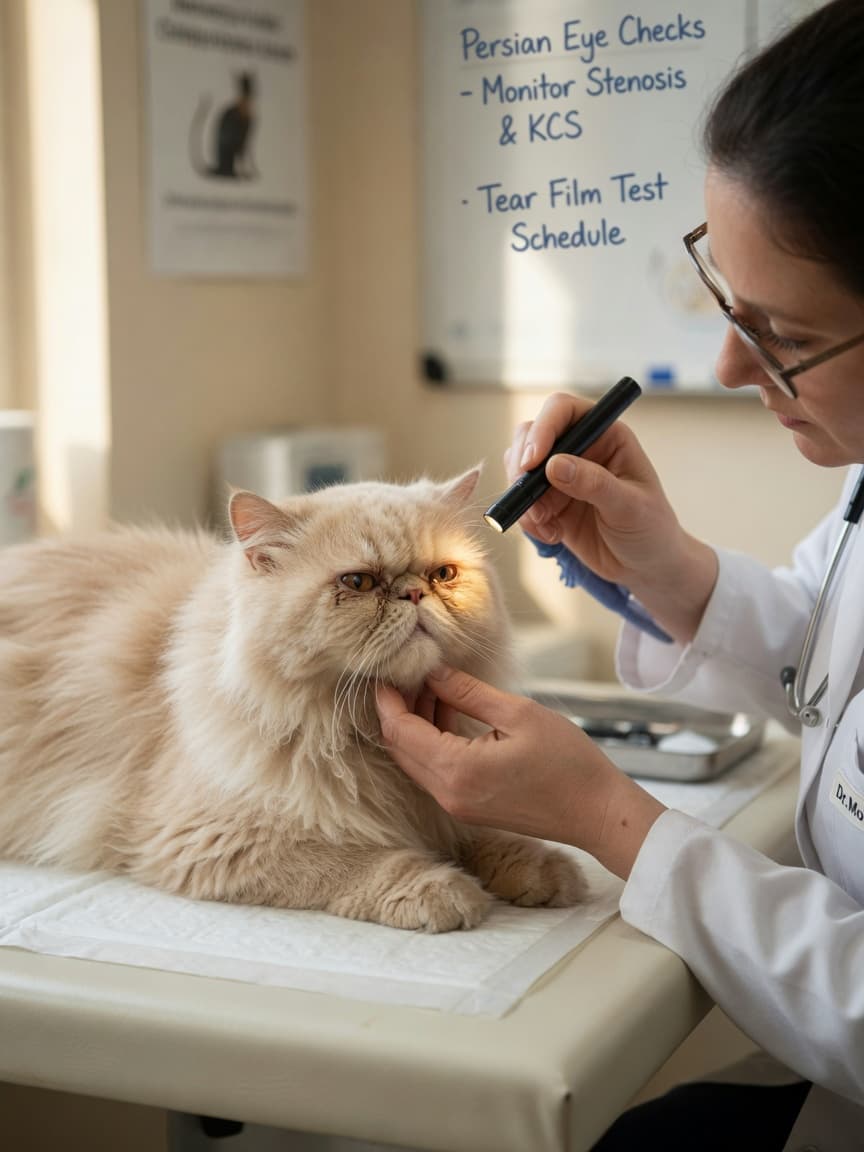
Les chats Persans sont prédisposés aux yeux qui pleurent et aux taches de larmes car leurs faces aplaties et brachycéphales raccourcissent les canaux lacrymaux et déforment les paupières, ce qui fait que les larmes s'écoulent sur le visage au lieu de s'écouler normalement par le nez. Le point le plus important à comprendre est que certaines taches sont simplement « normales pour la race » en raison de la structure faciale, mais une rougeur persistante, un écoulement épais, un plissement des yeux ou une aggravation soudaine ne sont jamais des choses à essuyer et ignorer — cela nécessite une évaluation vétérinaire, car cela peut signaler des problèmes douloureux et menaçant la vision qui se cachent derrière les larmes.
Pourquoi les chats Persans sont prédisposés aux problèmes oculaires et aux taches de larmes
La face charmante et aplatie du Persan est la cause première de la plupart de ses problèmes oculaires. Cette race a été sélectivement reproduite pour un museau raccourci et un crâne arrondi, un aspect souvent décrit comme brachycéphale. Bien que cela donne aux Persans leur apparence distinctive, cela s'accompagne de véritables compromis anatomiques autour des yeux.
Chez un chat normal, les larmes s'écoulent par de petites ouvertures (puncta) au coin interne de chaque œil, se déplaçant par le canal nasolacrimal jusqu'au nez. Chez les Persans, le crâne raccourci compresse et souvent plie ce canal, et les plis faciaux et les orbites peu profondes peuvent désaligner les puncta de sorte qu'ils ne se trouvent plus là où les larmes s'accumulent naturellement. Il en résulte que les larmes débordent sur la fourrure sous les yeux plutôt que de s'écouler en interne — c'est ce qu'on appelle l'épiphora.
Les Persans sont également prédisposés à une condition appelée entropion, où la paupière se replie vers l'intérieur, et à des orbites proéminentes et peu profondes qui laissent les yeux plus exposés. Les deux augmentent l'irritation, les larmes réflexes et le risque de lésions cornéennes. Ajoutez à cela les yeux caractéristiquement grands et proéminents de la race et la longue fourrure faciale qui absorbe l'humidité et retient les débris, et vous avez une combinaison parfaite pour les taches de larmes chroniques et une plus grande vulnérabilité aux problèmes de surface oculaire en général.
Il convient de noter que c'est une question structurelle, largement héréditaire, liée au type de corps à face aplatie — ce n'est pas causé par une mauvaise prise en charge du propriétaire, bien que les soins quotidiens fassent une réelle différence pour le confort et le risque d'infection secondaire. Quiconque envisage ou vit déjà avec cette race trouvera plus de contexte dans le guide de la race chat Persan, qui couvre le tableau de santé plus large au-delà des yeux.
Signes et symptômes précoces à surveiller
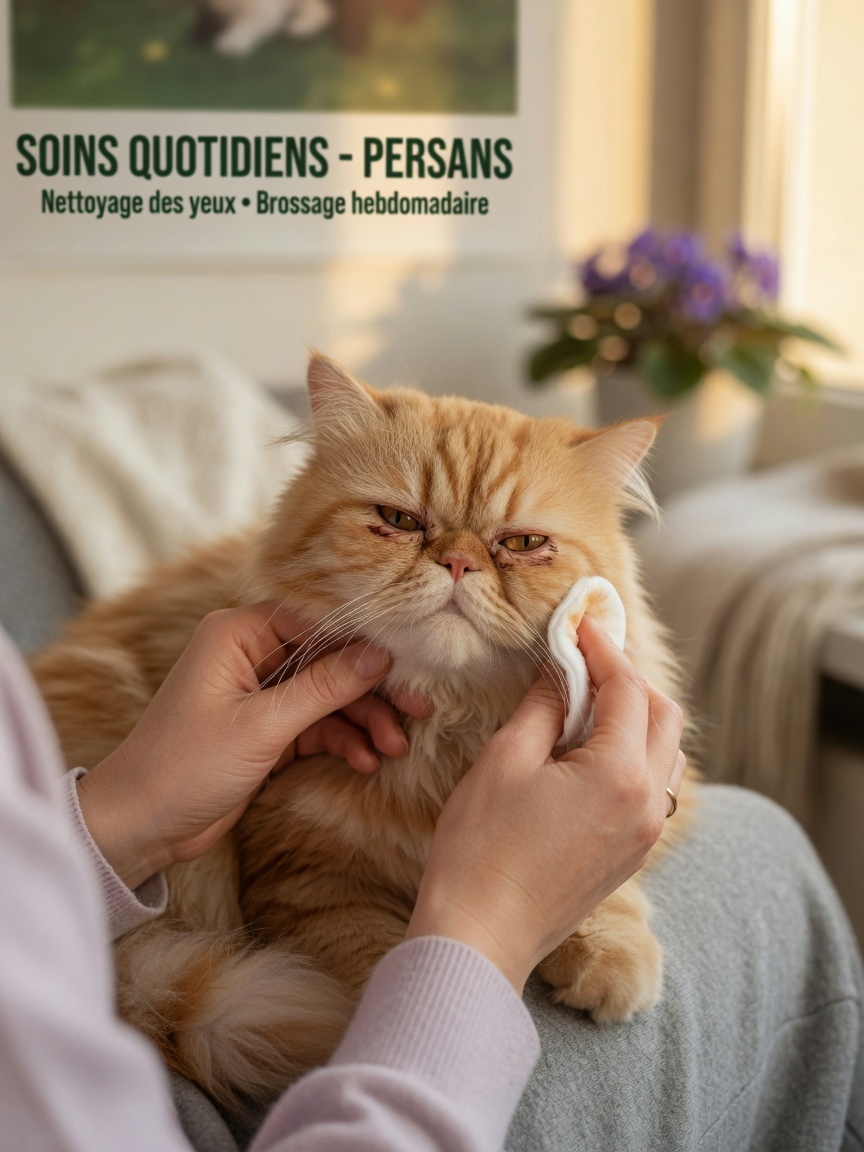
Parce que certaines larmes sont normales au départ pour les Persans, les propriétaires doivent apprendre à reconnaître « la normale de leur chat » pour pouvoir détecter les changements rapidement.
- Taches brun rougeâtre sur la fourrure sous les yeux, souvent plus prononcées d'un côté.
- Fourrure humide ou emmêlée autour des coins internes des yeux qui nécessite un essuyage régulier.
- Croûtes légères dans les coins après le sommeil, ce qui est courant et généralement sans souci si cela disparaît facilement.
- Une légère odeur ou une texture légèrement collante de l'écoulement, suggérant une prolifération bactérienne ou fongique sur la peau constamment humide.
Les signes qui suggèrent quelque chose au-delà des simples larmes anatomiques incluent :
- Plissement des yeux ou fermeture partielle d'un œil
- Se gratter ou se frotter le visage
- Écoulement épais jaune, vert ou gris plutôt que des larmes claires ou légèrement teintées
- Rougeur visible du blanc de l'œil ou des paupières intérieures
- Apparence trouble, bleuâtre ou terne de la cornée
- Augmentation soudaine des larmes d'un seul œil
- Perte de fourrure, rougeur ou croûtes sur la peau sous l'œil due à l'humidité constante
Quand c'est une urgence
La plupart des taches de larmes chez les Persans sont une nuisance chronique et gérable plutôt qu'une urgence. Cependant, certains signes nécessitent une attention vétérinaire le même jour car ils peuvent indiquer une ulcération cornéenne, une conjonctivite sévère ou un traumatisme — tous peuvent progresser rapidement chez une race aux yeux proéminents et exposés.
- Plissement soudain et sévère ou l'œil fermé fermement
- Opacité visible, une tache blanche ou grise sur la cornée, ou un changement dans la forme de l'œil
- Douleur évidente — se gratter frénétiquement le visage, se cacher, réduction de l'appétit
- Gonflement de l'œil ou quelque chose qui en sort
- Écoulement épais, coloré ou taché de sang
- Toute blessure, même légère en apparence, à la zone des yeux
Les orbites peu profondes des chats Persans et les yeux proéminents signifient que les ulcères cornéens peuvent se développer et s'aggraver plus rapidement que chez les races aux yeux plus enfoncés. Le retard du traitement risque un cicatrisation permanente ou, dans les cas graves, une perte de l'œil, donc péchez par prudence.
Diagnostic
Un vétérinaire évaluant les yeux d'un Persan commencera généralement par un examen complet du visage et des paupières, en vérifiant l'entropion, les cils ou les poils se frottant à l'œil, et la conformation du pli facial. Il appliquera souvent une teinture de fluorescéine, qui met en évidence les ulcères ou égratignures cornéennes sous la lumière bleue — un test rapide et indolore qui est particulièrement important pour cette race étant donné la facilité avec laquelle les lésions cornéennes peuvent être manquées lors d'un simple coup d'œil.
Les autres étapes diagnostiques peuvent inclure :
- Un test de larmes de Schirmer pour mesurer la production de larmes, excluant la sécheresse oculaire comme facteur contributif
- Vérification des ouvertures du canal lacrymal (puncta) pour la position et la perméabilité
- Des écouvillons ou des cultures si une infection est suspectée
- Évaluation des conditions connexes telles que les problèmes de conformation brachycéphale, car les problèmes oculaires chez les Persans ne surviennent rarement isolément
Options de gestion et de traitement
Le traitement dépend entièrement de ce qui provoque réellement les taches et des symptômes accompagnants.
Pour une simple épiphora anatomique (pas d'infection, pas de douleur, larmes claires ou légèrement teintées), la gestion concerne principalement l'hygiène quotidienne plutôt que la médication — voir la section soins ci-dessous.
Pour les infections ou la conjonctivite, un vétérinaire peut prescrire des gouttes ou une pommade antibiotique topique. Il est important de ne pas utiliser de gouttes oculaires humaines restantes ou prescrites précédemment pour chat sans avis vétérinaire, car certains médicaments sont inappropriés pour certaines conditions oculaires et peuvent aggraver les choses.
Pour l'entropion, les cas légers peuvent être surveillés, mais les paupières qui se replient modérément à gravement vers l'intérieur causant la friction des poils sur la cornée nécessitent généralement une correction chirurgicale. C'est une procédure bien établie avec généralement de bons résultats lorsqu'elle est réalisée par un vétérinaire expérimenté.
Pour l