
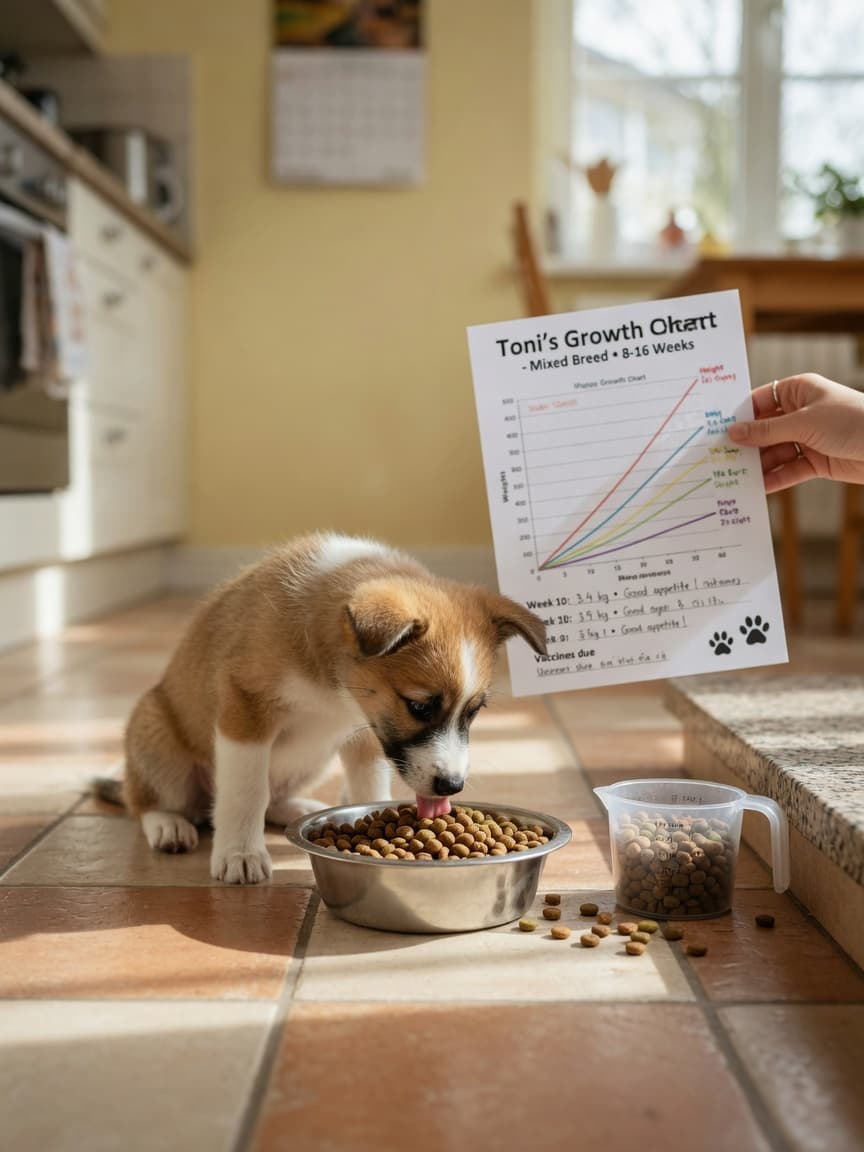
Quelle quantité donner à un chiot : tableau de rationnement selon le poids
- Repas par jour : 4x (moins de 3 mois) → 3x (3–6 mois) → 2x (6 mois et plus)
- Besoins caloriques : 2 à 3 fois plus élevés par kg que chez le chien adulte pendant le pic de croissance
- Point de départ : suivez le guide de rationnement figurant sur le sac de votre aliment
- Ajustez selon : la note d'état corporel — vous devez sentir les côtes sans les voir
- Pesez chaque mois : la croissance du chiot est rapide et les portions doivent être réajustées régulièrement
Par Julia Wrenfield, chercheuse en bien-être animal | Publié le 25 juin 2026
Suralimenter un chiot peut être tout aussi néfaste que le sous-alimenter. Un excès de calories pendant la croissance favorise la prolifération des cellules graisseuses et une croissance osseuse rapide, susceptible d'entraîner des troubles articulaires du développement, en particulier chez les grandes races. À l'inverse, un apport calorique insuffisant empêche le chiot de se développer correctement, avec des conséquences sur le développement cérébral, la fonction immunitaire et la masse musculaire. Déterminer la bonne quantité suppose de comprendre la densité calorique, la fréquence des repas et la manière d'utiliser l'état corporel de votre chiot — et pas seulement un tableau — comme guide principal.
Comprendre les besoins caloriques pendant la croissance
Les chiots ont des besoins énergétiques par kilogramme de poids corporel nettement supérieurs à ceux des chiens adultes. Un chiot de 10 semaines a besoin d'environ 2 à 3 fois plus de calories par kilogramme que ce dont le même chien aura besoin à l'âge adulte. En effet, la croissance — la construction de nouveaux muscles, d'os, de tissus d'organes et de structures du système nerveux — est coûteuse sur le plan métabolique. À mesure que la vitesse de croissance du chiot ralentit, ses besoins caloriques par kilogramme diminuent pour se rapprocher des niveaux d'entretien de l'adulte.
L'indicateur clé utilisé en nutrition vétérinaire est le besoin énergétique au repos (BER) : BER (kcal/jour) = 70 × (poids corporel en kg)^0,75. Pour les chiots, un facteur de croissance est appliqué. Pour les chiots de moins de 4 mois, multipliez le BER par environ 3,0. Pour 4 à 6 mois, par 2,5. Pour 6 à 12 mois, par 2,0. Après 12 mois (ou à 80 % du poids adulte attendu), commencez la transition vers l'entretien adulte.
En pratique, vous n'avez pas besoin de faire ce calcul vous-même — le sac d'aliment de votre chiot fournit des recommandations de rationnement. Mais comprendre le calcul vous aide à repérer les situations où ces recommandations doivent être ajustées.
Tableau des quantités journalières (croquettes sèches, approximatif)
Le tableau suivant indique les quantités journalières approximatives de croquettes sèches pour des chiots d'âges et de poids différents. Il s'agit d'estimations de départ basées sur des croquettes à environ 350–380 kcal pour 100 g — vérifiez toujours en parallèle la densité calorique de votre aliment spécifique.
| Poids actuel (kg) | 2–3 mois (g/jour) | 3–4 mois (g/jour) | 4–6 mois (g/jour) | 6–12 mois (g/jour) |
|---|---|---|---|---|
| 1–2 kg | 40–65 g | 35–55 g | 30–50 g | 25–45 g |
| 2–5 kg | 65–130 g | 60–120 g | 55–110 g | 50–100 g |
| 5–10 kg | 130–215 g | 120–200 g | 115–190 g | 100–175 g |
| 10–20 kg | 215–340 g | 200–320 g | 185–300 g | 170–280 g |
| 20–30 kg | 340–465 g | 320–440 g | 300–410 g | 280–380 g |
| Plus de 30 kg | 465–600 g | 440–570 g | 410–540 g | 380–500 g |
Fréquence des repas selon l'âge
Les jeunes chiots ont un petit estomac et des besoins énergétiques élevés — ils ne peuvent pas ingérer assez de nourriture en deux repas pour maintenir une glycémie stable tout au long de la journée. L'hypoglycémie (baisse du taux de sucre dans le sang) est un risque réel chez les races miniatures de moins de 3 mois si les repas sont trop espacés.
| Âge | Repas par jour | Répartition |
|---|---|---|
| 6–12 semaines | 4 repas | Toutes les 4 à 5 heures |
| 3–6 mois | 3 repas | Matin, midi, soir |
| 6–12 mois | 2–3 repas | Matin et soir (+ midi en option) |
| 12 mois et plus | 2 repas | Espacés de 12 heures |
Comment évaluer l'état corporel de votre chiot
Les tableaux et les calculs ne sont que des points de départ. C'est le corps de votre chiot qui vous indique si la quantité est correcte. Utilisez le système de note d'état corporel (NEC) sur une échelle de 1 à 9, où 4–5 est l'idéal pour un chiot en croissance :
- Trop maigre (NEC 1–3) : côtes, colonne vertébrale et os du bassin visibles à distance. Aucune couverture graisseuse. Augmentez les portions de 10 % et réévaluez dans 1 à 2 semaines.
- Idéal (NEC 4–5) : côtes facilement palpables mais non visibles de façon marquée. Légère taille visible vue de dessus. Abdomen relevé visible de profil. Aucun changement nécessaire.
- Surpoids (NEC 6–7) : côtes difficiles à palper ; légère couverture graisseuse excédentaire. Taille à peine discernable. Réduisez les portions de 10 à 15 %.
- Obésité (NEC 8–9) : côtes non palpables. Abdomen arrondi, pas de taille. Réduisez nettement les portions et consultez votre vétérinaire — l'obésité pendant la période du chiot a des conséquences sur la santé tout au long de la vie.
Cas particuliers des grandes et très grandes races
Les chiots de grande race (poids adulte supérieur à 25 kg) ne doivent pas être suralimentés pendant la croissance. Un apport calorique excessif provoque une croissance osseuse trop rapide, ce qui augmente le risque de dysplasie de la hanche, d'ostéochondrose (OCD) et d'ostéodystrophie hypertrophique. L'objectif pour les chiots de grande race est une croissance régulière et harmonieuse — et non une vitesse de croissance maximale. Utilisez un aliment spécialement formulé pour les chiots de grande race et, en cas de doute, restez plutôt dans la fourchette basse des quantités recommandées tout en surveillant la note d'état corporel.
Pâtée ou croquettes : ajuster les calories
La pâtée pour chiot contient généralement 70 à 80 % d'humidité, ce qui signifie que sa densité calorique par gramme est bien inférieure à celle des croquettes sèches. Une pâtée classique apporte environ 80 à 100 kcal pour 100 g, contre 350 à 380 kcal pour 100 g pour des croquettes sèches. Si vous donnez de la pâtée — ou un mélange de pâtée et de croquettes — calculez le total des calories journalières provenant des deux sources afin d'éviter une sous- ou une suralimentation. Les tableaux de rationnement figurant sur les boîtes de pâtée tiennent compte de cette différence.
Que vous préfériez l'alimentation sèche, humide ou mixte, Zooplus propose des gammes complètes de nutrition pour chiots des plus grandes marques, avec des tableaux nutritionnels détaillés pour vous aider à calculer précisément les portions. Les options d'abonnement avec réduction en font également une solution économique.
- Donnez 4 repas par jour jusqu'à 3 mois, 3 repas jusqu'à 6 mois, puis 2 repas à partir de 6 mois.
- Utilisez le guide de rationnement figurant sur l'emballage de votre aliment comme point de départ, puis ajustez en fonction de la note d'état corporel.
- Pesez votre chiot chaque mois et adaptez les portions à mesure qu'il grandit — les besoins évoluent rapidement au cours de la première année.
- Les chiots de grande race doivent rester minces — évitez l'alimentation à volonté et les excès de compléments.
- La note d'état corporel (visez 4–5 sur une échelle de 9 points) est le repère le plus fiable, au quotidien, pour déterminer la taille des portions.
Références
- Laflamme DP. "Development and validation of a body condition score system for dogs." Canine Practice. 1997;22(4):10-15.
- Kealy RD, et al. "Effects of diet restriction on life span and age-related changes in dogs." Journal of the American Veterinary Medical Association. 2002;220(9):1315-1320. PMID: 11991408
- Dobenecker B, et al. "Effect of a high calcium diet on skeletal development in puppies of two different breeds." Journal of Nutrition. 2006;136(7 Suppl):2201S-2203S. PMID: 16772463