
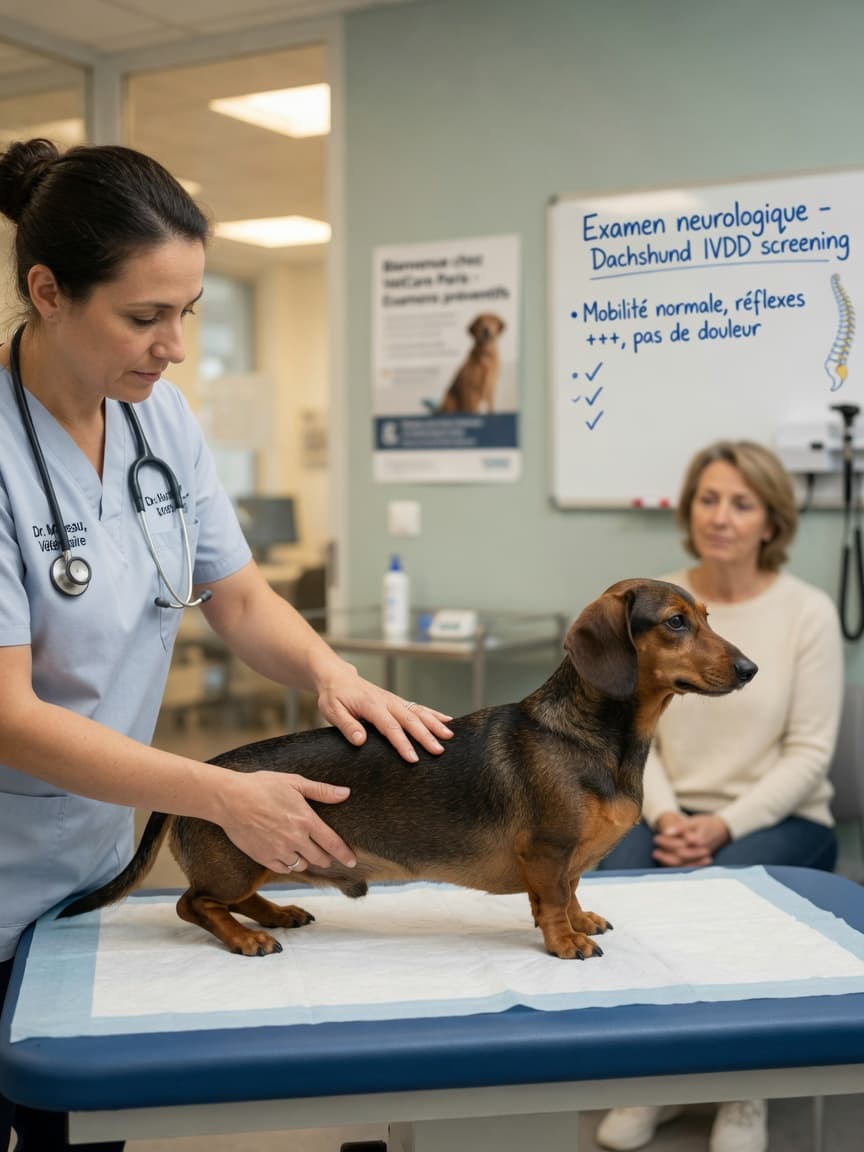
Les Teckels sont prédisposés à la maladie du disque intervertébral (MDIV) car leur silhouette unique avec un long dos et des pattes courtes (chondrodystrophie) est liée à une tendance génétique à la dégénérescence précoce de leurs disques vertébraux et à leur rupture soudaine, même pendant des activités normales et quotidiennes. La chose la plus importante à savoir est que toute réticence soudaine à se déplacer, des gémissements ou une instabilité des pattes arrière doivent être traités comme une urgence potentielle nécessitant une attention vétérinaire immédiate, car un traitement précoce améliore considérablement les chances de guérison complète.
Pourquoi les Teckels sont-ils si sujets aux problèmes de dos

La silhouette distinctive du Teckel résulte d'une mutation génétique qui provoque une chondrodystrophie, une forme de nanisme affectant la croissance du cartilage. C'est ce qui leur donne leurs pattes courtes et leur long épine dorsale, mais cela provoque également la calcification et la dégénérescence de leurs disques intervertébraux (les coussinets mous entre les os de la colonne vertébrale) bien plus tôt dans la vie que chez les races aux membres normaux. Au lieu de rester souples, ces disques peuvent durcir prématurément, parfois dès l'âge d'un ou deux ans.
Parce que les disques perdent leur flexibilité d'amortissement naturelle, des mouvements quotidiens tels que sauter d'un canapé, monter et descendre les escaliers, ou même un mouvement enthousiaste en jouant peuvent causer le renflement ou la rupture d'un disque dans le canal spinal. Cela exerce une pression sur la moelle épinière, entraînant une douleur, des lésions nerveuses et, dans les cas graves, une paralysie. Cette condition, la MDIV, est l'une des préoccupations orthopédiques et neurologiques les plus bien documentées de la race, et elle explique pourquoi les vétérinaires sont toujours particulièrement vigilants aux symptômes du dos et du cou chez les Teckels par rapport à beaucoup d'autres races.
Il convient de noter que tous les Teckels ne développeront pas de MDIV clinique, mais la base anatomique et génétique pour la dégénérescence discale est présente chez la grande majorité de la race. Si vous souhaitez en savoir plus sur la structure globale et les antécédents de santé de la race, le guide de race Teckel offre un aperçu utile.
Signes et symptômes précoces à surveiller

La MDIV peut se manifester progressivement ou soudainement, et les symptômes peuvent aller de subtils à graves. Les propriétaires doivent se familiariser avec les signes d'alerte précoces, car détecter la condition avant qu'elle ne progresse peut faire une différence significative dans l'issue.
- Réticence à sauter, monter les escaliers ou être soulevé – c'est souvent l'un des premiers signes les plus négligés.
- Une posture de dos voûtée ou arquée, parfois avec la tête baissée.
- Halètement, tremblements ou agitation qui semblent disproportionnés à l'environnement, souvent un signe de douleur.
- Gémissements ou cris quand on le touche, le soulève, ou lorsqu'il se déplace d'une certaine manière.
- Raideur dans le cou ou le dos, ou une réticence à tourner la tête.
- Pattes arrière instables, faibles ou mal coordonnées (ataxie), y compris un plissement sur les coussinets.
- Traînage des pattes arrière ou griffes écorchées par le traînage.
- Perte de contrôle de la vessie ou des intestins, ou difficulté à aller aux toilettes.
Certains chiens présentent uniquement une légère raideur intermittente, qui peut être confondue avec une sensibilité générale ou le vieillissement. Parce que les Teckels sont très sujets aux problèmes discaux, l'un de ces signes, aussi subtil soit-il, justifie une visite vétérinaire plutôt qu'une approche d'attente.
Quand s'agit-il d'une véritable urgence ?
Certains symptômes indiquent une urgence vétérinaire et ne doivent jamais être différés, même une nuit.
- Incapacité soudaine à marcher ou à se tenir debout, ou traînage des pattes arrière.
- Perte complète de sensation dans les pattes arrière ou la queue.
- Perte de contrôle de la vessie ou des intestins survenant aux côtés de la douleur ou de la faiblesse du dos.
- Cris de douleur sévère et constante qui ne diminue pas.
- Détérioration rapide d'une légère instabilité à une paralysie complète en quelques heures.
Le temps est véritablement critique lors des épisodes graves de MDIV. Si la moelle épinière est significativement comprimée, la fenêtre d'intervention chirurgicale pour restaurer la fonction peut se mesurer en heures à un ou deux jours, pas en jours à semaines. Si votre Teckel présente l'un de ces signes, contactez immédiatement un vétérinaire d'urgence plutôt que d'attendre un rendez-vous de routine.
Comment les vétérinaires diagnostiquent la MDIV
Le diagnostic commence généralement par un examen physique et neurologique approfondi, où le vétérinaire évalue la réponse à la douleur, les réflexes et la capacité à sentir et repositionner correctement les pattes (proprioception). Cela aide à classer la gravité de l'épisode, allant de la douleur légère à la paralysie complète sans sensation de douleur profonde.
L'imagerie est généralement nécessaire pour confirmer le diagnostic et localiser le disque affecté. Les radiographies simples peuvent suggérer une dégénérescence discale ou des espaces discaux rétrécis, mais ne peuvent pas montrer la moelle épinière elle-même. Pour un diagnostic définitif, la plupart des spécialistes recommandent une imagerie par résonance magnétique (IRM), qui fournit des images détaillées des disques et de la moelle épinière et est considérée comme l'étalon-or. Un scanner, parfois combiné à une myélographie (un colorant de contraste injecté autour de la moelle épinière), peut également être utilisé et peut être plus facilement accessible dans certaines régions. Ces tests d'imagerie nécessitent généralement un renvoi à un neurologue vétérinaire ou à un centre spécialisé.
Gestion et options de traitement
Le traitement dépend fortement de la gravité de l'épisode et du grade neurologique du chien à la présentation.
Gestion conservatrice (médicale)
Pour les cas plus légers, où le chien peut encore marcher (même s'il est instable) et a une certaine sensation de douleur, les vétérinaires peuvent recommander un repos strict en cage, généralement pendant plusieurs semaines, combiné à un traitement antidouleur et des médicaments anti-inflammatoires. Le repos strict est essentiel, car l'activité continue peut aggraver la hernie discale. Certains chiens bénéficient également de relaxants musculaires. Cette approche comporte un risque de récurrence ou de progression, donc une surveillance étroite est essentielle.
Traitement chirurgical
Pour les chiens présentant des signes plus graves, une douleur importante ou une perte de la sensibilité profonde