
Les chats peuvent-ils manger du brocoli ? Sécurité, bienfaits et à quoi s'attendre
Le brocoli est largement célébré comme l'un des légumes les plus nutritifs qu'un humain puisse manger. Il est riche en vitamine C, en vitamine K, en folate, en fibres et en composés antioxydants. Ainsi, lorsqu'un chat décide de faire tomber d'un coup de patte un fleuron de brocoli de votre assiette et d'en grignoter quelques morceaux, il est naturel de se demander : est-ce sans danger ? Et mon chat fait-il accidentellement quelque chose de bon pour sa santé ?
La réponse à la première question est en grande partie oui. La réponse à la seconde est en grande partie non — du moins pas de manière significative. Voici le tableau complet.
Le brocoli est-il sans danger pour les chats ?
Le brocoli n'apparaît sur aucune liste établie de toxines félines. Il n'est pas dans la même catégorie que l'oignon, l'ail, le raisin, les raisins secs ou le xylitol — qui sont tous réellement dangereux pour les chats. La base de données Animal Poison Control de l'ASPCA ne répertorie pas le brocoli comme une plante toxique pour les chats. En petites quantités, il est considéré comme sans danger pour la consommation féline.
Cela dit, « non toxique » est différent de « bénéfique ». Et « sans danger en petites quantités » est différent de « sans danger en grandes quantités ». Le brocoli, comme de nombreux légumes, contient des fibres et des composés végétaux que le système digestif félin gère imparfaitement — nous y reviendrons sous peu.
Pourquoi les chats tirent peu de bénéfice nutritionnel du brocoli
Les chats sont des carnivores stricts. Cette classification biologique signifie que leurs systèmes digestifs, leurs voies métaboliques et leurs besoins nutritionnels ont évolué autour de la consommation de proies animales. Plusieurs caractéristiques de cette biologie rendent le brocoli nutritionnellement sans intérêt pour les chats :
- Synthèse de la vitamine C : Le brocoli est célèbre pour sa teneur en vitamine C. Les chats synthétisent leur propre vitamine C de manière endogène dans le foie. Ils n'ont pas besoin — et ne peuvent pas bénéficier de manière significative — de vitamine C alimentaire provenant de sources végétales.
- Limitations du bêta-carotène : Le brocoli contient un peu de bêta-carotène, mais comme pour les carottes, les chats n'ont pas des niveaux suffisants de l'enzyme nécessaire pour convertir le bêta-carotène en vitamine A utilisable. Ils ont besoin de vitamine A préformée provenant de sources animales, en particulier le foie.
- Métabolisme des fibres : Les chats ont un tractus gastro-intestinal plus court que les omnivores et une capacité limitée à fermenter les fibres végétales. Une partie des fibres traverse le tube digestif sans être digérée. Ce n'est pas nocif à petites doses, mais cela signifie que les fibres du brocoli ne contribuent pas à la santé féline comme elles contribuent à la santé humaine.
- Digestion des glucides : Les chats ont une faible activité de l'amylase salivaire et une amylase pancréatique réduite par rapport aux omnivores — ces deux enzymes sont nécessaires pour décomposer les amidons végétaux. Le brocoli est relativement pauvre en amidon, mais la limitation générale demeure : les glucides d'origine végétale ne sont pas ce pour quoi le système digestif félin est optimisé.
Pourquoi certains chats aiment le brocoli
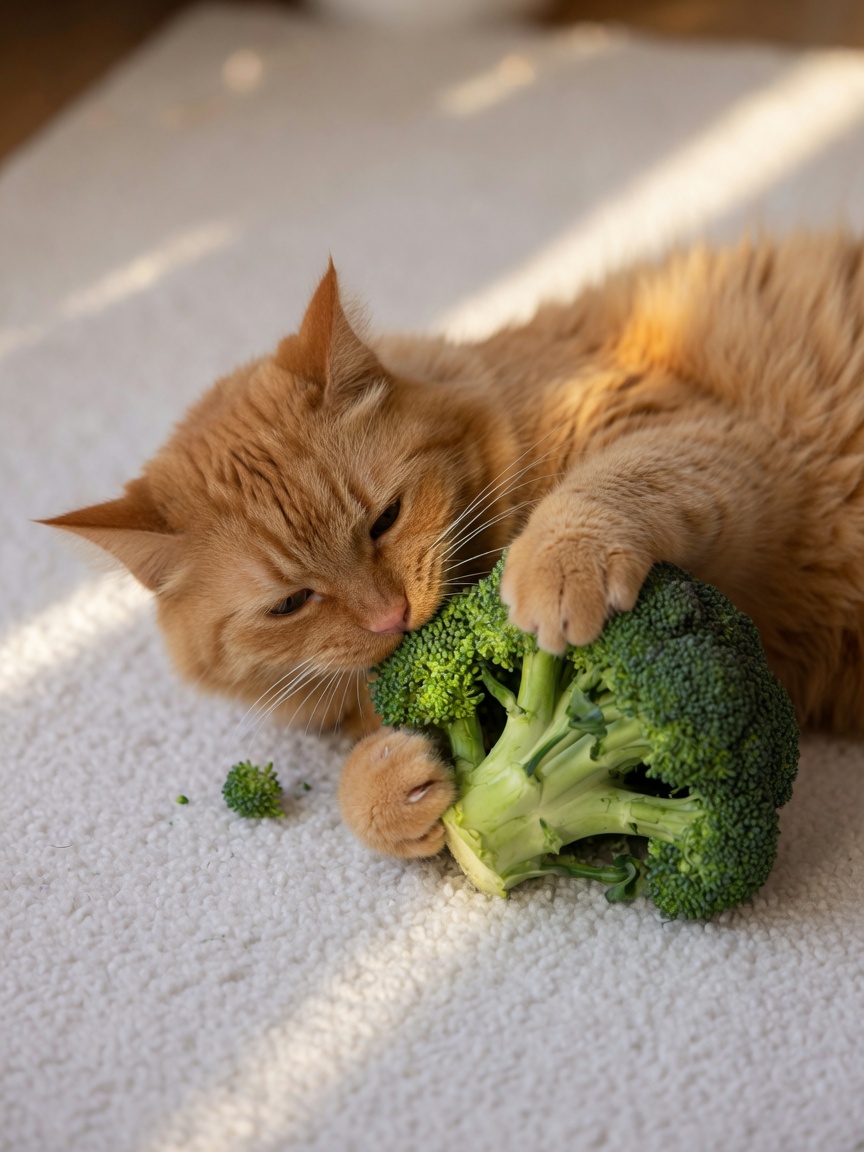
Il est réellement curieux que certains chats manifestent de l'intérêt pour le brocoli — d'autant plus que les chats n'ont pas de récepteurs fonctionnels du goût sucré et devraient théoriquement avoir peu d'incitation à rechercher des matières végétales. Quelques facteurs peuvent expliquer ce comportement :
- Attrait de la texture : La texture bosselée et fibreuse d'un fleuron de brocoli peut être intéressante à mâcher, fonctionnant presque autant comme un jouet que comme un aliment.
- Associations avec l'herbe : Les chats qui aiment manger de l'herbe étendent parfois cet intérêt à d'autres matières végétales. L'expérience de mâcher des fibres végétales peut procurer un léger soulagement digestif ou n'être simplement qu'un comportement d'autostimulation.
- Curiosité : Les chats explorent leur environnement avec leur bouche. Un objet nouveau sur le sol ou la table recevra souvent un coup de langue ou un grignotage, indépendamment de sa teneur nutritionnelle.
Aucune de ces raisons ne suggère qu'un chat qui convoite du brocoli cherche à satisfaire un besoin nutritionnel. Plus vraisemblablement, il s'agit d'une nouveauté texturale ou d'un intérêt comportemental.
Voir les aliments pour chats sur Zooplus →Le risque de trop de brocoli
Bien qu'une petite quantité de brocoli soit sans danger, trop peut causer des problèmes. Le brocoli appartient à la famille des Brassica — aux côtés du chou, du chou-fleur et des choux de Bruxelles — un groupe de légumes connus pour contenir des composés appelés glucosinolates. En grandes quantités, les glucosinolates peuvent interférer avec la fonction thyroïdienne en inhibant l'absorption de l'iode, bien que cela soit principalement un souci en cas d'exposition alimentaire très importante et prolongée plutôt qu'avec un petit morceau occasionnel.
Plus communément, la teneur élevée en fibres du brocoli provoque des troubles digestifs chez les chats lorsqu'il est donné en excès. Les symptômes comprennent :
- Flatulence et gaz
- Ballonnements et inconfort abdominal
- Selles molles ou diarrhée
- Vomissements (chez les individus sensibles)
Ces symptômes disparaissent généralement une fois le brocoli retiré de l'alimentation. S'ils persistent au-delà de 24 heures, consultez votre vétérinaire.
Brocoli cru ou cuit pour les chats
Le brocoli cuit est le choix le plus sûr. La cuisson ramollit les parois cellulaires fibreuses, ce qui facilite le traitement par la capacité limitée de digestion des végétaux du chat. Elle réduit également quelque peu la concentration en glucosinolates. Faites cuire le brocoli à la vapeur ou à l'eau sans sel, beurre, ail, oignon ni aucun assaisonnement. Nature et tendre, tel est l'objectif.
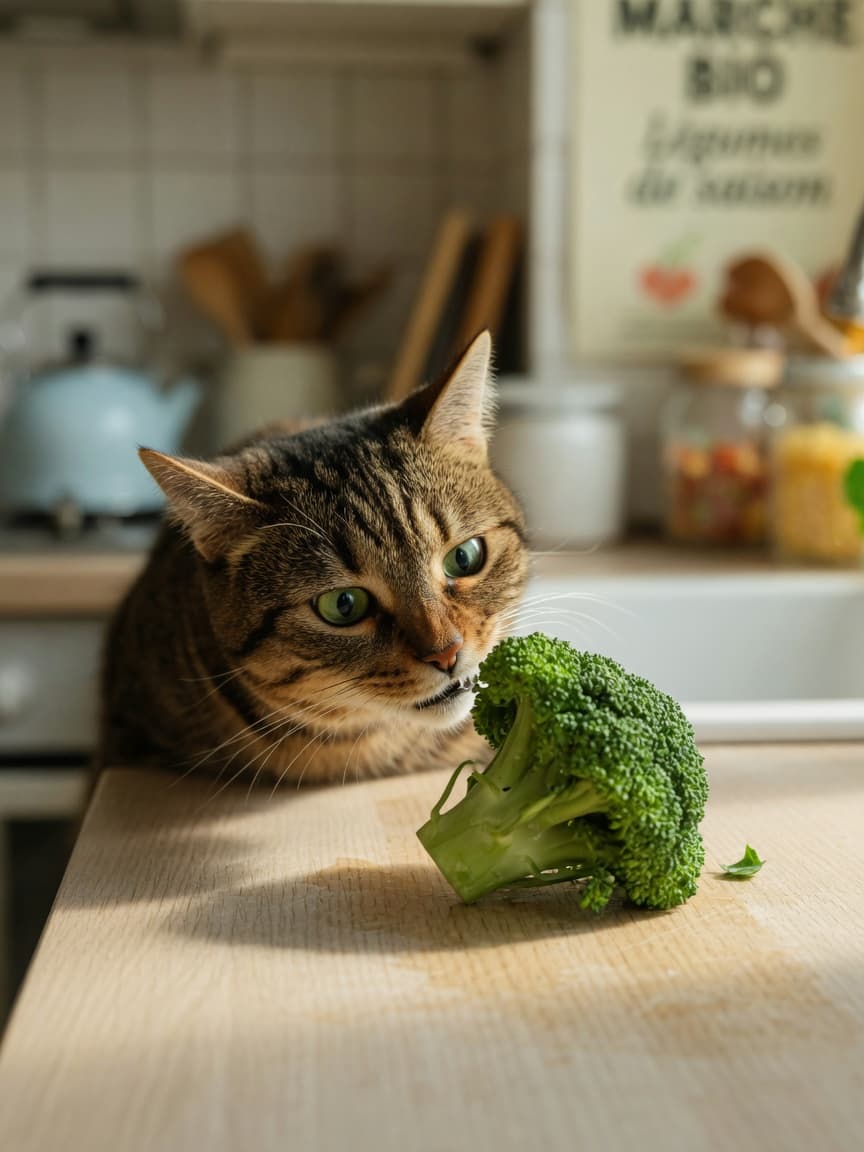
Le brocoli cru n'est pas toxique, mais il est plus difficile à digérer et sa texture plus ferme pourrait présenter un léger risque d'étouffement pour les chats de petite taille ou âgés. Si votre chat s'empare d'un fleuron de brocoli cru sur le plan de travail, une petite bouchée n'est pas une urgence — mais ce n'est pas le mode de service recommandé.
Quelle quantité est appropriée ?
Si vous choisissez de proposer du brocoli à votre chat, restez sur une très petite quantité — un seul fleuron ou même une portion d'un fleuron, proposé occasionnellement et non comme un élément régulier de l'alimentation. Les friandises de toutes sortes ne doivent pas dépasser 10 % de l'apport calorique quotidien total d'un chat. La source nutritionnelle principale doit toujours être un aliment commercial complet et équilibré pour chats qui répond aux normes nutritionnelles AAFCO pour les chats.
Le brocoli est mieux compris comme un aliment de curiosité à faible risque pour le petit sous-ensemble de chats qui l'apprécient — pas comme un complément santé, et certainement pas comme un substitut à quelque composante que ce soit d'une alimentation féline appropriée.
Ce dont les chats ont réellement besoin à la place
Les vitamines et minéraux pour lesquels le brocoli est célébré chez l'humain sont obtenus par les chats par une voie entièrement différente : les tissus animaux. Le foie fournit de la vitamine A préformée et des vitamines B. La viande fournit de la taurine, de la B12, du zinc et du fer. Le poisson fournit des acides gras oméga-3. Un aliment commercial de haute qualité pour chats intègre tous ces éléments dans des ratios correctement calibrés — ce qu'aucun légume isolé, ni même aucune combinaison de légumes, ne peut reproduire pour un carnivore strict.
Si vous vous inquiétez de savoir si votre chat reçoit une nutrition adéquate, la réponse n'est pas d'ajouter des légumes — c'est d'évaluer la qualité de l'alimentation commerciale que vous lui donnez. Recherchez des aliments avec des protéines de viande nommément identifiées comme premier ingrédient, formulés selon les normes AAFCO d'aliment complet et équilibré.
- Le brocoli n'est pas toxique pour les chats ; un petit morceau de brocoli cuit nature est sans danger.
- Certains chats apprécient la texture du brocoli, mais il s'agit de curiosité — pas d'un signal nutritionnel.
- Le brocoli cuit est préférable au cru ; il est plus facile à digérer et plus tendre à mâcher.
- Trop de brocoli provoque des gaz, des ballonnements et des troubles digestifs chez les chats.
- Les principaux nutriments du brocoli (vitamine C, bêta-carotène) ne sont pas réellement disponibles pour les chats en raison de leur métabolisme de carnivore strict.
- Les chats sont des carnivores stricts — les aliments végétaux comme le brocoli sont non essentiels et nutritionnellement marginaux au mieux.
- Un aliment commercial équilibré pour chats fournit tout ce dont les chats ont besoin ; les légumes ne sont pas un complément dont les chats ont besoin.
Références
- Morris JG. "Idiosyncratic nutrient requirements of cats appear to be diet-induced evolutionary adaptations." Nutr Res Rev. 2002;15(1):153-68. PMID: 19087395
- Verbrugghe A, Bakovic M. "Peculiarities of one-carbon metabolism in the strict carnivore, the domestic cat." Nutrients. 2013;5(7):2811-35. PMID: 23873295
- Plantinga EA, Bosch G, Hendriks WH. "Estimation of the dietary nutrient profile of free-roaming feral cats: possible implications for nutrition of domestic cats." Br J Nutr. 2011;106 Suppl 1:S35-48. PMID: 22005436