
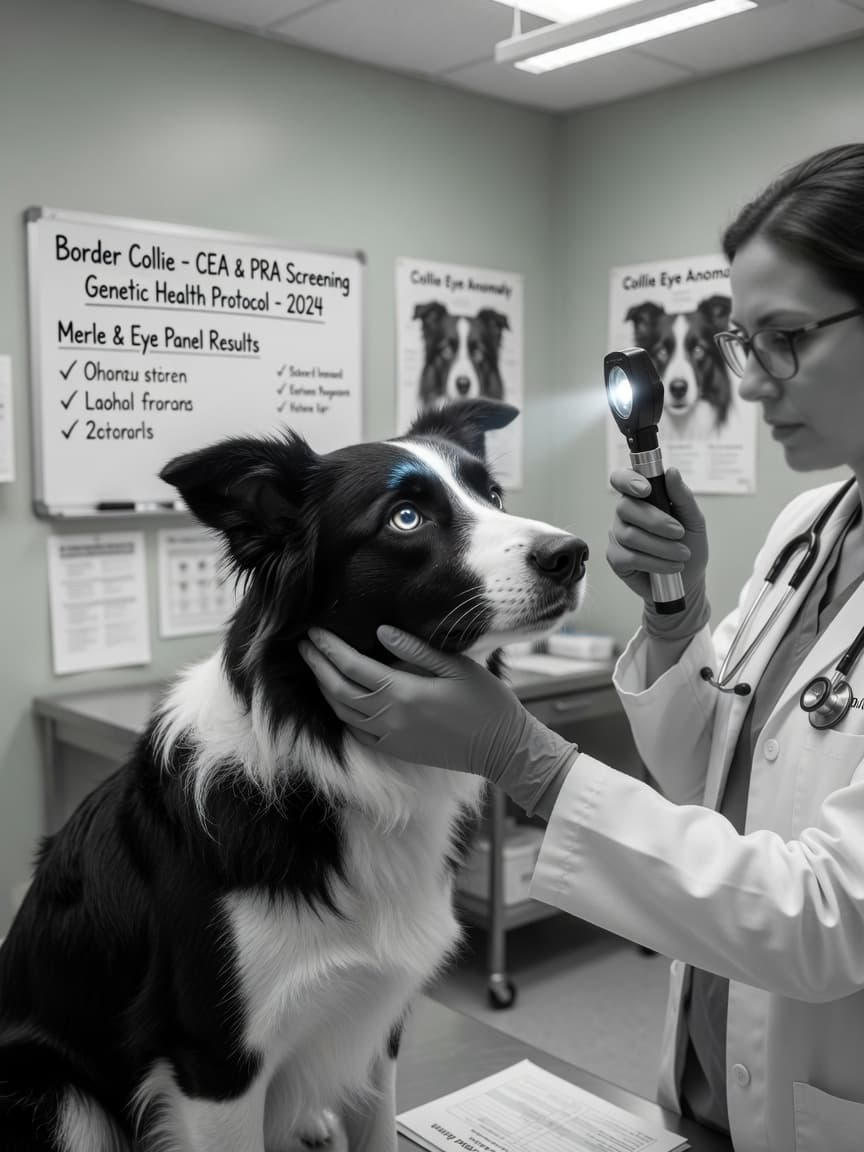
Santé du Border Collie : ACE, dysplasie de la hanche et stimulation mentale
Mise à jour juin 2026
- Espérance de vie : 12–15 ans
- Principaux risques sanitaires : Anomalie oculaire du Colley (ACE), dysplasie de la hanche, épilepsie, syndrome des neutrophiles emprisonnés, lipofuscinose céroïde neuronale
- Tests génétiques recommandés : Test ADN ACE/CH, test ADN TNS, test ADN NCL, test ADN MDR1 (ABCB1), dysplasie de la hanche/coude OFA, test auditif BAER
Les Border Collies sont largement reconnus comme les chiens domestiques les plus intelligents de toutes les races, et leur athlétisme physique et mental exceptionnels en font des chiens de travail et de sport remarquables. Cependant, cette race hautement spécialisée porte un nombre notable de conditions héréditaires, dont beaucoup peuvent être dépistées par test ADN avant l'achat d'un chiot. Comprendre le profil de santé de la race — physique et comportemental — est essentiel pour quiconque envisage de partager sa vie avec l'un de ces chiens exceptionnels.
Problèmes de santé les plus courants chez les Border Collies
L'anomalie oculaire du Colley (ACE) est la condition héréditaire la plus prévalente dans la race mondialement, affectant une proportion substantielle de Border Collies. La dysplasie de la hanche, bien que moins prévalente que chez certaines races plus grandes, cause des problèmes importants chez les chiens de travail et de sport. L'épilepsie idiopathique a une composante héréditaire et est surreprésentée chez les Border Collies. Deux conditions génétiques métaboliques graves — le syndrome des neutrophiles emprisonnés (TNS) et la lipofuscinose céroïde neuronale (NCL) — sont fatales sans identification précoce. La sensibilité aux médicaments due à la mutation MDR1 (ABCB1) crée des considérations prescriptives importantes. Au-delà des maladies physiques, les troubles comportementaux et compulsifs causés par des besoins de stimulation mentale non satisfaits représentent une préoccupation majeure pour le bien-être de la race.
Anomalie oculaire du Colley (ACE)
L'ACE est un spectre d'anomalies oculaires congénitales causé par une mutation du gène NHEJ1, héritée de manière autosomique récessive. La forme la plus bénigne — hypoplasie choroïdienne — cause un amincissement de la couche vasculaire sous la rétine et peut ne causer aucune déficience fonctionnelle. Les formes plus graves incluent le colobome (fosse ou trou dans le disque optique ou la scléra), des défauts du disque optique, et dans les cas les plus graves, un décollement de la rétine entraînant la cécité. La plupart des Border Collies affectés présentent la forme bénigne et vivent des vies visuellement normales. Le test ADN identifie les chiens clairs, porteurs et atteints ; les éleveurs responsables n'accouplent pas deux porteurs ensemble. L'examen ophtalmologique CAER à cinq à huit semaines d'âge (avant que la choroïde ne se pigmente complètement et « masque » la lésion) est la méthode diagnostique traditionnelle aux côtés du test ADN.
Dysplasie de la hanche
Environ 12 % des Border Collies évalués par l'OFA présentent un certain degré de dysplasie de la hanche. Chez un chien de berger au travail ou un concurrent en agility, même une dysplasie de la hanche modérée a des conséquences fonctionnelles importantes qui ne seraient pas aussi apparentes chez un animal de compagnie de taille comparable. La dysplasie de la hanche chez les Border Collies se manifeste par une réduction de la puissance des membres postérieurs, une réticence à sauter et une boiterie progressive. La certification OFA de la dysplasie de la hanche des deux parents est une pratique standard parmi les éleveurs responsables. Pour les chiens de lignée de travail, les scores du programme de dysplasie de la hanche BVA/KC fournissent l'équivalent au Royaume-Uni. La gestion est similaire à celle d'autres races : exercice contrôlé, gestion du poids, physiothérapie, médicaments anti-inflammatoires et options chirurgicales pour les cas graves. Renforcer la masse musculaire du tronc et des membres postérieurs par des exercices de conditionnement ciblés aide à soutenir les hanches dysplasiques tout au long de la carrière active d'un chien.
Épilepsie et conditions neurologiques
L'épilepsie idiopathique est surreprésentée chez les Border Collies, avec une base héréditaire qui n'est pas encore entièrement caractérisée génétiquement. L'apparition se situe généralement entre une et cinq ans d'âge. La plupart des Border Collies épileptiques peuvent être bien contrôlés avec des médicaments anticonvulsivants et maintenus dans leurs rôles de travail ou de sport avec une gestion appropriée. La lipofuscinose céroïde neuronale (NCL), en revanche, est une maladie de stockage neurodégénérative progressive et fatale. La forme Border Collie (CL5) est causée par une mutation du gène CLN5 et se présente avec une déficience visuelle progressive, une ataxie, un changement comportemental et une démence, généralement à partir de 15–18 mois d'âge. La mort suit généralement 12–24 mois après l'apparition. Un test ADN est disponible et permet l'élimination complète de la condition par l'élevage responsable.
Sensibilité aux médicaments (Mutation MDR1/ABCB1)
La mutation MDR1 altère la pompe P-glycoprotéine qui empêche normalement certains médicaments de s'accumuler à des niveaux toxiques dans le cerveau. Les Border Collies ayant une ou deux copies de la mutation peuvent connaître une toxicité neurologique grave due aux médicaments qui sont routinièrement sans danger dans d'autres races, notamment l'ivermectine (à doses antiparasitaires), le lopéramide (Imodium) et plusieurs agents de chimiothérapie. Un test ADN est disponible et est fortement recommandé, en particulier pour les chiens qui peuvent recevoir une chimiothérapie ou voyager dans des régions où des produits antiparasitaires à base d'ivermectine à haut dosage sont utilisés. Informez toujours votre vétérinaire du statut MDR1 de votre chien avant de prescrire l'un des médicaments impliqués.
Stimulation mentale : une impérieuse nécessité pour la santé
Les Border Collies ont été élevés pour travailler toute la journée dans des rôles complexes et cognitivement exigeants. Sans exercice physique suffisant et stimulation mentale, ils développent des comportements stéréotypés — poursuite compulsive de balles, poursuite d'ombres ou de lumières, rotation et herding obsessionnel — qui causent une véritable détresse et sont extrêmement difficiles à résoudre une fois établis. Ce ne sont pas des « problèmes » comportementaux à proprement parler, mais plutôt des manifestations médicales d'un besoin biologique non satisfait.