
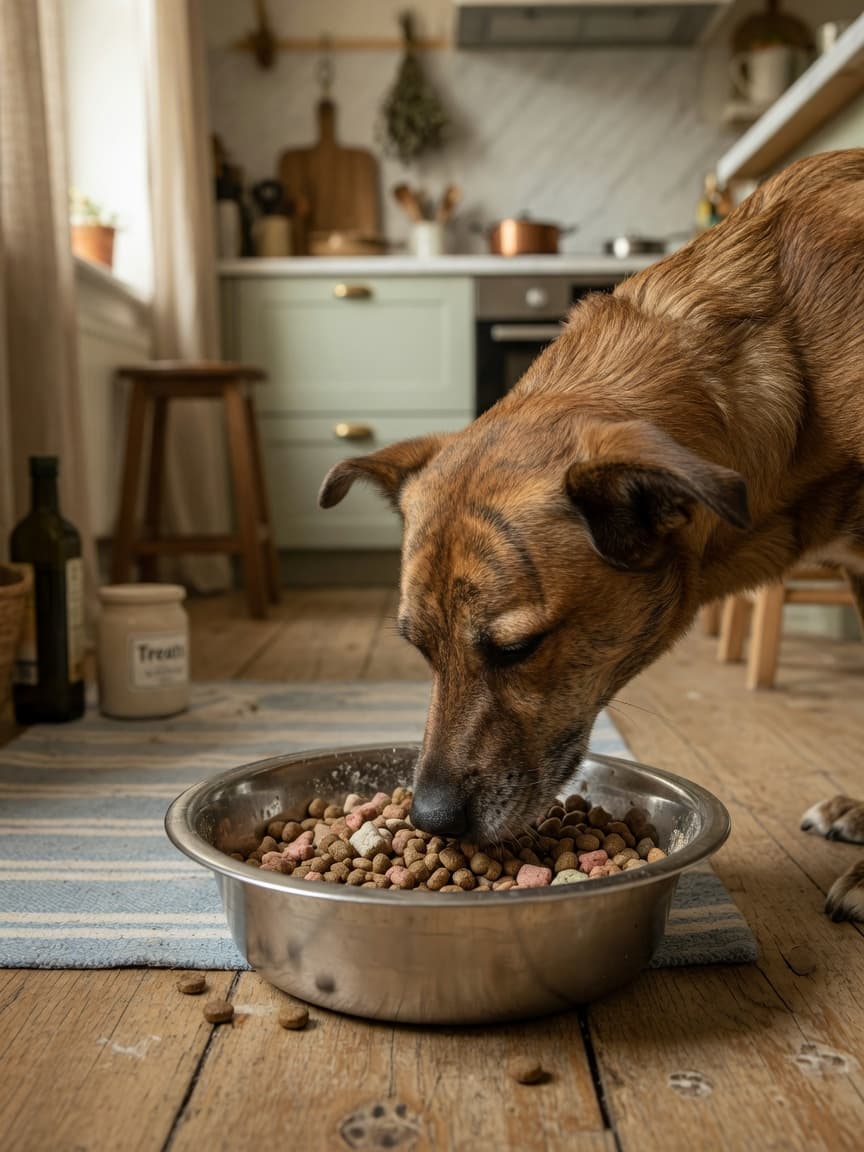
Ingrédients des aliments pour chiens à éviter : la liste noire définitive
Parcourez le rayon alimentation animale de n'importe quel supermarché et vous trouverez des sacs recouverts d'images de poulet frais, de légumes colorés et d'allégations rassurantes comme « naturel » et « sain ». Retournez toutefois le sac et lisez la liste des ingrédients, et le tableau change souvent radicalement. Conservateurs artificiels, protéines mystères non identifiées, colorants de synthèse sans aucun intérêt nutritionnel et charges de mauvaise qualité dominent fréquemment les formules des marques grand public populaires.
Comprendre ce qu'il y a réellement dans l'aliment de votre chien — et ce que ces ingrédients signifient pour sa santé à long terme — est l'une des choses les plus déterminantes que vous puissiez faire en tant que propriétaire d'animal. Ce guide couvre les ingrédients qu'il vaut le plus la peine d'éviter et ce qu'il faut rechercher à la place.
La liste noire : les ingrédients à éviter
1. BHA et BHT (Butylated Hydroxyanisole / Butylated Hydroxytoluene)
Le BHA et le BHT sont des antioxydants de synthèse utilisés comme conservateurs pour empêcher les graisses de rancir. Ils sont peu coûteux et efficaces pour prolonger la durée de conservation — c'est pourquoi l'industrie de l'alimentation pour animaux les privilégie. Le problème est que ces deux composés ont été classés comme cancérogènes possibles pour l'homme par le National Toxicology Program (NTP), et des études chez l'animal ont montré une formation de tumeurs dose-dépendante chez des rats et des souris exposés à des teneurs élevées en BHA.
Bien que les doses présentes dans les aliments pour animaux soient inférieures à celles utilisées dans les études de cancérogénicité, le fait que les chiens consomment le même aliment tous les jours pendant des années soulève des préoccupations légitimes concernant une exposition chronique à faible dose. De meilleures alternatives existent : les tocophérols mélangés (vitamine E), l'extrait de romarin et l'acide ascorbique (vitamine C) sont tous des conservateurs naturels efficaces, avec des profils de sécurité bien plus favorables.
2. Colorants artificiels : Red 40, Yellow 5, Yellow 6, Blue 2
Les chiens se moquent de la couleur de leur aliment. Ils ne distinguent pas particulièrement bien le rouge du vert. Les colorants artificiels n'ont qu'un seul but : rendre l'aliment plus attrayant pour l'humain qui l'achète. Red 40, Yellow 5, Yellow 6 et Blue 2 sont tous des colorants de synthèse dérivés du pétrole, sans aucune valeur nutritionnelle.
Red 40 et Yellow 5/6 ont été associés à des effets comportementaux chez des enfants hypersensibles dans des recherches humaines, et bien que les mêmes effets n'aient pas été démontrés de façon concluante chez le chien, l'absence totale de bénéfice rend leur inclusion injustifiable. Un aliment contenant des colorants artificiels indique que l'esthétique prime sur la qualité de la formulation.
3. Carraghénane
La carraghénane est un épaississant et un gélifiant extrait d'algues rouges, couramment présent dans les aliments humides/en conserve pour chiens afin de leur donner une texture lisse et homogène. Bien qu'issue d'une source naturelle, la carraghénane a fait l'objet d'une importante controverse scientifique. Certaines recherches ont associé la carraghénane à une inflammation intestinale, à des ulcérations et à une altération de la fonction de barrière intestinale dans des modèles animaux.
La préoccupation est particulièrement pertinente pour les chiens ayant l'estomac sensible, une maladie inflammatoire chronique de l'intestin ou des intolérances alimentaires. La carraghénane « dégradée » (poligeenan) est clairement nocive et n'est pas utilisée dans l'alimentation ; le débat porte sur le point de savoir si la carraghénane de qualité alimentaire se dégrade dans l'environnement acide de l'intestin pour produire des effets inflammatoires similaires. Le principe de précaution suggère de l'éviter, en particulier chez les chiens sensibles sur le plan digestif.
4. Propylène glycol
Le propylène glycol est utilisé comme humectant (agent retenant l'humidité) dans certains aliments et friandises semi-humides pour chiens afin de conserver leur texture moelleuse. Il est approuvé par la FDA pour une utilisation dans l'alimentation canine mais interdit dans l'alimentation féline — les chats y sont beaucoup plus sensibles et peuvent développer une anémie à corps de Heinz. Chez le chien, une exposition chronique a été associée à des modifications des cellules sanguines, même aux niveaux autorisés. Les aliments semi-humides contenant du propylène glycol sont également généralement fortement transformés et riches en sucre. Il n'y a aucune bonne raison de rechercher un aliment contenant cet ingrédient.
5. Sirop de maïs et sucres ajoutés
Sirop de maïs, mélasse de canne, sucrose, dextrose — toute forme de sucre ajouté dans l'aliment pour chiens sert à rendre plus savoureuses pour les chiens des formules de mauvaise qualité, peu appétentes. Les chiens possèdent des récepteurs du goût sucré et mangeront de préférence des aliments sucrés, même lorsque ceux-ci sont nutritionnellement inférieurs. Les sucres ajoutés contribuent à l'obésité, aux maladies dentaires et à un dérèglement de la glycémie. Chez les chiens diabétiques ou prédiabétiques, ils sont particulièrement nocifs. Si une forme quelconque de sucre ou de sirop apparaît n'importe où dans la liste des ingrédients — surtout dans la première moitié — considérez-le comme un signal d'alarme.
6. « Farine de viande » et « farine de volaille » sans identification de l'espèce
La farine (viande déshydratée, issue de l'équarrissage) n'est pas mauvaise en soi — en fait, les farines identifiées comme « farine de poulet » ou « farine de saumon » sont des sources de protéines concentrées qui peuvent être nutritionnellement saines. Le problème survient avec les termes non spécifiés « farine de viande », « farine de volaille », « farine animale » ou « farine de viande et d'os ». Ces termes indiquent une source de protéines d'origine inconnue qui peut inclure n'importe quelle combinaison d'espèces, de déchets de transformation et de matières de mauvaise qualité. Les fabricants réputés nomment toujours l'espèce. Les farines non identifiées sont une mesure de réduction des coûts qui sacrifie la constance et la transparence.
7. Sous-produits de viande d'origine inconnue
De même, les « sous-produits » provenant de sources identifiées — comme les « sous-produits de poulet » — sont réglementés et peuvent inclure des abats nutritionnellement précieux (foie, reins, rate). La préoccupation concerne les « sous-produits de viande » ou « sous-produits animaux » sans espèce identifiée. Il s'agit de matières d'équarrissage qui peuvent inclure des déchets d'abattoir provenant de plusieurs espèces, des matières 4-D d'usines d'équarrissage (animaux morts, mourants, malades, handicapés) et d'autres apports sans garantie de qualité. Les sous-produits identifiés provenant d'une seule source nommée sont acceptables ; les sous-produits non identifiés ne le sont pas.
8. Arômes artificiels
Indiqués simplement comme « arômes artificiels » sur un tableau d'ingrédients, ce sont des composés de synthèse conçus pour rendre acceptable au goût des chiens un aliment autrement peu appétent. Un aliment bien formulé, fabriqué à partir d'ingrédients de qualité, n'a pas besoin d'arômes artificiels — les chiens sont naturellement attirés par l'odeur et le goût des protéines de viande réelle. Les arômes artificiels masquent des ingrédients de base de mauvaise qualité et vous indiquent que le fabricant se préoccupe davantage de l'ingénierie de l'appétence que de l'intégrité nutritionnelle.
9. Éthoxyquine
L'éthoxyquine est un conservateur antioxydant de synthèse, développé à l'origine comme durcisseur de caoutchouc et pesticide. Elle a été largement utilisée dans l'alimentation animale pendant des décennies, en particulier dans les farines de poisson et d'autres formules contenant du poisson. La FDA a demandé aux fabricants d'aliments pour animaux de réduire volontairement les teneurs en éthoxyquine en 1997 après avoir reçu des plaintes de consommateurs concernant d'éventuels effets sur la santé, notamment des préoccupations relatives au foie et au système immunitaire. Bien qu'elle soit encore techniquement autorisée dans l'alimentation animale, de nombreux fabricants l'ont retirée volontairement. Elle peut être présente dans la farine de poisson utilisée comme ingrédient même si elle n'est pas mentionnée sur l'étiquette — interrogez directement les fabricants si cela vous importe.
10. Nitrite de sodium
Le nitrite de sodium est utilisé comme fixateur de couleur et conservateur dans certains aliments et friandises pour animaux, en particulier ceux conçus pour ressembler à de la viande (friandises et morceaux d'aliment rose-rougeâtre). En présence de chaleur élevée et d'acides aminés, les nitrites peuvent former des nitrosamines — des composés classés comme cancérogènes probables pour l'homme. Bien que les preuves chez le chien spécifiquement soient moins développées, le nitrite de sodium n'a qu'une fonction cosmétique dans les aliments pour animaux où son usage est le plus courant, ce qui en fait un ingrédient sans bénéfice et à risque potentiel.
La liste noire en un coup d'œil
| Ingrédient | Rôle dans l'aliment | Préoccupation principale | Meilleure alternative |
|---|---|---|---|
| BHA / BHT | Conservateur de synthèse | Cancérogène possible (classification NTP) | Tocophérols mélangés, extrait de romarin |
| Red 40 / Yellow 5 & 6 / Blue 2 | Colorant artificiel | Aucun bénéfice ; dérivé du pétrole | Aucun colorant nécessaire |
| Carraghénane | Épaississant/gélifiant | Inflammation intestinale potentielle | Agar-agar, gomme de guar, amidon de tapioca |
| Propylène glycol | Humectant (rétenteur d'humidité) | Modifications des cellules sanguines ; interdit dans l'alimentation féline | Glycérine (d'origine végétale) |
| Sirop de maïs / sucres ajoutés | Exhausteur d'appétence | Obésité, maladies dentaires, problèmes de glycémie | Protéines de qualité pour une appétence naturelle |
| Farine de viande / farine de volaille (non identifiée) | Source de protéines | Origine inconnue, qualité inconstante | « Farine de poulet », « farine de saumon » (identifiées) |
| Sous-produits de viande (non identifiés) | Protéine/charge | Origine inconnue, possible approvisionnement 4-D | « Sous-produits de poulet » (espèce identifiée) |
| Arômes artificiels | Appétence | Masque des ingrédients de mauvaise qualité | Protéines de viande réelle pour un goût naturel |
| Éthoxyquine | Conservateur de synthèse | Préoccupations relatives au foie et au système immunitaire | Tocophérols mélangés, acide ascorbique |
| Nitrite de sodium | Fixateur de couleur / conservateur | Risque de formation de nitrosamines | Aucun fixateur de couleur nécessaire dans un aliment de qualité |
Ce qu'il faut RECHERCHER : les ingrédients positifs
Éviter les mauvais ingrédients n'est que la moitié de l'équation. Voici ce que devrait inclure la liste d'ingrédients d'un aliment pour chiens de haute qualité :
Des protéines animales identifiées en tête de liste : « poulet désossé », « saumon », « bœuf », « agneau » — pas « protéines animales » ni « digestat de volaille ». Le premier ingrédient devrait presque toujours être une protéine animale entière identifiée ou une farine identifiée.
Des abats identifiés : foie de poulet, rein de bœuf, cœur de dinde — ils sont denses en nutriments et nutritionnellement précieux, contrairement aux « sous-produits » non identifiés.
Des légumes et fruits entiers : patate douce, myrtilles, épinards, carottes, potiron — ils apportent des fibres, des antioxydants et des micronutriments. Ils ne doivent pas dominer la liste, mais ce sont des ingrédients d'accompagnement positifs.
Des sources de matières grasses saines : graisse de poulet (identifiée), huile de saumon, graines de lin — elles apportent des acides gras essentiels. Recherchez des sources de matières grasses identifiées, pas « graisse animale ».
Des conservateurs naturels : tocophérols mélangés (vitamine E), acide ascorbique (vitamine C), extrait de romarin — ils prolongent la durée de conservation sans les préoccupations liées aux substances chimiques de synthèse.
Probiotiques et prébiotiques : Lactobacillus acidophilus, racine de chicorée, produit de fermentation séché de Bacillus subtilis — ils soutiennent la santé intestinale et sont de plus en plus inclus dans les formules de qualité.
Minéraux chélatés : protéinate de zinc, protéinate de cuivre, protéinate de manganèse — les minéraux chélatés sont liés à des acides aminés pour une absorption supérieure par rapport aux formes inorganiques comme l'oxyde de zinc ou le sulfate de zinc.
Comment lire l'étiquette efficacement
Quelques compétences pratiques de lecture d'étiquette qui rendent l'évaluation des ingrédients plus rapide :
- Vérifiez les cinq premiers ingrédients. Ils représentent l'essentiel de la formulation de l'aliment en poids. Si les cinq premiers sont dominés par des protéines animales identifiées de qualité, vous partez du bon pied.
- Attention au fractionnement des ingrédients. Les fabricants listent parfois le même ingrédient plusieurs fois sous des noms différents pour le faire apparaître plus bas dans la liste (par ex. « maïs broyé », « gluten de maïs », « sirop de maïs » — tout est du maïs, mais fractionné pour paraître mineur). Additionnez mentalement les ingrédients provenant de la même source.
- Recherchez une mention AAFCO. L'Association of American Feed Control Officials (AAFCO) établit des normes nutritionnelles minimales. Recherchez la mention indiquant que l'aliment répond aux exigences de l'AAFCO pour le stade de vie de votre chien — et de préférence qu'il a été vérifié par des essais d'alimentation, et non par une simple analyse des nutriments.
- Renseignez-vous sur le fabricant. L'entreprise emploie-t-elle des nutritionnistes vétérinaires certifiés ? Mène-t-elle ses propres recherches ? Possède-t-elle ses propres usines de fabrication ? Ces indicateurs de qualité ne figurent pas sur l'étiquette, mais on peut les trouver avec une brève recherche.
- Le BHA et le BHT sont des conservateurs de synthèse classés comme cancérogènes — choisissez plutôt des aliments conservés avec des tocophérols mélangés ou de l'extrait de romarin.
- Les colorants artificiels (Red 40, Yellow 5/6, Blue 2) n'ont aucun intérêt nutritionnel et sont le signe de priorités de formulation de mauvaise qualité.
- Les « farine de viande », « farine de volaille » et « sous-produits de viande » non identifiés sont des signaux d'alarme en matière de transparence — recherchez des ingrédients identifiés par espèce.
- Les sucres ajoutés, le sirop de maïs et la mélasse masquent une mauvaise appétence et contribuent à l'obésité et aux maladies dentaires.
- La carraghénane, le propylène glycol, l'éthoxyquine et le nitrite de sodium présentent tous des préoccupations qu'il vaut la peine d'éviter lorsque des alternatives sont facilement disponibles.
- Ingrédients de qualité à rechercher : protéines animales identifiées en premier, légumes entiers, sources de matières grasses identifiées, conservateurs naturels, minéraux chélatés, et une mention AAFCO « complet et équilibré » issue d'essais d'alimentation.
- « Naturel » sur l'étiquette ne signifie pas grand-chose — lisez toujours la liste complète des ingrédients.
- Dzanis DA. Les profils nutritionnels AAFCO des aliments pour chiens et chats. Vet Clin North Am Small Anim Pract. 1994;24(6):1241–1252. PMID: 7863567
- Pedrinelli V, Zafalon RVA, Rodrigues RBA, et al. Concentrations en macronutriments, minéraux et métaux lourds dans les régimes cuits préparés à la maison et commerciaux pour chiens et chats. Sci Rep. 2019;9(1):13058. PMID: 31506467
- Saker KE, Remillard RL. Performance d'un régime fait maison pour chiens atteints de maladie de la peau, évaluée par une enquête par questionnaire auprès de propriétaires d'animaux. J Nutr. 2005;135(8):1944S–1948S. PMID: 16046756