
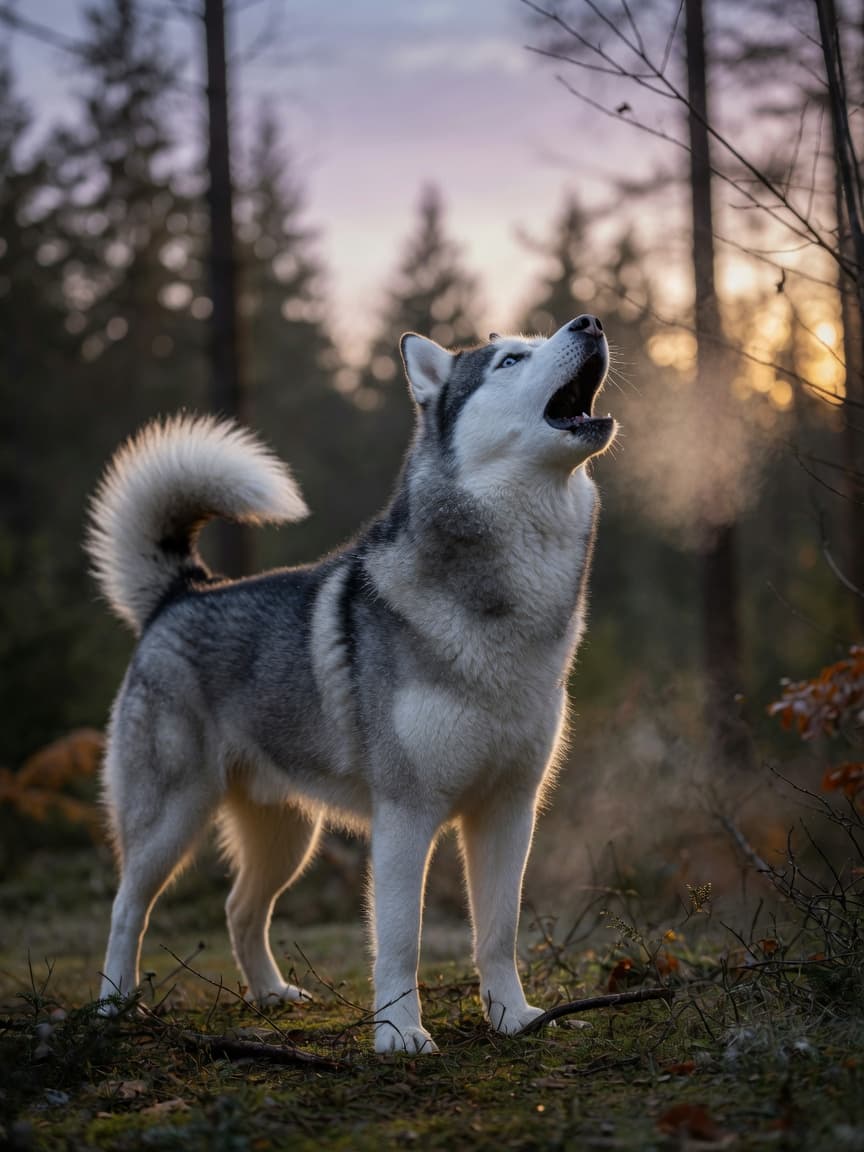
Why Does My Dog Howl? Communication, Pain & Separation
Ancient call: A dog's howl can carry up to 10 kilometres in open terrain. It's one of the oldest forms of canine communication, used by wolves for millennia to locate pack members, signal territory, and coordinate group activity. Your dog's 3am response to a passing ambulance siren is that exact same ancient instinct, helpfully deployed in a semi-detached house at full volume.
Few sounds are quite as attention-grabbing as a dog in full howl. Whether it's a husky throwing their head back in melodic glory or a beagle responding to a distant siren with apparent anguish, howling is one of the most evocative behaviours in a dog's communicative repertoire. It's also one of the most misunderstood.
Howling is not a sign that something is necessarily wrong — it's a form of language. But the specific reason behind your dog's howling matters, because some causes are benign and others are urgent. Here's a complete breakdown.
Reason 1: Wolf Ancestry and Pack Communication
The most fundamental explanation is evolutionary. Dogs are descended from wolves, and wolves howl as a primary long-distance communication tool. Howling can signal location to separated pack members, coordinate group movement, warn rival packs to stay away from a territory, and function as a kind of canine roll call — "I'm here, where are you?"
The howl is extraordinarily well-designed for this purpose. Its sustained, fluctuating frequency carries further than barking and is harder to directionally pinpoint, which historically made it harder for rivals to locate the source precisely. Research published in PLOS ONE found that wolves and dogs maintain distinct individual howl signatures, suggesting howling may also convey identity information to pack members.
The Dogs Trust notes that howling is a completely natural, species-typical behaviour in dogs, rooted in their evolutionary history as social pack animals.
Reason 2: Responding to Sounds — The Siren Effect
This is the cause behind one of dog ownership's most relatable moments: the ambulance goes past, and your dog launches into a spirited accompaniment. Certain high-pitched, sustained sounds appear to trigger a reflexive howling response in many dogs — sirens, certain musical instruments (particularly wind instruments and string instruments), and even singing.
The leading hypothesis is that these sounds share acoustic properties with wolf howls — sustained, high-pitched, fluctuating tones — and trigger the same neural response as hearing a distant pack member call. Your dog isn't distressed by the siren; they're answering it. Some dogs are much more reactive to sounds than others, with breed playing a significant role.
Interestingly, a study highlighted by ScienceDaily found that dogs who howl at music tend to be more anxious overall, suggesting individual temperament influences sound-triggered howling.
Reason 3: Separation Anxiety
Howling when left alone is a hallmark sign of separation anxiety. Unlike barking, which can have many triggers, sustained howling in an owner's absence is strongly associated with distress rather than alerting or excitement. Neighbours often hear it before owners do — it's worth asking whether your dog vocalises after you leave.
Other signs that accompany separation anxiety howling include destructive behaviour directed at entry and exit points (doors, window frames), house-soiling despite being toilet trained, pacing, drooling, and frantic greeting behaviour on the owner's return. The RSPCA recommends a structured programme of graduated absences — very short departures that build slowly in duration — as the gold-standard approach to separation anxiety.
Reason 4: Pain Signal
A sudden onset of howling or yelping in a dog who doesn't usually vocalise excessively — especially when moving, being touched, or getting up and lying down — is a potential pain signal and should be treated as urgent. Dogs experiencing acute pain (from injury, bloat, urinary obstruction, or spinal issues like IVDD) may howl or yelp involuntarily.
This is particularly important to recognise in breeds prone to conditions like intervertebral disc disease (Dachshunds, Basset Hounds, French Bulldogs), gastric dilatation-volvulus/bloat (large and giant breeds), or urinary problems. A dog crying out when touched in a specific area, when moving suddenly, or when attempting to urinate should be seen by a vet immediately.
Reason 5: Breed Predisposition
Some breeds are simply significantly more vocal than others — and howling is part of that. Huskies, Malamutes, and other Nordic breeds were selectively developed for sled team communication, where howling served practical coordination purposes. Scent hounds including Beagles, Bassets, and Bloodhounds were bred to give voice (bay) while trailing prey, so their vocal architecture and drive to vocalise is deeply embedded.
If you have one of these breeds, frequent howling is a feature, not a bug. Managing it requires giving appropriate outlets for vocalisation (such as dedicated training and exercise) and ensuring neighbours are informed and — ideally — on board.
A feature in The Guardian on canine vocalisation explored how breed-specific vocal tendencies are among the most reliably inherited behavioural traits in dogs, persisting strongly even in mixed-breed dogs with significant scent hound or Nordic heritage.
Reason 6: Medical Causes and Senior Dogs
As with many behaviour changes in older dogs, new or increased howling in a senior dog can signal an underlying medical cause: cognitive dysfunction (disorientation leading to distress vocalisation), hypothyroidism, hearing loss (which can cause dogs to vocalise more as their perception of their own voice changes), or neurological conditions. A vet check is strongly recommended if howling appears or worsens suddenly in a dog over 8 years old.
Key Takeaways
- Howling is ancient pack communication — your dog is using the same long-distance signalling system as their wolf ancestors.
- Siren and music-triggered howling is a reflexive acoustic response, not distress — it's triggered by sounds resembling distant howls.
- Howling when alone, especially accompanied by destruction and house-soiling, is a strong indicator of separation anxiety.
- Sudden howling or yelping, especially with movement, is a pain signal — treat as urgent and see a vet.
- Huskies, Malamutes, Beagles, and Bassets are bred to howl — it's genetic, and managing it requires appropriate outlets and training.
- New howling in a senior dog warrants a veterinary assessment to rule out cognitive or physical causes.
If separation anxiety is behind your dog's howling, calming supplements can be a useful part of a broader behaviour management plan. HolistaPet offers natural calming products formulated specifically for dogs, including stress-relief chews and CBD oil. Explore HolistaPet calming range →
References
- Yeon SC, et al. (2011). Differences between vocalization evoked by social stimuli in feral cats and house cats. Behavioural Processes, 87(2), 183–189. PMID: 21300137
- Mazzini F, et al. (2013). Individual variation in wolves' howling: is it specifically used in communication? PLOS ONE, 8(11), e81842. PMID: 24312364