
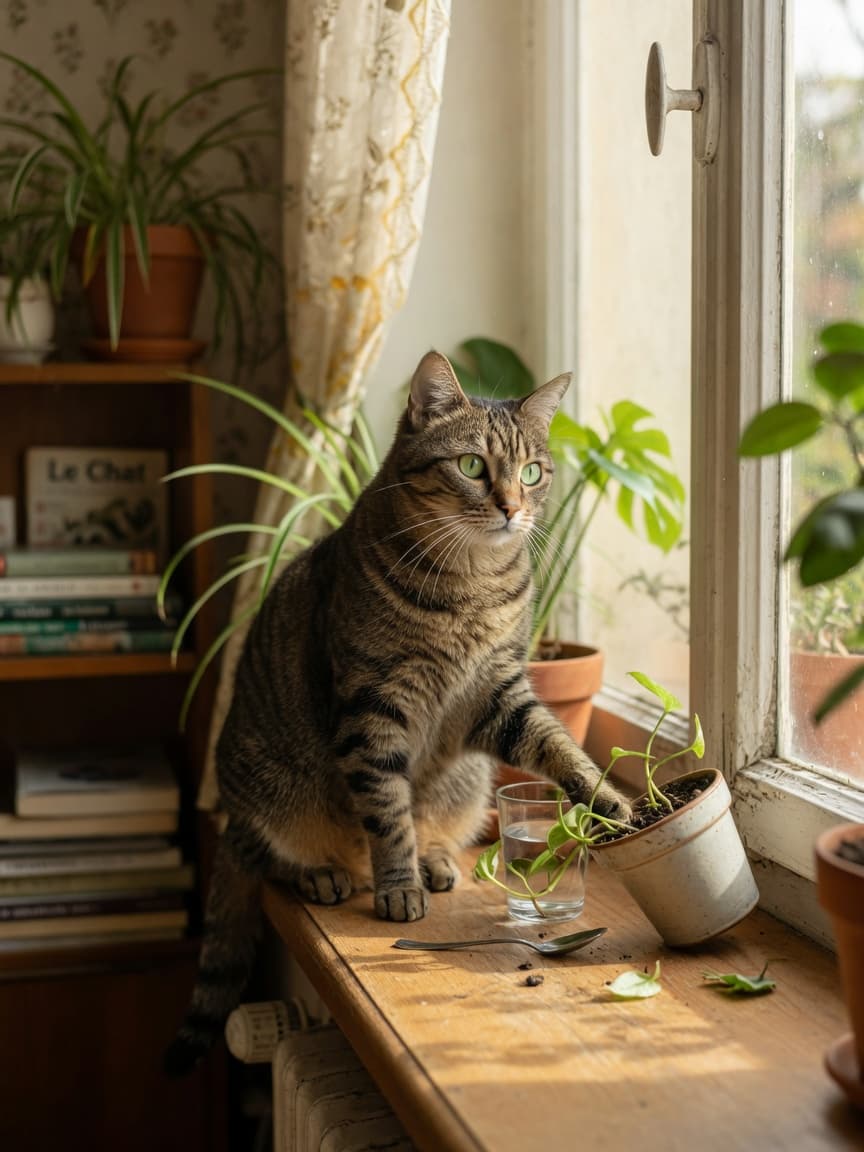
Why Cats Knock Things Over: It Is Not Just Mischief
You have arranged your desk perfectly. Within minutes, your cat saunters over, makes deliberate eye contact, and calmly flicks your pen onto the floor. Then your coffee mug. Then your phone. Most cat owners assume this is spite or entertainment, but the behaviour is rooted in instinct, neurology, and social communication. Understanding why cats knock things over can help you address it — and appreciate your cat a little more in the process.
The Predatory Instinct: Testing Whether Something Is Prey
Cats are obligate carnivores that evolved as solitary hunters. Every domestic cat, however pampered, retains a fully wired predatory drive. When your cat taps an object and watches it move, they are running the same behavioural sequence they would use to assess potential prey in the wild: prodding, observing the response, prodding again.
A motionless object that suddenly moves — or makes a sound when struck — triggers the same neural reward pathways as a fleeing mouse. The paw swipe is not random. It is a precise, methodical test. Many cats will nudge an object gently first, then strike harder if it does not react. This mirrors the cautious approach a wild felid would use before committing to a full kill bite.
Objects near edges are particularly attractive because knocking them off a surface produces motion, sound, and unpredictability — all the hallmarks of prey behaviour. Your cat is not being destructive; they are practising.
Attention-Seeking Behaviour
Cats are far more socially sophisticated than their reputation suggests. Research has confirmed that cats learn to associate specific behaviours with specific human responses. If your cat knocked something over last Tuesday and you immediately jumped up, scolded them, and repositioned the object, you unwittingly trained them. Even negative attention is attention, and cats are quick to exploit that equation.
Attention-seeking object-knocking tends to follow a pattern: the cat watches to see whether you are occupied, positions themselves where you can see them, and then performs the swipe whilst maintaining eye contact. The theatre of it is intentional. Cats that do this reliably before mealtimes, when you are on the phone, or when you have been less interactive than usual are almost certainly using the behaviour as a demand signal.
Curiosity and Sensory Exploration
A cat's paws are extraordinarily sensitive sensory organs. The pads and toes contain dense clusters of mechanoreceptors that can detect texture, temperature, and vibration with remarkable precision. Before a cat commits to touching something with their more vulnerable nose or mouth, they will often investigate with a careful paw.
Knocking an object and watching where it lands — how it rolls, bounces, or shatters — provides a cascade of sensory information. Kittens do this constantly as part of normal cognitive development, but adult cats retain the curiosity drive throughout their lives, particularly if they live in relatively unstimulating environments.
Peripheral Vision Testing
Cats have a visual field of approximately 200 degrees, with a large portion dedicated to peripheral motion detection. Their forward-facing binocular vision is relatively narrow, which means objects at the edge of their visual field can appear blurry or ambiguous. Tapping something and observing how it responds can help a cat's brain confirm what the object is and whether it warrants further investigation. It is, in essence, a form of visual calibration.
Boredom and Understimulation
Indoor cats with insufficient mental and physical stimulation will find their own entertainment. The International Society of Feline Medicine (ISFM) highlights environmental enrichment as one of the five pillars of a healthy indoor cat's life, alongside nutrition, health care, social interaction, and a sense of control over their environment.
A cat that knocks things over repeatedly throughout the day, particularly between your active periods, may be signalling boredom. Other accompanying signs include excessive vocalisation, destructive scratching in inappropriate places, and over-grooming. ISFM guidance recommends rotating toys regularly, providing puzzle feeders, ensuring vertical space such as cat trees and wall shelves, and scheduling at least two interactive play sessions of ten to fifteen minutes daily.
ISFM Enrichment Recommendations
- Provide a variety of toy types: wand toys for hunting simulation, puzzle feeders for cognitive challenge, and crinkle toys for sensory stimulation.
- Rotate toys every few days to maintain novelty — cats habituate quickly to static environments.
- Install window perches so your cat can observe outdoor movement, fulfilling the visual hunting drive without access to live prey.
- Use feeding enrichment such as scatter feeding or slow feeders to extend meal engagement.
- Offer cardboard boxes, paper bags (handles removed), and safe tunnels for exploratory behaviour.
How to Reduce Object-Knocking Behaviour
The most effective approach is to remove the reward. For attention-seeking knocking, withdraw attention entirely — no eye contact, no reaction, no repositioning the object — and redirect your cat to an appropriate interactive toy before the behaviour begins. Consistency is essential; inconsistent responses will simply maintain the behaviour on an unpredictable reinforcement schedule, which is actually more powerful than consistent rewards.
Tidy away irreplaceable or breakable objects from accessible surfaces. Provide your cat with sanctioned "knocking" outlets: lightweight toys on flat surfaces, food puzzles that move when batted, or ball tracks designed for exactly this kind of paw-and-chase interaction.
See Your Vet If...
Occasional object-knocking is entirely normal feline behaviour. However, you should consult your vet if you notice any of the following:
- The behaviour has become compulsive — your cat seems unable to stop or becomes distressed when prevented.
- Object-knocking is accompanied by other repetitive behaviours such as excessive pacing, wool-sucking, or rhythmic vocalisation.
- There has been a sudden increase in intensity or frequency with no change in your cat's environment or routine, which could indicate pain, a neurological issue, or hyperthyroidism.
- Your cat appears disoriented or loses their footing during or after the behaviour, which warrants prompt veterinary assessment.
Compulsive or obsessive-compulsive behaviours in cats are recognised conditions that can be managed with behavioural intervention, environmental modification, and, in some cases, medication. A vet can refer you to a feline behaviour specialist if needed.
The Bottom Line
Your cat knocking things over is almost always a combination of predatory instinct, curiosity, and a bid for engagement — not deliberate sabotage. The behaviour is a window into the rich inner life of an animal that is simultaneously a pampered companion and a finely tuned hunter. With the right enrichment, consistent responses, and a few strategic toy placements, you can channel the impulse productively. And perhaps invest in a non-slip mat for your coffee mug.