

A Bulge Beside the Tail That Should Never Be Ignored
A soft swelling appearing to one or both sides of a dog's anus, particularly in an older intact male, is one of the more distinctive presentations in small animal practice. Perineal hernia is not especially common, but when it occurs it carries the potential for serious and life-threatening complications. Understanding what it is, why it happens, and why early repair matters could make a significant difference to your dog's outcome.
What Is a Perineal Hernia?
The perineum is the region between the anus and the external genitalia, supported by a muscular diaphragm that forms a kind of sling around the rectum and pelvic structures. When the muscles of this diaphragm weaken or separate, abdominal and pelvic contents — including fat, fluid, the bladder, prostate, or sections of bowel — can herniate through the gap, creating a visible bulge under the skin beside the anus.
Hernias are classified as unilateral (affecting one side) or bilateral (both sides), with bilateral cases being common even when only one side appears symptomatic initially.
Who Is Affected and Why?
The condition is strongly associated with intact (entire) male dogs, typically middle-aged to older, with small to medium breeds including Corgis, Boston Terriers, Boxers, and Dachshunds over-represented in clinical surveys. The hormonal influence of testosterone on perineal musculature is believed to contribute, as is the chronic straining associated with prostatic enlargement — itself a consequence of intact male hormones.
Females and neutered males can be affected, but far less frequently. In these cases, underlying causes such as chronic constipation, pelvic masses, or rectal disease are typically implicated.
Recognising the Signs
Early and Mild Presentations
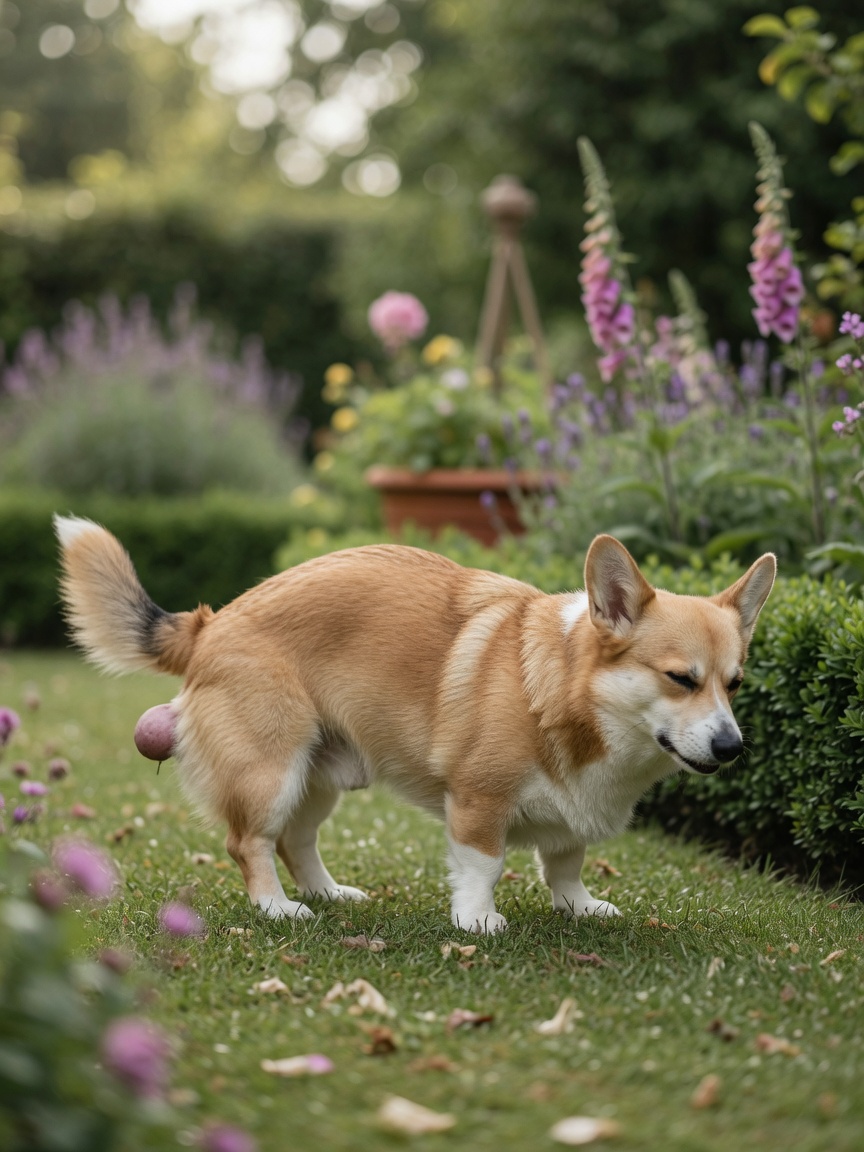
In the early stages, owners may notice a soft, painless swelling beside the anus that fluctuates in size. Dogs may show mild difficulty defecating, adopting unusual postures when straining, or producing ribbon-like stools as the herniated tissue partially compresses the rectum.
Progressive Symptoms
As the hernia enlarges or more structures become involved, signs escalate. Chronic tenesmus — persistent straining to defecate — is one of the most consistent features. Constipation can develop as loops of bowel become entrapped. Perineal skin may become irritated and inflamed from repeated licking and moisture accumulation.
Emergency Signs
The most dangerous complication occurs when the urinary bladder retroflexes into the hernia — a situation in which the bladder folds back on itself and becomes trapped. Affected dogs are unable to urinate, rapidly become distressed, and may vomit or collapse. This is a veterinary emergency requiring immediate intervention. Any dog with a known perineal hernia that suddenly cannot urinate must be seen by a vet without delay.
Diagnosis and Pre-Surgical Assessment
Diagnosis is usually straightforward on clinical examination, with the swelling palpable and the perineal musculature felt to be deficient on rectal examination. Imaging — radiographs or ultrasound — is valuable to identify which structures are within the hernia and to assess the prostate in intact males. Blood and urine tests help evaluate overall health prior to anaesthesia.
In intact males, concurrent castration is strongly recommended and often performed at the same time as hernia repair. Castration reduces prostatic size over time, decreases the hormonal influence on perineal musculature, and significantly lowers the recurrence rate of the hernia.
Surgical Repair: Techniques and Outcomes
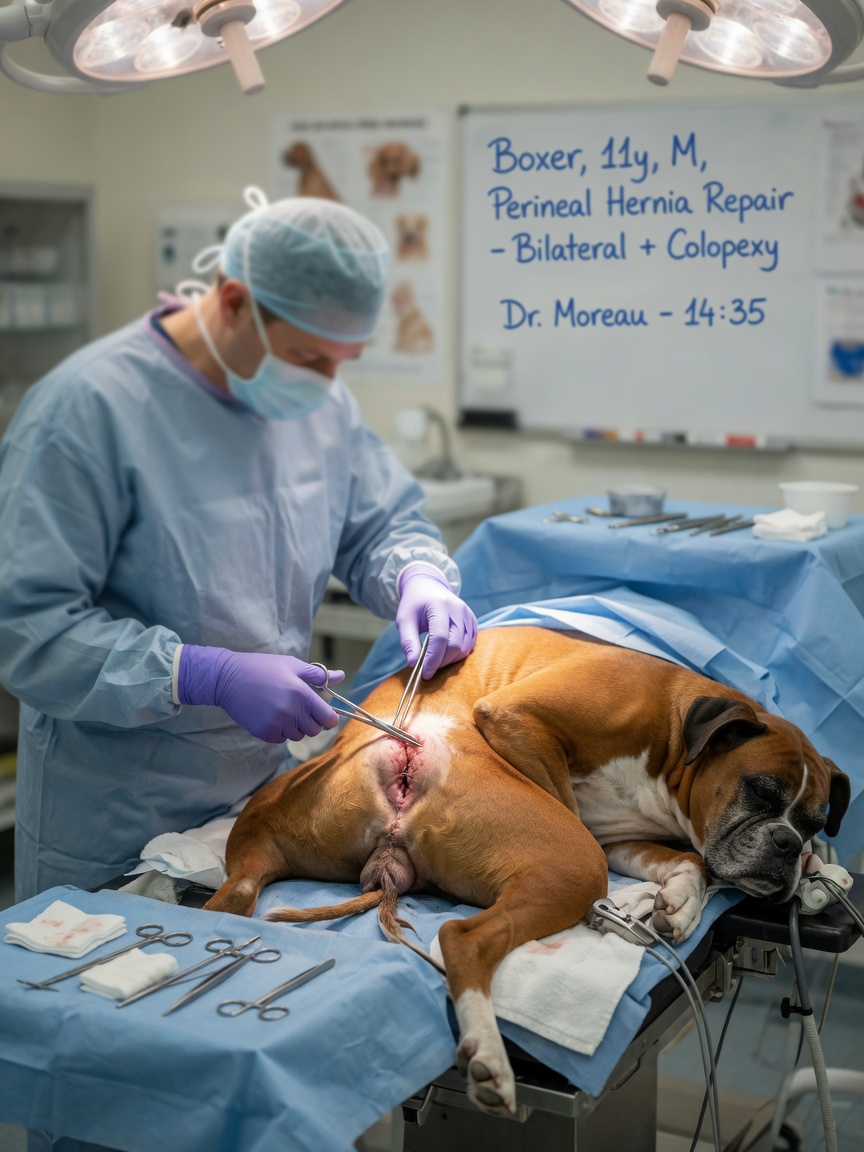
Surgery is the only effective treatment for perineal hernia. Conservative management may temporarily alleviate signs but does not address the structural defect, and complications become increasingly likely with delay.
The traditional technique involves suturing the weakened muscle groups back together using the internal obturator muscle as a flap to reinforce the repair. In cases where local muscles are too atrophied or the defect too large, surgeons may use the superficial gluteal muscle or synthetic mesh implants to achieve a durable closure.
Reported recurrence rates vary depending on technique, surgeon experience, and whether castration was performed. With modern techniques and concurrent castration, recurrence rates of under fifteen per cent are achievable, though bilateral hernias and cases with bladder retroflexion carry a guarded prognosis.
Recovery and Long-Term Care
- Stool softeners are routinely prescribed post-operatively to prevent straining during healing.
- Restricted activity for several weeks allows the repair to consolidate.
- High-fibre diets support long-term bowel regularity and reduce recurrence risk.
- Neutering at the time of repair remains the single most important preventive measure in intact males.
- Regular veterinary check-ups allow early detection of the contralateral side developing in initially unilateral cases.
- Any return of straining or swelling following repair should prompt immediate veterinary review.
If you notice any unexplained swelling near your dog's anus or observe persistent difficulty defecating, consult your vet promptly. Perineal hernia is one condition where early intervention offers considerably better outcomes than a wait-and-see approach.