
Pet Microchip Laws in Europe: Country-by-Country Guide
Key Takeaways
- The EU standard for pet microchips is ISO 11784/11785, a 15-digit chip that must be readable by international scanners; older non-ISO chips may not be recognised at borders.
- Mandatory microchipping for dogs is now law in most EU member states, as well as in the UK; several countries have extended the requirement to cats.
- Fines for non-compliance range from modest administrative penalties to several thousand euros, depending on the country.
- Two key European databases — EUROPETNET and PETMAXX — aggregate national registries to help locate owners of found animals across borders.
- Microchipping dramatically improves the odds of reuniting a lost pet with its owner, but only if the chip is properly registered with current contact details in a searchable database.
The EU Standard: ISO 11784 and ISO 11785
Across Europe, the microchip standard for companion animals is defined by two ISO norms. ISO 11784 specifies the code structure: a 15-digit number in which the first three digits identify the country or manufacturer, and the remaining digits form a unique identification number for the animal. ISO 11785 specifies the technical standard for data transmission between the chip and the reader — essentially the radio frequency and communication protocol.
The frequency used by ISO-compliant chips is 134.2 kHz. Older chips operating at 125 kHz (common before roughly 2000 in some countries) are not guaranteed to be read by modern ISO-compliant scanners. If your pet was microchipped in an earlier era or in a country with non-standard chips, it is worth having a vet scan the chip with a universal reader to verify it is detectable — especially before international travel.
EU Regulation 576/2013 on the non-commercial movement of pet animals requires that dogs, cats, and ferrets moving between EU member states or entering the EU carry a microchip that complies with ISO 11784/11785, or that the owner carries documentary proof of the chip number if the chip is non-ISO. For all practical purposes, ISO compliance is now the only viable option for travelling pets in Europe.
Country-by-Country Requirements
The table below summarises microchipping legislation across key European countries. Note that enforcement and fine amounts can change; verify with official sources before relying on this for compliance purposes.
| Country | Species Covered (mandatory) | Age Requirement | Fine for Non-Compliance (approximate) |
|---|---|---|---|
| Spain | Dogs (all); cats (varies by region) | Dogs: before 3 months of age | €200–€15,000 depending on regional legislation and classification of infraction |
| United Kingdom | Dogs (since 2016); cats (since 10 June 2024) | Dogs: by 8 weeks of age; Cats: by 20 weeks of age | Up to £500 for each unchipped animal |
| France | Dogs, cats, ferrets | Dogs and cats: before 4 months of age | €750 (Class 3 administrative fine) |
| Germany | Dogs (federal recommendation; Länder legislation varies) | Varies by state; generally within first months of life | Varies by Bundesland; can reach several hundred euros |
| Italy | Dogs; cats in some regions (Toscana, Emilia-Romagna) | Dogs: by 4 months of age | €25–€500 depending on region |
| Netherlands | Dogs and cats | Before leaving the breeder or by 7 weeks | Administrative fine; amount varies |
| Belgium | Dogs, cats, ferrets | Dogs and cats: by 8 weeks | €50–€500 per animal |
| Ireland | Dogs | Before being sold, given away, or by 12 weeks | Up to €2,500 on summary conviction |
| Portugal | Dogs, cats | Dogs: by 3 months; cats: by 4 months | €50–€3,740 |
| Sweden | Dogs (since 2011) | By 4 months of age | Administrative sanction; amounts set at county level |
Spain in Detail: Ley de Bienestar Animal and Regional Variation
Spain introduced mandatory dog microchipping through its national and regional animal protection legislation well before EU Regulation 576/2013 harmonised the rules for cross-border movements. Under Spain's national framework (most recently updated by Ley 7/2023, de 28 de marzo, de protección de los derechos y el bienestar de los animales), all dogs must be microchipped before three months of age and registered in the national REGO database. Breeders, shelters, and new owners all carry registration obligations.
Cats are handled differently across Spain's autonomous communities. Catalonia and the Canary Islands, for example, have had mandatory cat microchipping for some years; other regions are still catching up. The 2023 national law encourages harmonisation but enforcement timelines vary. If you live in Spain with a cat, checking your regional animal registration rules (padró municipal d'animals de companyia in Catalonia, or the equivalent in your community) is necessary.
United Kingdom: Dogs and Now Cats
The UK's mandatory dog microchipping law came into force on 6 April 2016 under the Microchipping of Dogs (England) Regulations 2015, with parallel legislation in Scotland, Wales, and Northern Ireland. All dogs must be microchipped and registered in a compliant database by the age of eight weeks. Keepers of unchipped dogs can be issued a notice requiring compliance within 21 days; failure to comply results in a fine of up to £500.
From 10 June 2024, mandatory microchipping was extended to cats in England under the Microchipping of Cats (England) Regulations 2023. Cats must be chipped by the age of 20 weeks and registered. This makes England one of the first jurisdictions in the world to mandate cat microchipping at the national level. Scotland, Wales, and Northern Ireland were considering equivalent cat microchipping regulations; the status of each devolved nation's legislation should be confirmed separately.
The UK maintains several authorised microchip databases — including Petlog, Identibase, Animal Tracker, and the Kennel Club — all of which are required to be interconnected so a scan of any chip can be traced to the keeper via a single lookup.
How to Check If a Chip Is Working: Scanners and Databases
A microchip is only useful if it can be read and the number traced back to the owner. There are two potential failure points: the chip itself (which can fail or migrate) and the database record (which can be out of date).
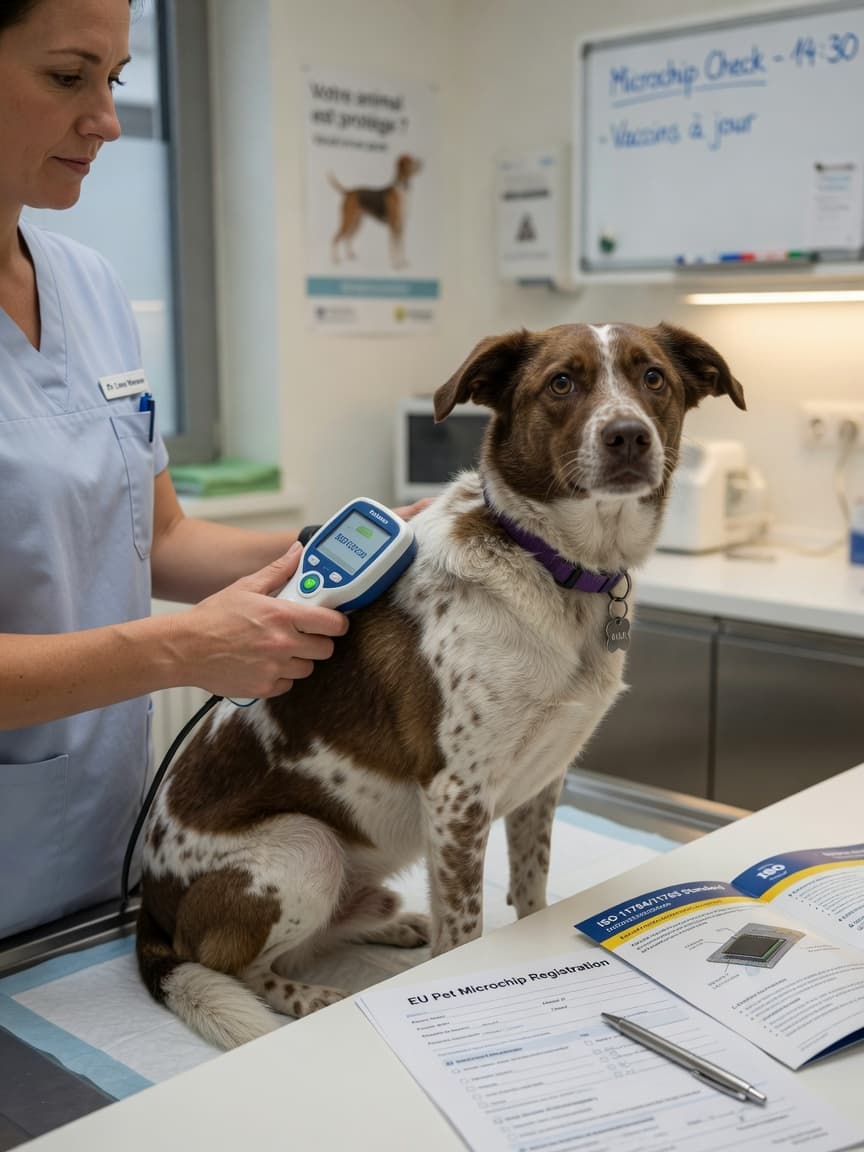
Your veterinarian can scan your pet's chip at any routine appointment. Ask for the chip number to be read and confirmed in writing — then cross-check it against what appears in your registration record. If your vet uses an older low-frequency scanner, it may not read ISO 11785 chips correctly; universal scanners that read both 125 kHz and 134.2 kHz are now standard at most clinics.
For cross-border found animals, two European databases serve as aggregators:
- EUROPETNET (europetnet.com): A network of national pet identification databases that allows searches across member countries. Entering a chip number in EUROPETNET queries the linked national registries and returns owner contact information if the chip is registered in any participating database.
- PETMAXX (petmaxx.com): Another pan-European database that allows free chip number lookups and lost pet reporting across multiple countries.
It is worth searching your pet's chip number in both databases to confirm it is discoverable. If it is not found, contact your national registration authority or the database where you registered to investigate whether the data was properly submitted.
Microchipping and Lost Pet Reunification
Studies consistently show that microchipped pets are significantly more likely to be reunited with their owners than those without chips. A landmark study published in the Journal of the American Veterinary Medical Association found that dogs with microchips were returned to their owners over 52% of the time, compared to 21.9% for unchipped dogs. For cats, the difference was even more dramatic: 38.5% versus just 1.8%.
However, the chip is only as effective as the registration record attached to it. A found animal whose chip number leads to an old address or disconnected telephone number cannot be reunited with its owner. The most common failure mode in microchipping is not technical — it is administrative. When you move home, change your phone number, or transfer ownership of a pet, updating the database record immediately is essential. Many national databases charge a small administrative fee for updates; this fee is trivially small compared to the cost of losing a pet permanently.
Additionally, if you acquire a second-hand pet, always ask for proof of the chip number, scan the chip yourself at a vet clinic to confirm, and transfer the registration into your name as the new keeper. Chips cannot be removed without surgery and remain with the animal for life; the database record is your real control over the system.
Practical Checklist for European Pet Owners
Whether you are a new pet owner or an existing one auditing your compliance, the following steps cover the essentials: confirm your pet is chipped with an ISO 11784/11785 compliant chip; ask your vet to scan and record the chip number at the next visit; verify that the number is registered in your national database and that all contact details are current; search the chip number in EUROPETNET and PETMAXX to confirm cross-border discoverability; if you travel with your pet within the EU, ensure the chip number appears correctly in your EU Pet Passport; and if your pet is a cat in a jurisdiction that has recently passed mandatory chipping law, schedule the procedure if not already done.
References & Sources
- European Parliament and Council. Regulation (EU) No 576/2013 of 12 June 2013 on the non-commercial movement of pet animals and repealing Regulation (EC) No 998/2003. Official Journal of the European Union, L 178, 28.6.2013. Available at: https://eur-lex.europa.eu/legal-content/EN/TXT/?uri=CELEX:32013R0576
- UK Parliament. The Microchipping of Dogs (England) Regulations 2015 (SI 2015/108). Available at: https://www.legislation.gov.uk/uksi/2015/108/contents/made; and The Microchipping of Cats (England) Regulations 2023. Available at: https://www.legislation.gov.uk/uksi/2023/1164/contents/made