
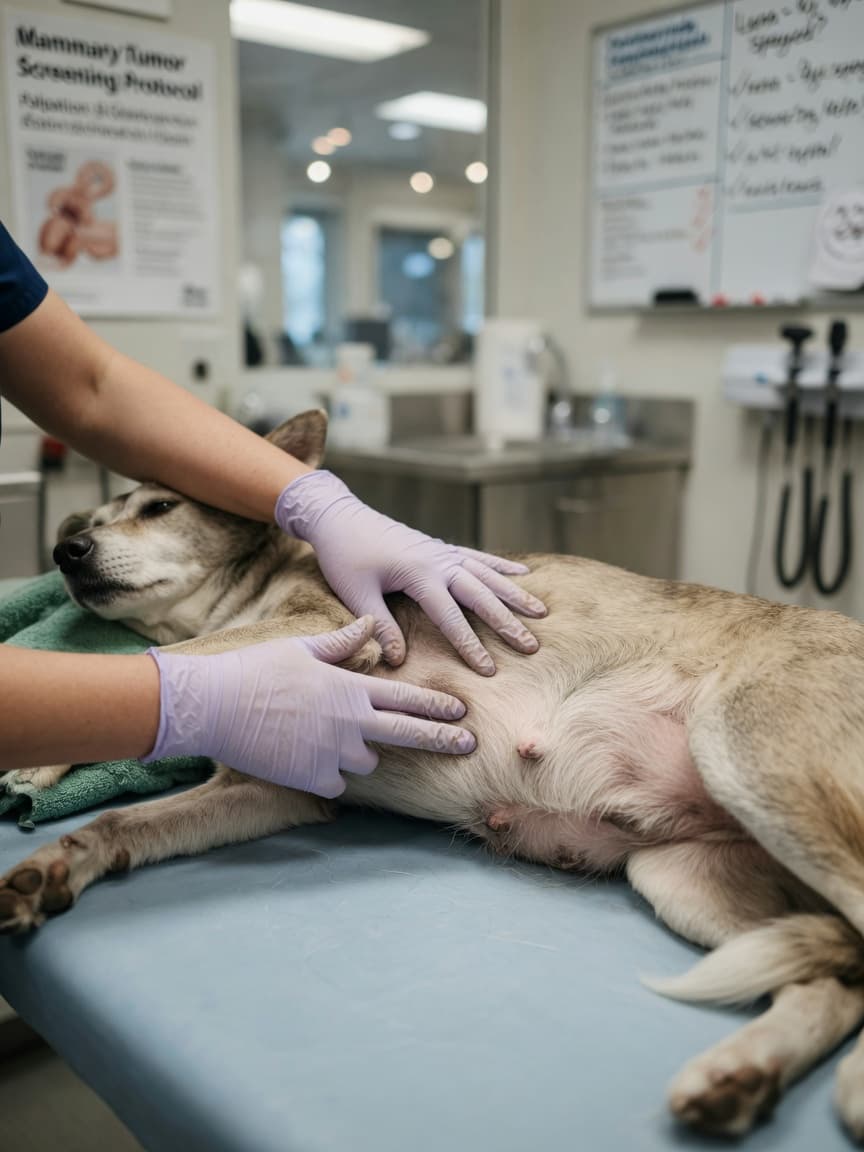
The Most Preventable Cancer in Female Dogs
Mammary tumours are the most common neoplasm in intact female dogs, accounting for approximately 50% of all tumours in unspayed bitches in countries where early neutering is not routine practice. The striking — and clinically important — fact is that the risk of developing mammary tumours is profoundly influenced by a single decision: when, or whether, a dog is spayed. Understanding this relationship gives dog owners one of the clearest preventive levers available in all of veterinary medicine.
The Hormone Connection: Why Spaying Timing Is Everything
Canine mammary gland development and tumour formation are strongly driven by oestrogen and progesterone. The seminal research in this area established that spaying before the first oestrus reduces the lifetime risk of mammary tumours to approximately 0.5%. Spaying after the first season increases that risk to around 8%. After the second season, risk rises to approximately 26%. Beyond two to three seasons, spaying confers little protection against mammary tumour development, though it may still be recommended for other health reasons.
This data makes a compelling case for early spaying in dogs not intended for breeding — but the decision is not without nuance. Evidence also links early spaying in certain large breeds to increased risk of orthopaedic disease and some other cancers. The optimal timing for spaying is breed-specific and worth discussing in detail with your vet, ideally before the first season.
Recognising Mammary Tumours
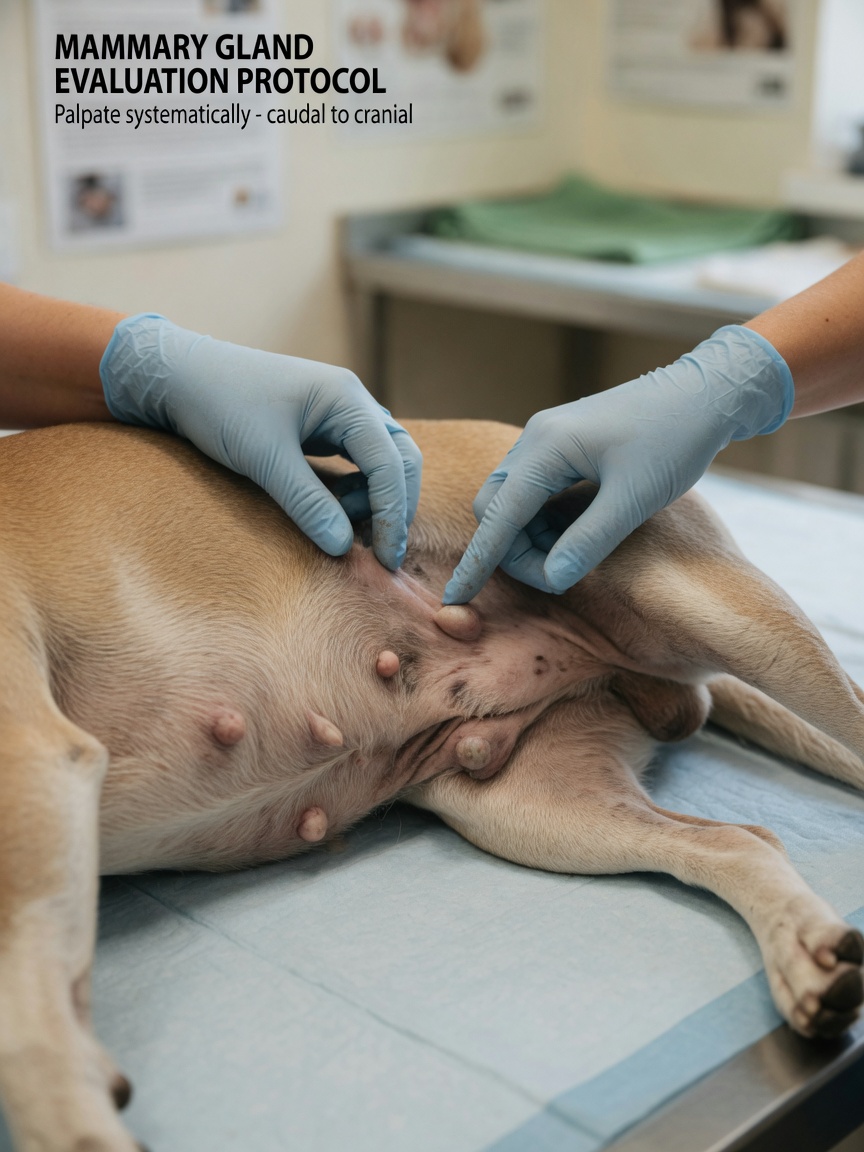
Dogs have five pairs of mammary glands extending from the chest to the groin. Tumours most commonly arise in the caudal (rear) glands, which have higher oestrogen receptor density. They may present as small, firm, discrete nodules or as larger, irregular, ulcerated masses. Approximately 50% of canine mammary tumours are benign and 50% are malignant — a ratio that underscores why all mammary masses require veterinary assessment and should not simply be monitored.
Malignant tumours may grow rapidly, feel fixed to underlying tissue, involve the overlying skin, or be accompanied by swollen regional lymph nodes. Inflammatory mammary carcinoma, a rare and aggressive variant, presents as diffuse redness, heat, and swelling of one or more glands without a discrete mass — it is often mistaken for mastitis and carries a very poor prognosis.
Diagnosis and Staging
Fine-needle aspiration can provide useful cytological information but is less reliable for mammary tumours than for many other canine cancers. Excisional biopsy — removing the lump and submitting it for histopathology — provides definitive diagnosis, tumour type, grade, and margin assessment simultaneously.
Staging for malignant tumours includes regional lymph node evaluation (with aspiration or biopsy of any enlarged nodes), thoracic radiographs or CT to assess pulmonary metastasis, and abdominal imaging. Tumour size at diagnosis is an important prognostic factor: tumours under 3 cm at surgery carry a significantly better prognosis than larger masses.
Surgery: The Primary Treatment
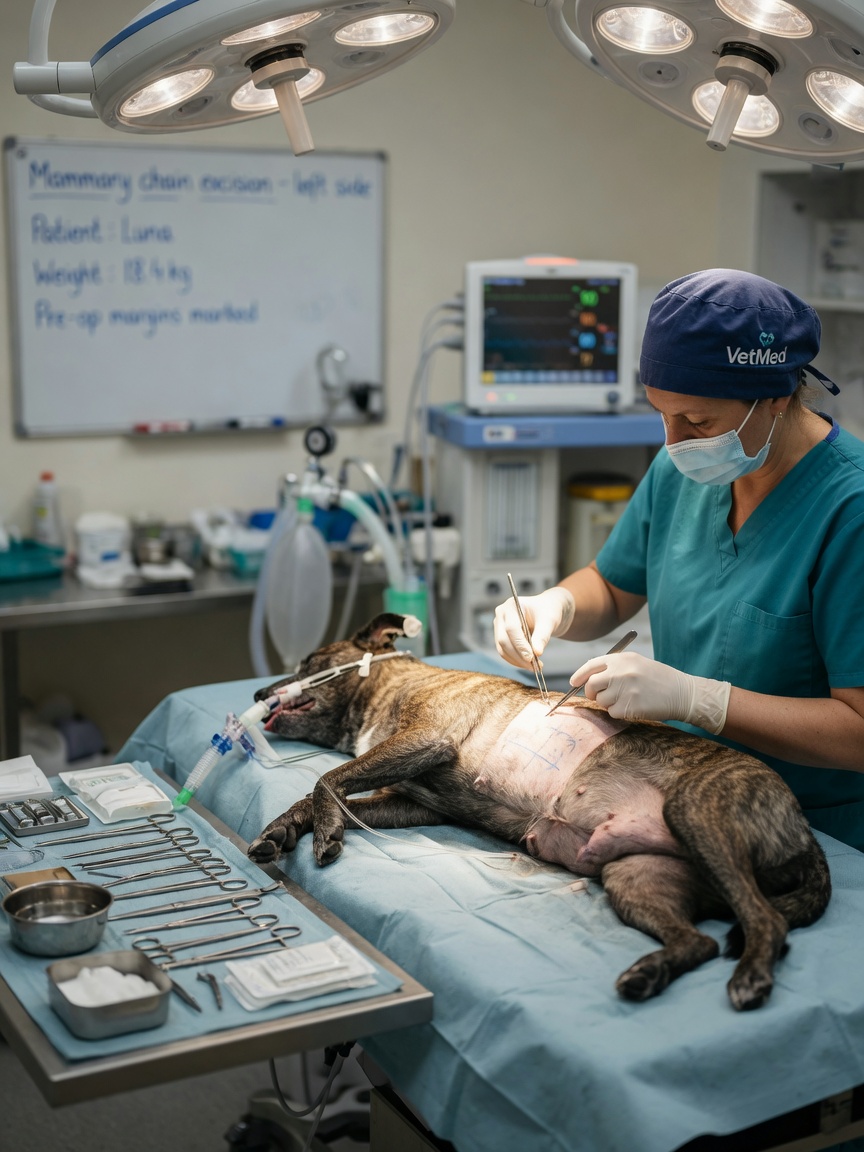
Surgical excision is the mainstay of treatment for localised mammary tumours. Several surgical approaches exist, ranging from lumpectomy (removal of the tumour alone) to radical mastectomy (removal of an entire mammary chain). The choice depends on tumour size, number, location, and the surgeon's assessment of how best to achieve complete excision with clean margins.
There is ongoing debate about whether spaying at the time of mammary tumour surgery confers survival benefits. Current evidence is mixed, but spaying is generally recommended in intact bitches unless anaesthetic risk is prohibitive, as it eliminates ongoing hormonal stimulation to any residual mammary tissue.
When Margins Matter
Complete excision with histologically confirmed clean margins is the most important surgical goal. Incompletely excised malignant tumours have a significantly higher rate of local recurrence. In some cases, revision surgery or adjuvant therapy may be recommended when margins are reported as close or involved.
Adjuvant Treatment: Chemotherapy and Beyond
Unlike some canine cancers, there is no universally established chemotherapy protocol for mammary tumours with strong evidence of survival benefit. Doxorubicin-based protocols are most commonly used for high-grade or metastatic disease, but responses are variable. Clinical trials are ongoing, and veterinary oncologists may be able to offer enrolment in studies evaluating newer approaches.
Cyclooxygenase-2 (COX-2) enzyme overexpression has been identified in a proportion of canine mammary carcinomas, which provides the rationale for using NSAIDs such as piroxicam as part of the management plan. While not a substitute for surgery or chemotherapy, NSAIDs may provide anti-tumour activity and improve comfort concurrently.
Hormone receptor status — analogous to oestrogen receptor testing in human breast cancer — is not yet routinely assessed in veterinary practice, though research interest is growing.
Prognosis and Monitoring
Prognosis varies widely depending on tumour type, grade, size, lymph node involvement, and completeness of excision. Dogs with small, completely excised, low-grade carcinomas may live for many years without recurrence. High-grade tumours, lymphovascular invasion, or nodal metastasis at diagnosis carry a significantly more guarded outlook.
After surgery, structured monitoring is essential. Owners should examine all remaining mammary tissue monthly for new lumps. Chest radiographs are typically recommended every three to six months for malignant cases to monitor for pulmonary metastasis. Any change in the surgical site or new swelling should be reported promptly.
Practical Guidance for Owners
- Discuss spaying timing with your vet before your dog's first season if breeding is not planned
- Examine your dog's mammary glands monthly from adulthood onwards
- Do not adopt a wait-and-see approach with any new mammary lump — seek veterinary assessment promptly
- Ensure histopathology is performed on all excised tissue, including apparently benign lumps
- Request margin assessment results and ask what they mean for ongoing monitoring or further treatment
- Ask your vet about NSAID therapy as an adjunct to surgical management in malignant cases
- For high-grade or advanced disease, request referral to a veterinary oncologist
Mammary cancer in dogs is a disease where timing, vigilance, and informed decision-making make a measurable difference. Early spaying, prompt investigation of any new lump, and thorough pathological assessment after surgery are the three most impactful steps owners and vets can take together.