
Light as Medicine: Less Strange Than It Sounds
Therapeutic laser — also called low-level laser therapy (LLLT) or photobiomodulation — has quietly become one of the most widely adopted rehabilitation tools in veterinary practice. Walk into almost any veterinary physiotherapy or rehabilitation centre in the UK and you will find one. But unlike some complementary therapies, laser treatment has a reasonably solid biological rationale and a growing body of peer-reviewed evidence behind it. Understanding how it works helps owners evaluate whether it is worth pursuing for their own animal.
The Biology: What Laser Actually Does to Tissue
Therapeutic lasers emit specific wavelengths of red and near-infrared light, typically between 600 and 1,000 nanometres. These wavelengths penetrate skin and superficial tissue to reach target cells. Inside those cells, photons of light are absorbed by cytochrome c oxidase, a key enzyme in the mitochondrial respiratory chain — the cellular energy production system.
This absorption triggers a cascade of biological effects: increased production of adenosine triphosphate (ATP, the cell's primary energy currency), improved mitochondrial function, reduced oxidative stress, and modulation of inflammatory signalling pathways. At the tissue level, this translates to accelerated healing, reduced inflammation, decreased pain signalling, and improved blood flow to the treated area.
Crucially, therapeutic lasers operate at power levels that stimulate tissue rather than damage it. They are categorically different from surgical lasers used to cut or ablate tissue.
Conditions That Respond Well
Musculoskeletal Pain
This is where the evidence is strongest. Osteoarthritis, tendon injuries, muscle strains, and ligament damage all show meaningful response to photobiomodulation in controlled studies. Dogs with hip dysplasia or spinal arthritis often show improved mobility and reduced analgesic requirements with regular treatment.
Wound Healing
Laser therapy accelerates healing of both acute wounds and chronic, non-healing lesions. Post-surgical incision sites, degloving injuries, and pressure sores have all been treated successfully. The mechanism — enhanced cellular energy production and reduced inflammation — directly supports tissue repair.
Neurological Recovery
Emerging research suggests photobiomodulation may support nerve regeneration following spinal cord injury or peripheral nerve damage. Dogs recovering from intervertebral disc disease surgery are increasingly offered laser as part of rehabilitation protocols, though evidence here is less mature than for musculoskeletal applications.
Ear and Skin Conditions
Chronic otitis, hot spots, and lick granulomas — particularly in dogs — respond to laser therapy in many cases. The anti-inflammatory and tissue-stimulating effects help break cycles of inflammation and self-trauma that perpetuate these conditions.
What a Session Involves
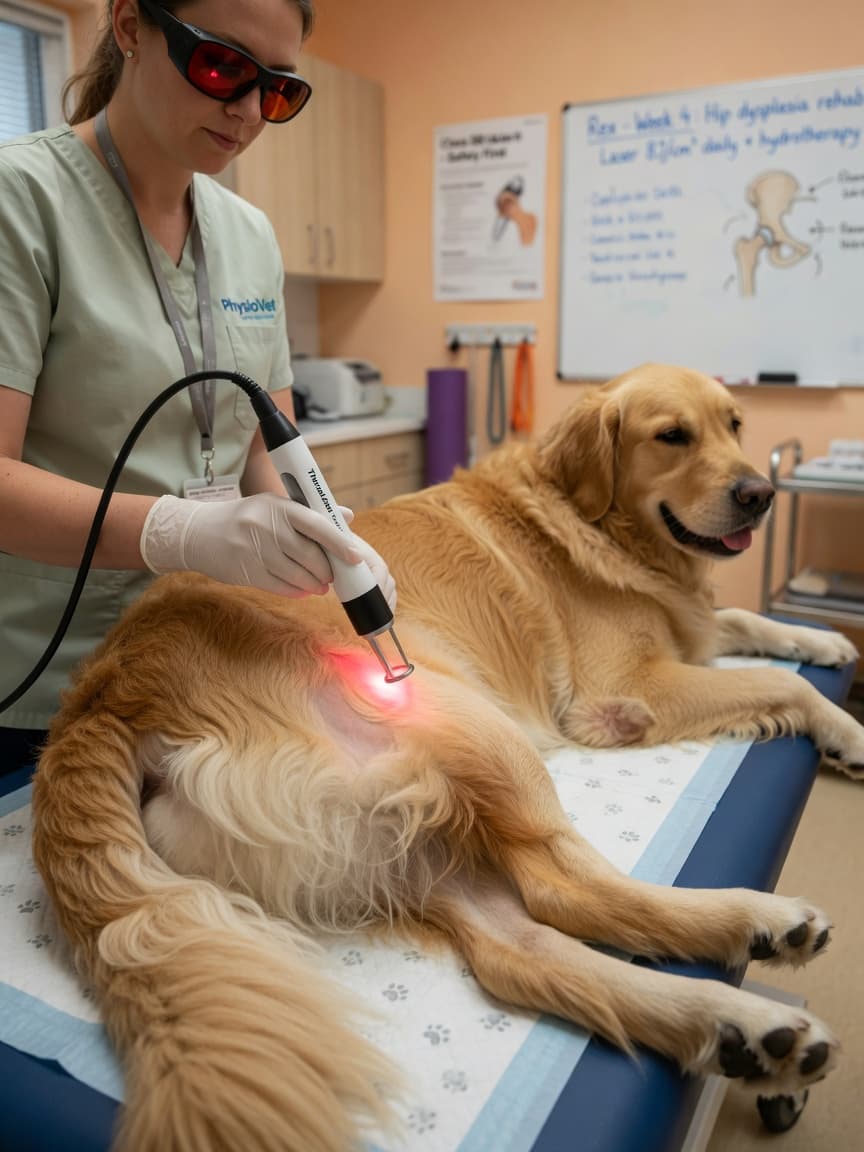
Treatment is non-invasive and painless. The veterinarian or therapist passes a handheld laser probe over the treatment area, maintaining contact with or close proximity to the skin. Protective goggles are worn by all people present, and the animal's eyes are shielded if the treatment area is near the head.
Sessions last between five and twenty minutes depending on the area being treated, the power output of the device, and the condition. Most animals find it comfortable; warmth is sometimes felt at the treatment site. There is no sedation, no recovery period, and no post-treatment restrictions in most cases.
Frequency varies by condition. Acute injuries may be treated daily for the first week. Chronic conditions such as osteoarthritis are often treated two to three times per week initially, tapering to weekly or fortnightly maintenance once a good response is established.
Class IV Versus Class III: Does It Matter?
Laser devices are classified by power output. Class III devices (also called cold lasers) operate at lower power and require longer treatment times to deliver the same energy dose. Class IV devices deliver higher power, allowing deeper tissue penetration and shorter treatment times. Both can be effective; Class IV devices are generally considered more versatile for deeper structures such as hip joints in large dogs.
What matters most is that the device is used by a trained professional who calculates the correct dose for the tissue being treated. Underdosing produces no effect; overdosing can cause tissue damage. This is not a device for untrained home use.
Safety and Limitations
When used correctly by trained professionals, therapeutic laser has an excellent safety profile. The main contraindications are treatment directly over active tumours (laser may stimulate cellular activity, which is undesirable in cancerous tissue), over the eyes without protection, and over pregnant uteri. Tattoos and dark pigmentation can increase absorption and risk of overheating in affected areas.
It is also important to have realistic expectations. Laser therapy is a supportive tool, not a cure. It works best as part of a multimodal plan alongside appropriate diagnosis, medication where indicated, exercise rehabilitation, and weight management. Always discuss it with your vet, who can advise whether your animal is a suitable candidate and coordinate it with broader care.