
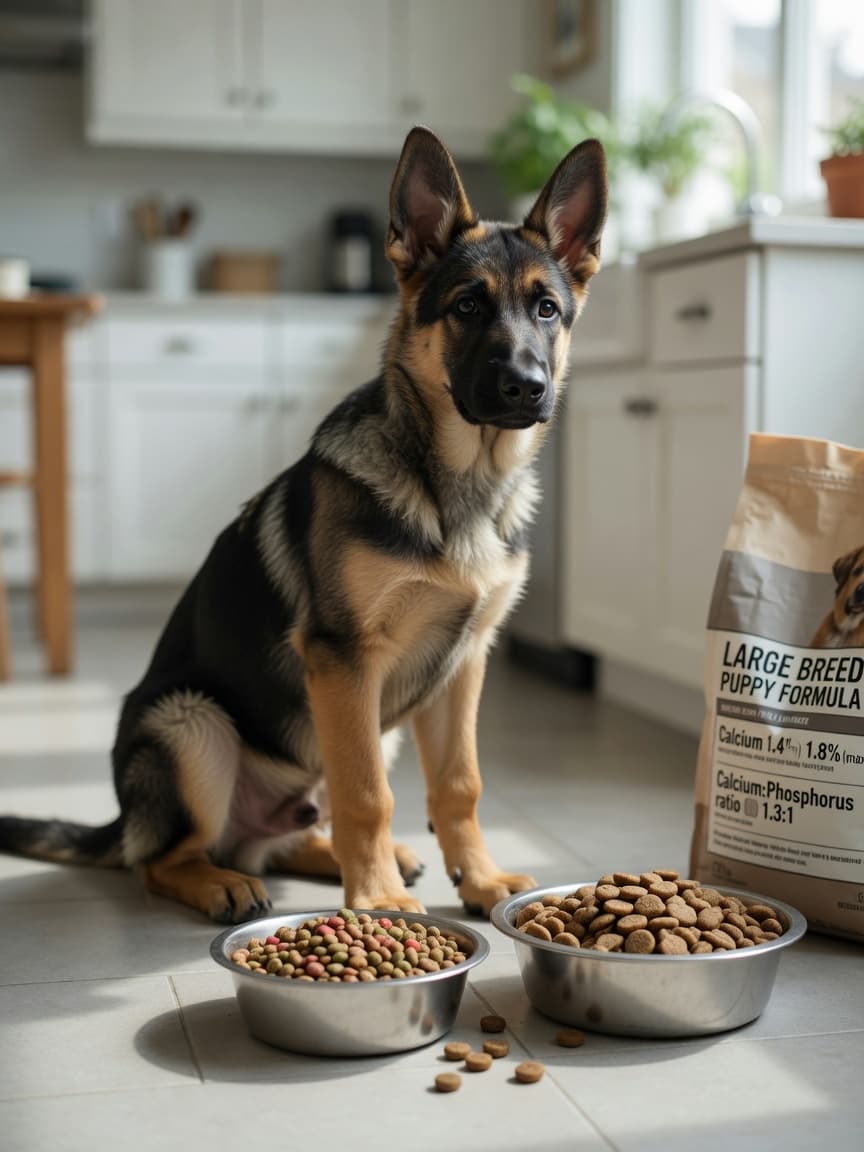
The Nutritional Stakes Are Higher for Large Breed Puppies
If you have a puppy that is going to grow into a dog over 25 kg, what you feed them in their first year or two of life carries consequences that go well beyond general health. The skeletal development of large and giant breed puppies is particularly sensitive to nutritional imbalances — and calcium, specifically, sits at the centre of that concern.
This is not a marginal or theoretical risk. Overfeeding calcium to large breed puppies has been demonstrated in controlled studies to cause developmental orthopaedic disease (DOD), a group of conditions that includes osteochondrosis, hip dysplasia exacerbated by early bone malformation, and wobbler syndrome. These are serious, often painful, and sometimes permanent conditions. The good news is that nutrition is one factor you have direct control over.
Why Calcium is Problematic in Excess

In small and medium breeds, the gut has a self-regulating mechanism that reduces calcium absorption when intake is high. This passive absorption system keeps excessive calcium from causing harm even if dietary levels are somewhat elevated. Large breed puppies do not have the same regulatory efficiency — their gut absorbs a higher proportion of dietary calcium regardless of how much is coming in, making them far more vulnerable to overconsumption.
Too much calcium during the growth phase disrupts the normal process of bone remodelling. Growth plates — the areas of soft cartilage at the ends of bones where lengthening occurs — can mineralise too quickly or unevenly, leading to weakened bone structure, joint abnormalities, and increased susceptibility to conditions like osteochondritis dissecans (OCD), where cartilage fails to convert properly to bone.
Research published in the Journal of Nutrition demonstrated clearly that Great Dane puppies fed high-calcium diets developed significantly more skeletal abnormalities than those fed appropriate levels, even when total caloric intake was controlled. The relationship between calcium excess and orthopaedic disease in giant breeds in particular is well established in the veterinary literature.
What the Numbers Actually Mean
FEDIAF guidelines recommend that complete foods for large breed puppies should contain between 0.8% and 1.5% calcium on a dry matter basis. For giant breeds (over 45 kg adult weight), some veterinary nutritionists recommend staying closer to the lower end of that range.
Equally important is the calcium-to-phosphorus ratio. Bone is made largely of calcium phosphate, and these two minerals work together. A ratio of calcium to phosphorus between 1:1 and 1.8:1 is considered appropriate. Skewed ratios — either too much calcium relative to phosphorus, or vice versa — can interfere with bone mineralisation even when absolute calcium levels are within range.
When assessing a food, look for these figures on the guaranteed analysis panel. If they are not present on the packaging, the manufacturer should be able to provide them on request or on their website. If they cannot or will not, that is itself a useful data point.
The Problem with Standard Puppy Foods for Large Breeds
Standard puppy foods — formulated for all sizes — are typically designed to meet the higher calcium needs of small and medium breeds, which require proportionally more calcium per kilogram of bodyweight during growth. This means a standard puppy food may deliver more calcium than a large breed puppy should be consuming.
This is why the market for large breed specific puppy foods exists and why it is not simply a marketing category. A purpose-formulated large breed puppy food will have lower calcium and phosphorus levels, adjusted energy density to support slower, more controlled growth, and often modified protein and fat levels to avoid excessive weight gain — which adds mechanical stress to developing joints independently of any nutritional factor.
Foods labelled for "all life stages" are another option sometimes recommended. Because these must meet growth requirements by default, they are technically appropriate, but their calcium levels vary considerably by brand. Always check the actual figures rather than relying on the label category alone.
Energy Density and Growth Rate: The Other Side of the Equation

Calcium is the most studied variable in large breed puppy orthopaedic health, but it does not act in isolation. Overfeeding in general — causing a large breed puppy to grow faster than its skeleton can safely accommodate — compounds nutritional risk factors.
The goal for a large or giant breed puppy is not the fastest possible growth to adult size. It is steady, controlled growth at a rate the bones and joints can handle. A puppy that reaches adult weight two months earlier than average is not healthier for it — and the research consistently shows that rapid early weight gain in large breeds is associated with higher rates of hip dysplasia and other orthopaedic problems regardless of breed predisposition.
Large breed puppy foods therefore tend to have slightly lower energy density than standard puppy foods, and feeding guidelines are designed to support lean body condition rather than maximum growth rate. Regularly assess your puppy's body condition score: you should be able to feel ribs easily without pressing, see a waist from above, and see a slight abdominal tuck from the side. A puppy carrying excess condition is being overfed, regardless of what the feeding guide says.
Practical Steps for Large Breed Puppy Owners
- Choose a food specifically formulated and labelled for large or giant breed puppies, not a general puppy food.
- Verify the calcium content is between 0.8% and 1.5% dry matter, and the calcium-to-phosphorus ratio is between 1:1 and 1.8:1.
- Do not supplement with calcium, bone meal, or dairy products unless specifically directed by a veterinary nutritionist — additional calcium on top of a complete food is one of the most common ways owners inadvertently create excess.
- Feed to maintain lean body condition rather than following feeding guides rigidly, as individual puppies vary considerably in their caloric needs.
- Keep feeding a large breed puppy formula until your dog reaches skeletal maturity — 15 to 18 months for large breeds, up to 24 months for giants like Great Danes, Mastiffs, and Saint Bernards.
- Schedule regular weight and condition checks with your vet, particularly in the first year.
Getting nutrition right in the large breed puppy phase will not eliminate genetic predisposition to hip dysplasia or other orthopaedic conditions, but it is one of the most meaningful environmental factors within your control. The window for getting it right is finite — make the most of it.