

Labrador Retriever: Breed Overview
The Labrador Retriever consistently tops European dog breed popularity polls and has done so for decades. Recognised by the Fédération Cynologique Internationale (FCI) under Group 8 (Retrievers, Flushing Dogs, Water Dogs), standard number 122, the Labrador is celebrated across the EU for its balanced temperament, trainability, and genuine love of family life. Whether you live in a Dutch suburb, a Spanish city, or a rural British farmhouse, the Labrador adapts with remarkable ease.
Origin and History
Despite the name suggesting Canada's Labrador region, this breed's true origins lie in Newfoundland, where fishermen kept small, hardworking dogs known as St. John's Water Dogs during the early nineteenth century. These dogs assisted fishermen by retrieving nets and catching fish that escaped the line. British aristocrats visiting Newfoundland were so impressed that they imported several to England in the 1820s and 1830s.
The Earl of Malmesbury, the Duke of Buccleuch, and the Earl of Home are credited with developing the modern Labrador through selective breeding on their estates. The breed was officially recognised by The Kennel Club in 1903. Over the following decades, the Labrador's natural ability to retrieve game, its soft mouth, and its biddable nature made it the gundog of choice across the British Isles and, eventually, throughout continental Europe.
Size, Weight, and Appearance
The Labrador is a medium-to-large breed. Males typically stand 56–57 cm at the shoulder and weigh between 29–36 kg, while females measure 54–56 cm and weigh 25–32 kg. The breed is solidly built, with a broad skull, kind eyes, and the famous thick, tapering "otter tail" that acts as a rudder in water. The coat comes in three accepted colours: black, yellow (ranging from pale cream to fox red), and chocolate. All three colour variants share identical breed characteristics and temperament.
Temperament and Personality
The Labrador is famously outgoing, even-tempered, and gentle. It bonds deeply with its family and is particularly patient with children, making it one of the most trusted family dogs in Europe. Labradors are sociable with strangers and other animals, which makes them poor guard dogs but outstanding companions, assistance dogs, and therapy animals. They are eager to please, which underpins their world-renowned performance as guide dogs, search-and-rescue dogs, and drug detection animals across EU member states.
Labradors are mouthy by nature — they love to carry objects and chew — so providing durable toys and appropriate chews is essential. Without sufficient stimulation, they can become destructive. This is a breed that thrives on inclusion; leaving a Labrador isolated for long periods regularly is strongly inadvisable.
Exercise Needs
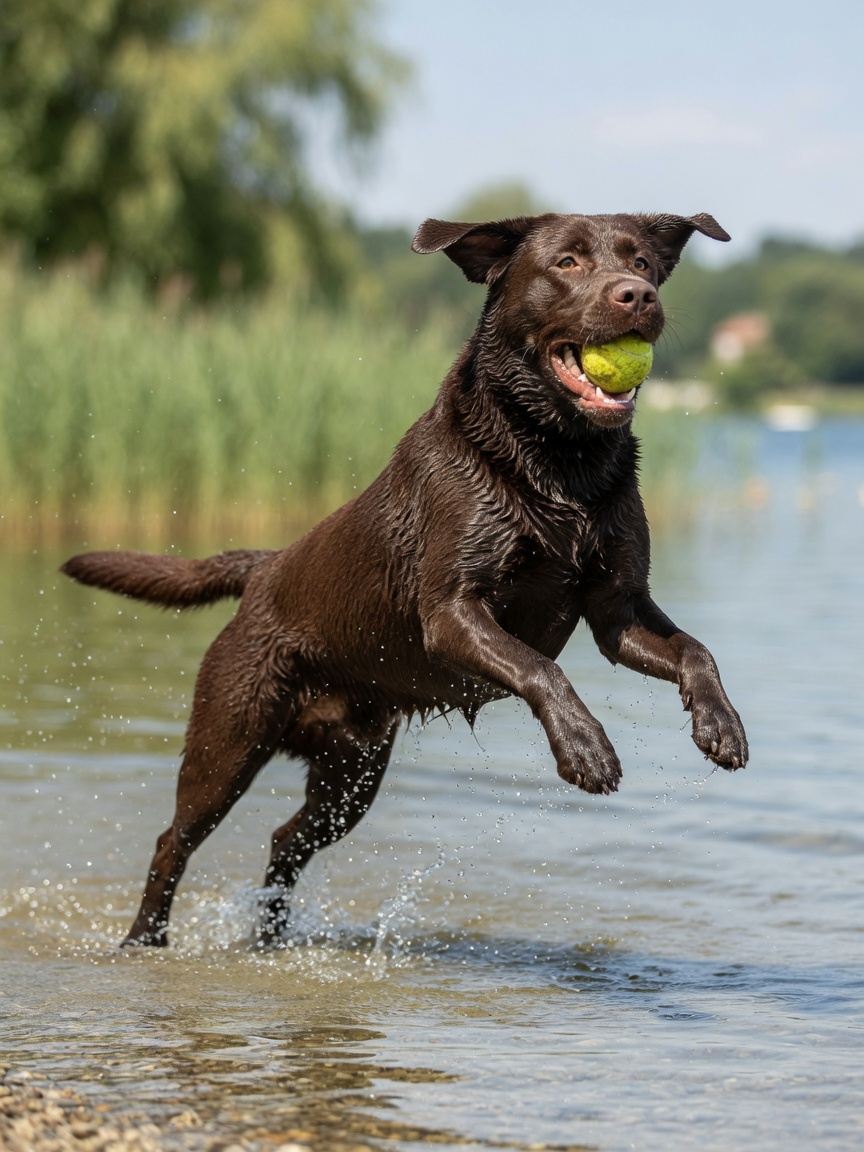
Labradors are high-energy dogs that require substantial daily exercise. Adult dogs need at least 60–80 minutes of vigorous activity each day, split across two or more sessions. They excel at swimming, fetching, running alongside cyclists, and participating in dog sports such as agility and obedience. Puppies should follow the widely accepted guideline of five minutes of structured exercise per month of age, twice daily, to protect developing joints. Mental stimulation through training sessions, puzzle feeders, and nose work is equally important.
Common Health Problems

As with any popular breed, the Labrador carries a number of hereditary health concerns that prospective owners must understand before purchasing or adopting.
- Hip and Elbow Dysplasia: Abnormal joint development that leads to arthritis and pain. Responsible breeders across the EU screen breeding stock using the BVA/KC Hip Dysplasia Scheme or equivalent national schemes. Always request scores before buying a puppy.
- Obesity: Labradors are notoriously food-motivated and prone to weight gain. A mutation in the POMC gene, found in a significant proportion of the breed, impairs the feeling of fullness. Obesity worsens joint problems and reduces lifespan. Careful portion control and limited treats are non-negotiable.
- Progressive Retinal Atrophy (PRA): A group of inherited eye conditions that cause progressive vision loss and eventual blindness. DNA testing can identify carriers; reputable breeders will provide clear results.
- Exercise-Induced Collapse (EIC): A condition triggered by intense exercise, causing the dog's hind legs to give way. Affected dogs may collapse and appear disoriented for 5–25 minutes before recovering. A DNA test identifies carriers and affected dogs.
- Centronuclear Myopathy (CNM): A muscle disease causing weakness and exercise intolerance from a young age. DNA testing is available and responsible breeders test for this condition.
Lifespan is typically 10–12 years, though well-maintained Labradors reaching 13–14 years are not unusual.
Grooming Requirements
The Labrador's double coat — a soft, dense undercoat beneath a short, hard-wearing topcoat — is relatively straightforward to maintain. Weekly brushing is sufficient for most of the year, increasing to several times per week during moulting seasons in spring and autumn, when shedding is considerable. The coat is water-resistant and repels mud reasonably well, though Labradors' love of water and muddy puddles means bathing is often required. Ears should be checked and cleaned regularly, as the drop-ear shape can trap moisture and lead to infections. Nails require trimming every 4–6 weeks.
For quality brushes, de-shedding tools, and shampoos suited to double-coated breeds, Zooplus offers an extensive range at competitive prices across Europe.
Training and Suitability
The Labrador is widely considered one of the easiest dog breeds to train. It responds enthusiastically to positive reinforcement and food rewards, learns commands quickly, and retains them reliably. Early socialisation and basic obedience classes are recommended for all puppies. Labradors can develop pulling habits on the lead if not trained consistently from an early age.
This breed is well suited to first-time dog owners, families with young children, multi-pet households, and active individuals of all ages. It adapts to urban and rural environments provided its exercise needs are met. The Labrador Retriever is, by almost every measure, one of the most well-rounded dogs available in Europe today.