

Is My Cat Overweight? Body Condition Score & Feeding Guide
How Common Is Feline Obesity?
Feline obesity has reached epidemic proportions in the developed world. Surveys consistently show that 50–60% of domestic cats are overweight or obese. Indoor-only cats, neutered cats, and cats fed exclusively dry kibble are at highest risk. Despite being surrounded by overweight cats, many owners rate their cat's weight as "normal" — a phenomenon researchers call normalization bias or "fat blindness."
The consequences are serious and well-documented: obese cats have significantly higher rates of type 2 diabetes mellitus, osteoarthritis, urinary tract disease, hepatic lipidosis, respiratory compromise, and reduced lifespan. The good news is that obesity is one of the most preventable chronic diseases in companion cats — and with the right approach, most cats can safely return to a healthy weight.
Understanding the Feline Body Condition Score (BCS)
The Body Condition Score (BCS) is a standardized 1–9 scale used to objectively assess a cat's body fat level through physical examination. A score of 4–5 is ideal. Here is what each range means:
- BCS 1–3 (Underweight): Ribs, spine, and pelvic bones are visible from a distance. No palpable fat. Muscle mass may be depleted. Urgent veterinary attention required.
- BCS 4–5 (Ideal): Ribs are easily felt with a thin fat covering — like feeling the back of your hand through a layer of fabric. A clear waist is visible when viewed from above. Slight abdominal tuck visible from the side. A small fat pad is present on the abdomen but does not hang.
- BCS 6–7 (Overweight): Ribs are difficult to feel under a noticeable fat layer. The waist is barely visible or absent from above. The abdominal fat pad is prominent. The cat appears rounded from above.
- BCS 8–9 (Obese): Ribs cannot be felt at all. Heavy fat deposits on the face, limbs, and spine. A large, pendulous abdominal fat pad swings visibly when the cat walks. The neck appears thick. The cat may have difficulty grooming its hindquarters.
How to Assess Your Cat at Home
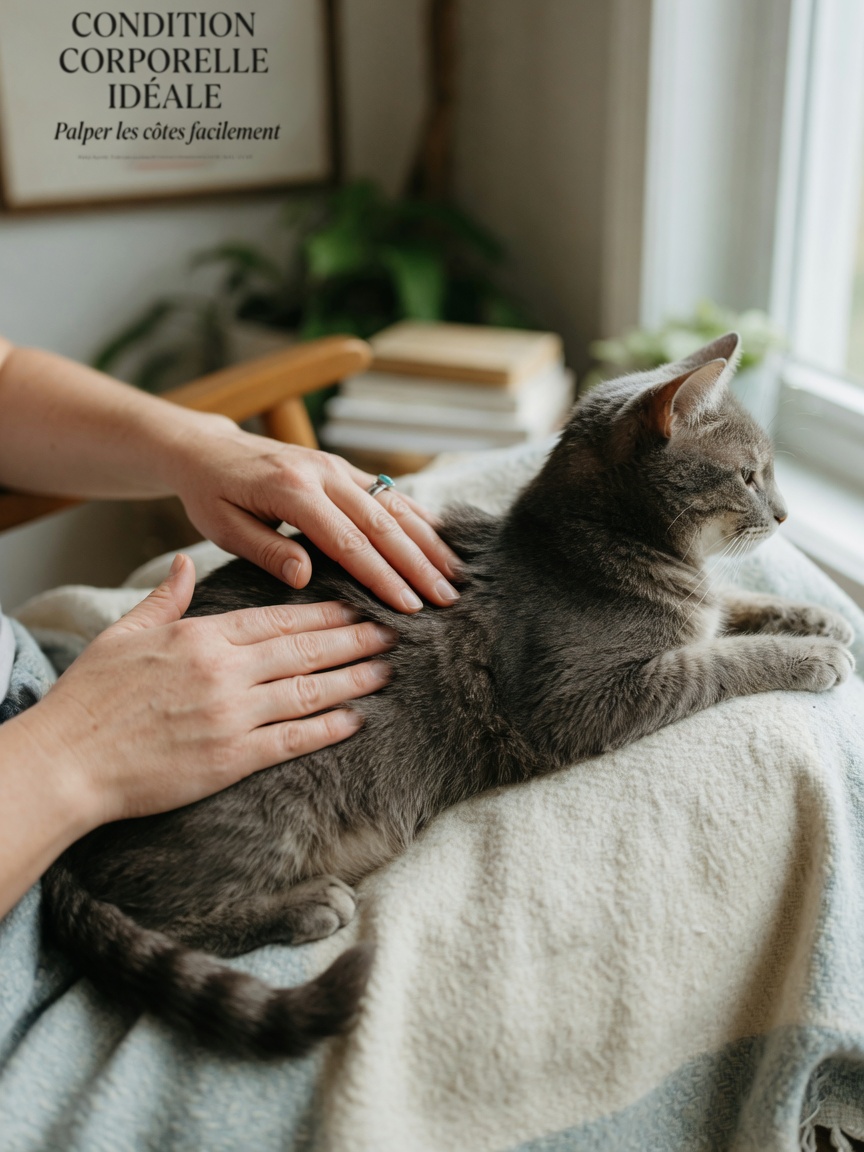
The Rib Feel Test
Place both hands around your cat's chest and run your fingertips along the rib cage with gentle pressure. In an ideal-weight cat, you should feel each rib clearly with minimal pressure — similar to running your fingers over a wooden washboard. If you must press firmly to detect the ribs, your cat is overweight. If ribs protrude sharply without any palpation, your cat may be underweight.
The Overhead Waist Check
Stand above your cat and look straight down. Behind the rib cage, you should see a clear narrowing — the waist — before the hips widen again. In an overweight cat, this curve disappears entirely; the body looks like a rectangle or even widens behind the ribs.
The Abdominal Fat Pad
Cats normally have a small "primordial pouch" — a natural loose fold of skin and fat on the lower abdomen. This is normal anatomy and is not an obesity indicator on its own. What matters is the quantity and firmness of the fat within it. In obese cats, this pouch becomes large, firm, and pendulous, visibly swaying when the cat moves.
Ideal Weight by Frame Size
There is no single ideal weight for "a cat." A petite female Siamese and a large-framed male Maine Coon will have very different healthy weights. As a rough general guideline:
- Small-framed cats (e.g., Siamese, Devon Rex): Ideal weight typically 2.7–3.6 kg (6–8 lbs)
- Medium-framed cats (domestic shorthair or longhair, most breeds): Ideal weight typically 3.6–5.0 kg (8–11 lbs)
- Large-framed cats (e.g., Maine Coon, Norwegian Forest Cat, Ragdoll): Ideal weight typically 5.0–7.5 kg (11–16 lbs)
Frame size matters more than breed generalizations. Your veterinarian can help establish an individual target weight based on BCS, bone structure, and breed history.
Health Risks of Feline Obesity
- Type 2 diabetes mellitus: Obese cats are 4 times more likely to develop diabetes. Adipose tissue impairs insulin sensitivity, eventually overwhelming the pancreas's ability to compensate. The good news: weight loss can bring some diabetic cats into remission.
- Osteoarthritis: Excess weight accelerates joint cartilage breakdown. Obese cats show measurable changes in gait and significantly reduced mobility even before clinical lameness becomes apparent.
- Hepatic lipidosis: If an obese cat stops eating — due to stress, illness, or sudden dietary change — fat is rapidly mobilized from peripheral stores and overwhelms the liver's processing capacity, causing fatty infiltration and liver failure. This is a life-threatening emergency unique to cats.
- Lower urinary tract disease: Overweight cats are at higher risk of feline idiopathic cystitis (FIC), urolithiasis, and urethral obstruction, partly due to reduced water intake (common in dry-food-fed cats) and reduced activity.
- Reduced grooming and skin disease: Obese cats cannot reach their hindquarters to groom effectively, leading to matting, fecal soiling, and skin fold infections.
Safe Weight Loss: The Go-Slow Principle
Safe weight loss in cats is significantly slower than in dogs. Target a loss of no more than 0.5–1% of body weight per week. For a 7 kg cat, this means losing 35–70 grams per week — less than the weight of a standard AA battery.
Start by reducing daily calories by 15–20% from current intake, not from theoretical maintenance. Switch to measured meals rather than free-choice feeding. Add a timed feeder if necessary to enforce meal structure. Increase water intake by offering wet food, cat fountains, or broth-topped meals — better hydration supports metabolic health and urinary tract function.
Weigh your cat monthly on the same scale. If weight loss is faster than 1% per week, add calories back gradually. If there is no progress after 6–8 weeks, consult your veterinarian to reassess the calorie calculation and rule out metabolic conditions.
Browse Weight Management Cat Food at Zooplus →
Key Takeaways
- 50–60% of domestic cats are overweight or obese — indoor, neutered, and dry-food-fed cats are at highest risk.
- Use the 1–9 BCS scale: ribs should be easily felt, a waist visible from above, and abdominal tuck visible from the side at ideal weight (BCS 4–5).
- Ideal weight varies by frame size — a healthy Maine Coon and a healthy Siamese will weigh very different amounts.
- Obesity causes diabetes, arthritis, lower urinary tract disease, and grooming failure in cats.
- Never crash-diet a cat — rapid weight loss causes fatal hepatic lipidosis. Target no more than 1% body weight loss per week.
- Consult your vet before starting a weight loss program, especially if your cat has any concurrent health issues.
References
Courcier EA, et al. (2012). Prevalence and risk factors for feline obesity in a first opinion practice in Glasgow, Scotland. Journal of Feline Medicine and Surgery. PubMed
Verbrugghe A & Bakke AM. (2012). Feline adipose tissue and adipokines in health and disease. Veterinary Sciences. PubMed