
Why Feeding Guidelines on Packaging Are Just a Starting Point
The feeding guide printed on a bag of kibble is a broad recommendation designed for an average dog of a given weight. The problem is that no dog is truly average. Age, breed, activity level, neuter status, metabolic rate, and current body condition all influence how many calories a dog actually needs. Using the back-of-the-bag guideline without adjustment is one of the leading causes of gradual, unintentional weight gain in dogs.
Calculating correct portions properly requires a small amount of maths, but it is straightforward once you understand the underlying logic. The starting point is understanding your dog's caloric needs — and from there, working out how many grams of their specific food provides that amount.
Step One: Determine Your Dog's Resting Energy Requirement
The Resting Energy Requirement (RER) is the number of calories your dog needs simply to exist — to breathe, maintain body temperature, and keep organs functioning — at rest. It does not account for any activity. The formula used by veterinary nutritionists is:
RER (kcal/day) = 70 x (body weight in kg)^0.75
So for a 20 kg dog: 70 x (20)^0.75. The 0.75 power of 20 is approximately 9.46, so the RER would be roughly 662 kcal per day. This is the baseline before any lifestyle factors are added.
If maths is not your strong point, many veterinary websites offer RER calculators where you simply enter the weight and get the result instantly.
Step Two: Apply a Lifestyle Multiplier
The RER is then multiplied by a factor that reflects your dog's actual life circumstances. These multipliers are based on peer-reviewed research and widely used by veterinary professionals:
- Neutered adult dog, ideal weight: RER x 1.6
- Intact adult dog, ideal weight: RER x 1.8
- Overweight dog needing to lose weight: RER x 1.0 to 1.2 (use the dog's target weight, not current weight)
- Underweight dog needing to gain weight: RER x 1.2 to 1.8
- Lightly active or working dog: RER x 2.0 to 3.0
- Highly active or athletic dog: RER x 3.0 to 6.0
- Senior dog (reduced activity): RER x 1.4 to 1.6
- Puppy under four months: RER x 3.0
- Puppy four months to adult: RER x 2.0
Using the 20 kg neutered adult dog from above: 662 x 1.6 = approximately 1,059 kcal per day. This is the dog's daily calorie target.
Step Three: Calculate the Amount to Feed
Now you need to know how many calories are in your specific food. This information is usually listed on the packaging as kcal per 100 g (for dry food) or kcal per can (for wet food). If it is not clearly printed, check the manufacturer's website or contact them directly — reputable brands will always provide this information.
Let us say the kibble contains 350 kcal per 100 g. Divide your dog's daily calorie target by the caloric density of the food:
1,059 ÷ 350 x 100 = approximately 303 g of kibble per day.
Split this across however many meals you feed — typically two for adult dogs — to get your per-meal portion.
The Important Role of Treats in the Calorie Budget
Treats are frequently overlooked when owners calculate daily food amounts, yet they can represent a significant proportion of total calorie intake. As a general guideline, treats should account for no more than ten per cent of your dog's daily calories. In the example above, that means no more than roughly 106 kcal from treats per day — which can be reached surprisingly quickly with commercial treats.
When you give a treat, subtract the equivalent calories from the daily kibble portion. This sounds tedious but quickly becomes second nature, and it is the single most common oversight in weight management plans that fail to produce results.
Why Neutered Dogs Need Fewer Calories
Neutering reduces testosterone and oestrogen, both of which play roles in metabolic regulation and muscle maintenance. Research consistently shows that neutered dogs have metabolic rates approximately 20 to 30 per cent lower than intact dogs of the same size and activity level. They also tend to be less active and may experience increased appetite. This is why the multiplier for neutered dogs is lower, and why weight gain so commonly follows neutering when owners do not adjust feeding amounts accordingly.
Weighing Food Rather Than Scooping
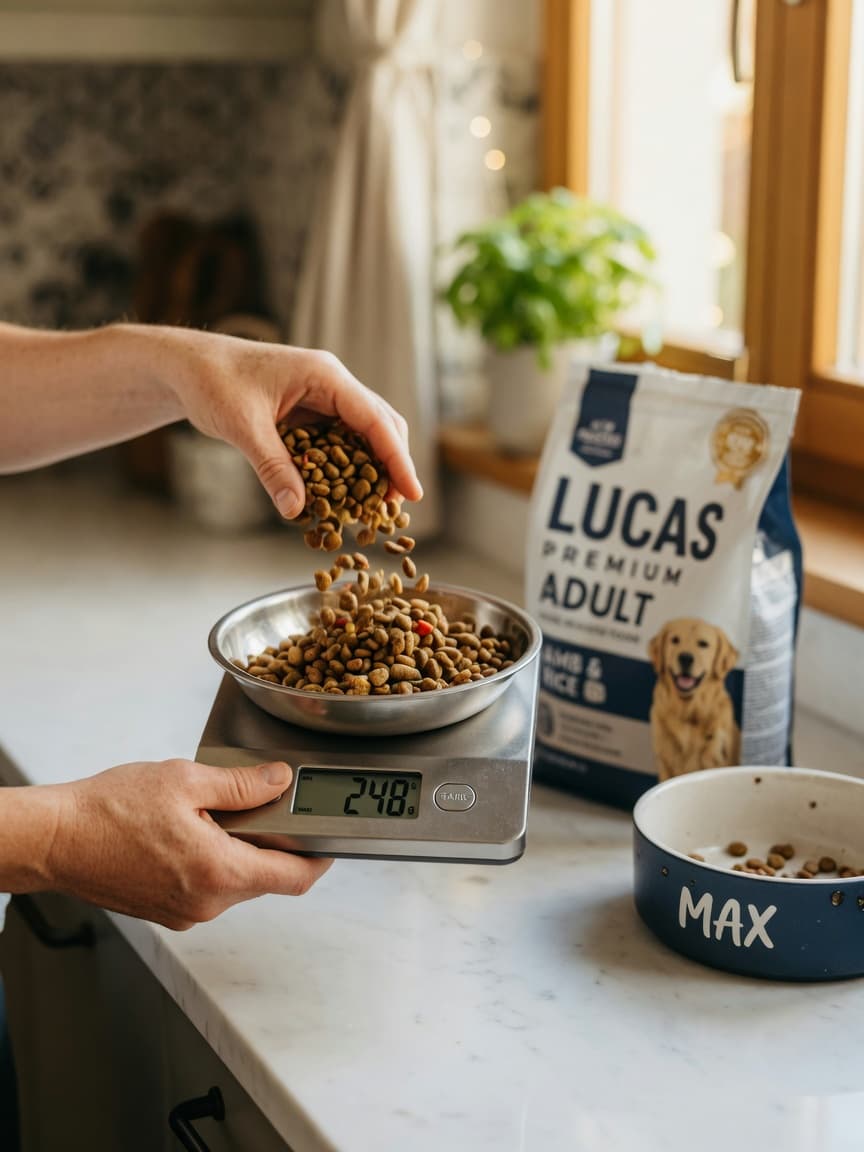
Once you have calculated your dog's daily food weight, measure it accurately. Scooping with a cup or mug introduces enormous variability — studies have shown that owners using cup measures can overfeed by 20 to 80 per cent depending on the food type and how tightly it is packed. A simple digital kitchen scale costing very little is one of the most effective tools in any dog's weight management plan.
Measure the full day's portion in the morning and keep it in a container. This gives you a clear visual of exactly how much your dog receives across all meals and treats throughout the day.
Reassessing Regularly
Calorie requirements change over time. A puppy's needs shift dramatically as they grow. An elderly dog that has slowed down needs fewer calories than the same dog at peak activity. A dog recovering from illness or surgery may need temporary adjustments. Reassess your dog's body condition score every four to six weeks and recalculate if their BCS moves up or down from the ideal.
The goal is not to obsess over grams and calories indefinitely — it is to understand the baseline so you can make informed adjustments. Many owners find that once they have gone through this calculation once and established a routine, maintaining an appropriate weight becomes far less complicated than they expected.