
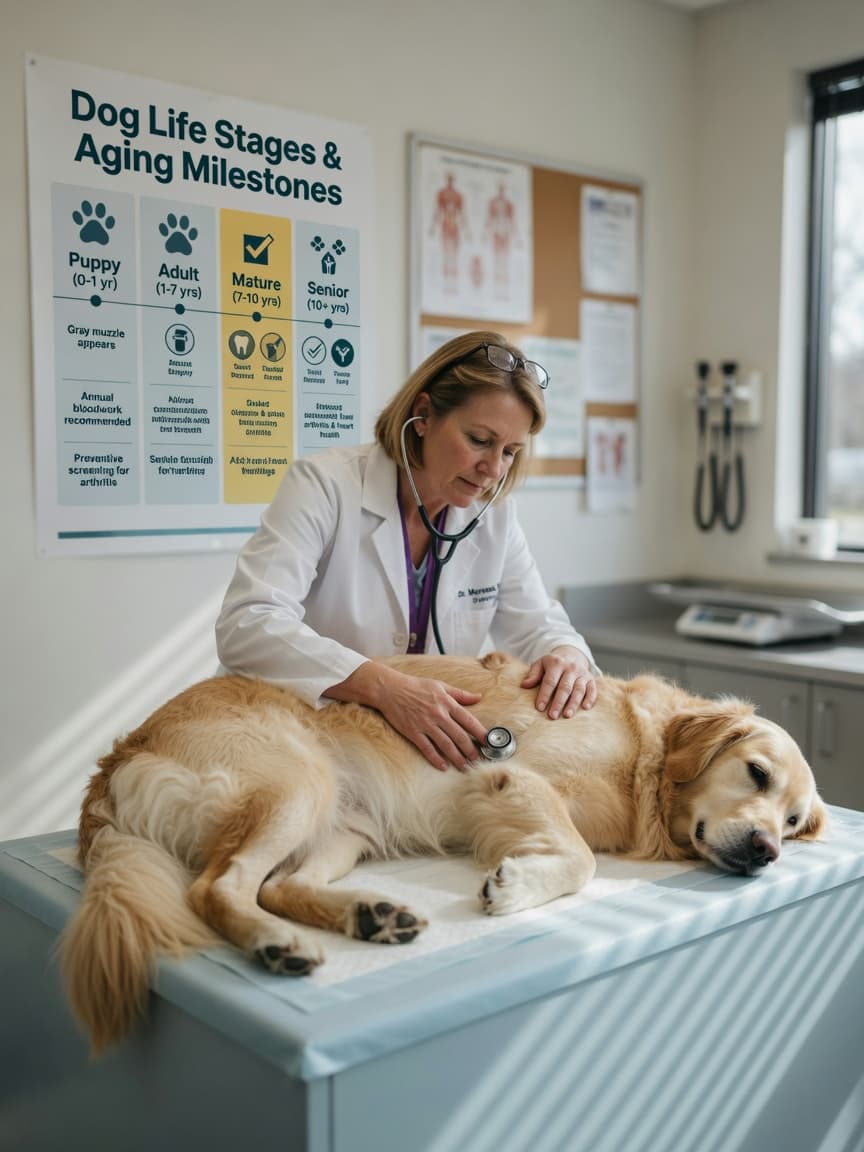
The Rule That Was Never Really a Rule
Almost every dog owner has used it: multiply your dog's age by seven to get their "human age." It is tidy, memorable, and widely repeated. It is also a dramatic oversimplification that can lead owners to misjudge where their dog actually sits in its life cycle. A one-year-old Labrador is not equivalent to a seven-year-old child — biologically, it is closer to a young adult human in their mid-thirties.
Understanding how dogs truly age matters for practical reasons: vaccination schedules, dietary transitions, exercise limits, and cancer screening all depend on an accurate picture of your dog's biological stage. The science here has moved on considerably, and it is worth knowing what it actually says.
Where the 7:1 Ratio Came From
The origin of the seven-year rule is murky. One popular explanation is that it was derived by dividing average human life expectancy (around 70 years) by average dog life expectancy (around 10 years) — a crude statistical shortcut that was never grounded in biology. Another theory suggests it emerged as a public health message to encourage more frequent veterinary visits.
Whatever its origin, the ratio has persisted largely through repetition rather than evidence. It treats dog ageing as a linear process, which it is not.
The Real Biology of Dog Ageing
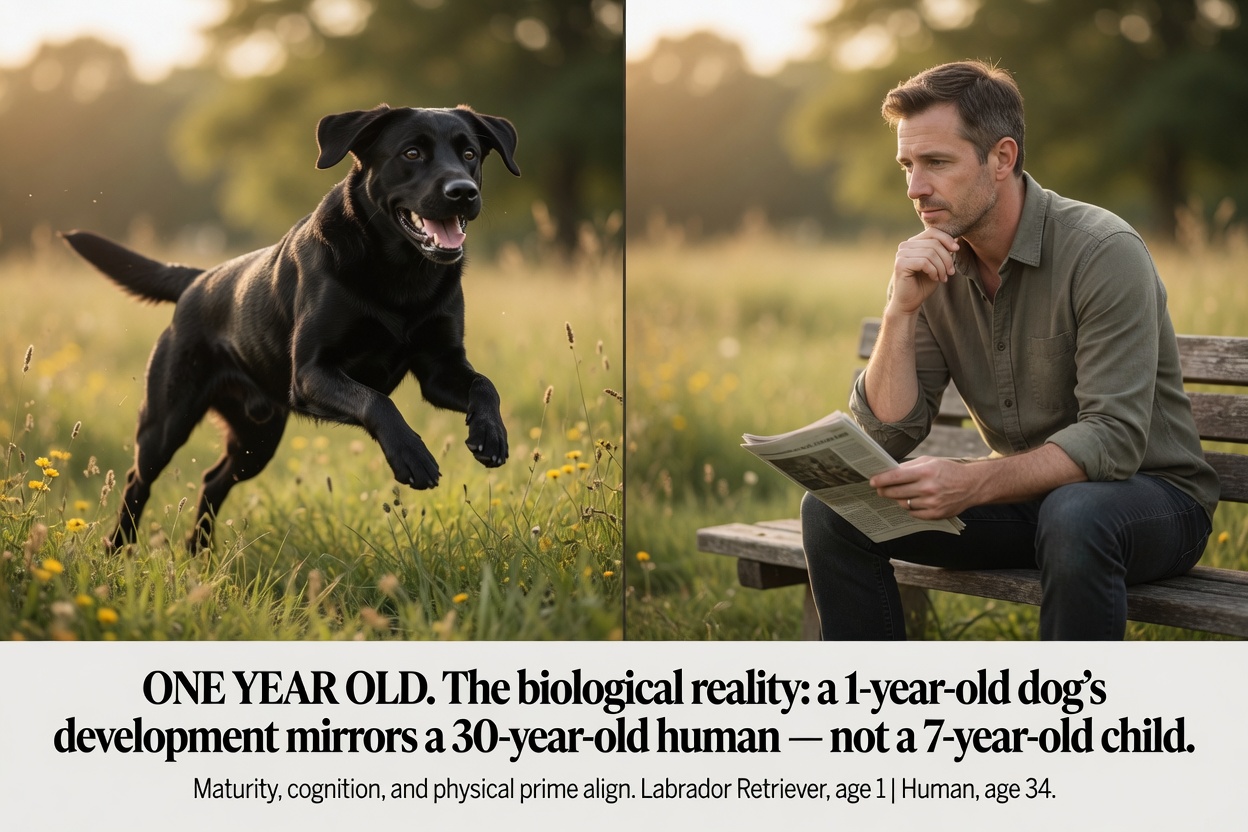
Dogs age rapidly in early life and then slow down. In the first year alone, a dog reaches sexual maturity, full skeletal development, and immune system competence — milestones that take humans 12 to 18 years to reach. After that initial sprint, the pace of biological ageing becomes more gradual and more variable.
A 2020 study published in Cell Systems examined DNA methylation patterns — chemical changes to DNA that act as a reliable molecular clock — in dogs and humans. The researchers found that a one-year-old dog corresponds to roughly a 30-year-old human in epigenetic terms, while a four-year-old dog aligns with a human in their early fifties. The relationship is logarithmic, not linear.
The formula they proposed: human age = 16 × ln(dog age) + 31. It is not intended as a kitchen-table calculation, but it illustrates the non-linear reality far more accurately than multiplying by seven.
Why Breed and Size Change Everything
Small Breeds Age More Slowly
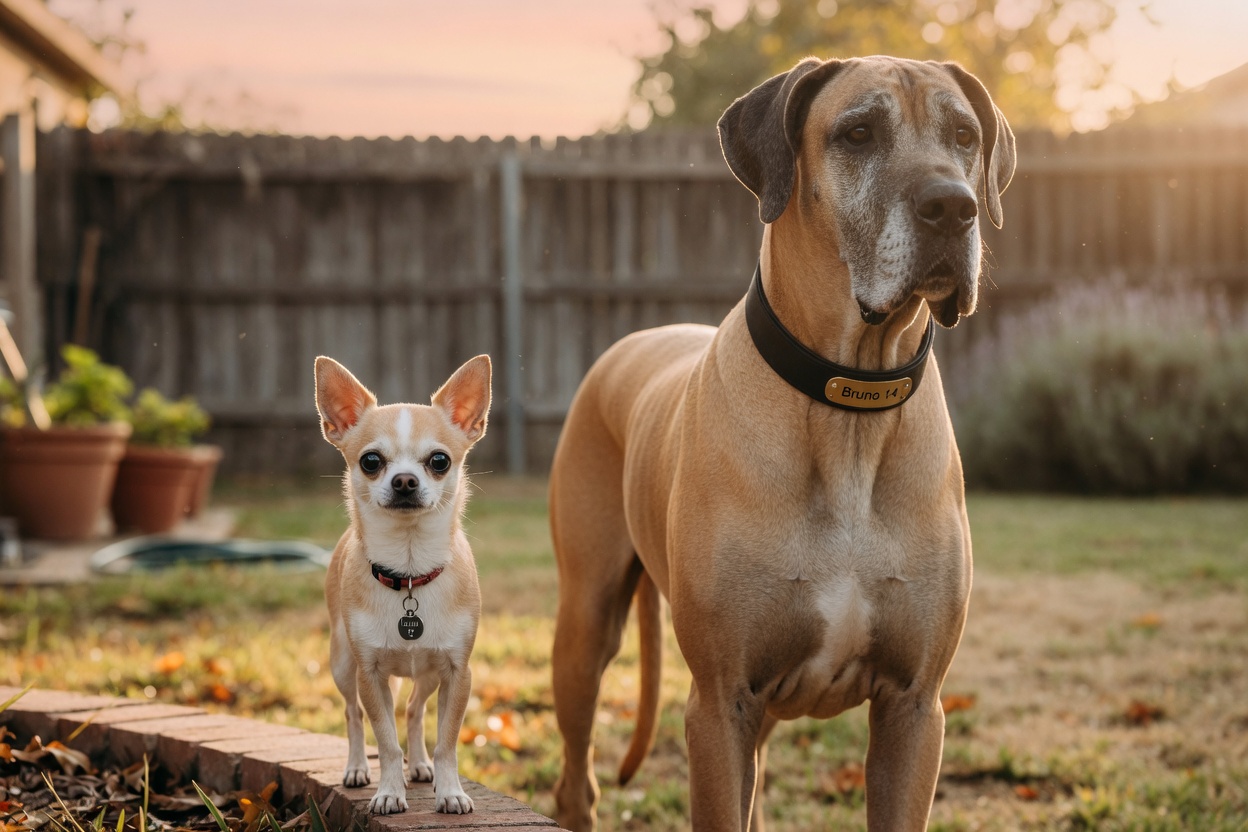
A Chihuahua and a Great Dane born on the same day are on entirely different ageing trajectories. Small breeds tend to live 12 to 16 years or more. Their biological development is similar in the early years, but they age more slowly in middle and later life. A ten-year-old Jack Russell is not the same as a ten-year-old Irish Wolfhound.
Large Breeds Age Faster
Giant breeds typically live only 7 to 10 years. Researchers believe this is partly because larger bodies require more rapid cellular division during growth, which may accelerate the accumulation of DNA damage over time. Great Danes, Bernese Mountain Dogs, and similar breeds are considered senior as early as five or six years of age, while a Border Collie of the same age may still be in its prime.
What This Means for Veterinary Care
Size-adjusted ageing is not merely academic. Larger breeds benefit from earlier screening for orthopaedic conditions, cardiac issues, and certain cancers. Smaller breeds may remain on adult nutritional formulas for longer before transitioning to senior diets. Always ask your vet about breed-appropriate health milestones rather than relying on a generic age conversion.
Life Stage Frameworks: A More Useful Lens
Rather than a single number, veterinary organisations such as the American Animal Hospital Association use life stage classifications: puppy, junior, adult, mature, senior, and geriatric. These categories are adjusted for body size and capture biological reality far better than any multiplier.
For most medium-sized dogs, the framework looks roughly like this:
- Puppy: birth to 6–9 months
- Junior: 6–9 months to 2 years
- Adult: 2 to 7 years
- Mature: 7 to 10 years
- Senior: 10 to 12 years
- Geriatric: 12 years and above
These thresholds shift considerably for giant breeds, where senior status may begin at five, and for small breeds, where it may not apply until nine or ten.
Practical Takeaways for Dog Owners
Understanding your dog's true biological age has real consequences for day-to-day care. Here is what the science suggests:
- Do not delay preventive screenings. Dogs aged 7 or above should have bloodwork and urinalysis at least annually, regardless of how energetic they appear.
- Transition diets thoughtfully. Senior formulas are typically lower in calories and adjusted for kidney and joint support. The right time to switch depends on your dog's breed and size, not just a birthday.
- Adjust exercise expectations in both directions. Young dogs require more vigorous activity than the seven-year rule might suggest; older large-breed dogs may need gentler exercise sooner than owners expect.
- Know your breed's specific risks. Certain breeds carry elevated risks for heart disease, cancer, or joint problems at particular life stages. Your vet can advise on targeted screening.
- Consult a veterinarian about any significant health decisions. Age conversions are interesting — what matters most is a thorough physical examination and health history reviewed by a professional.
The seven-year rule is a relic of convenience, not science. Replacing it with a more accurate understanding of canine ageing means making better decisions for your dog at every stage of life.