
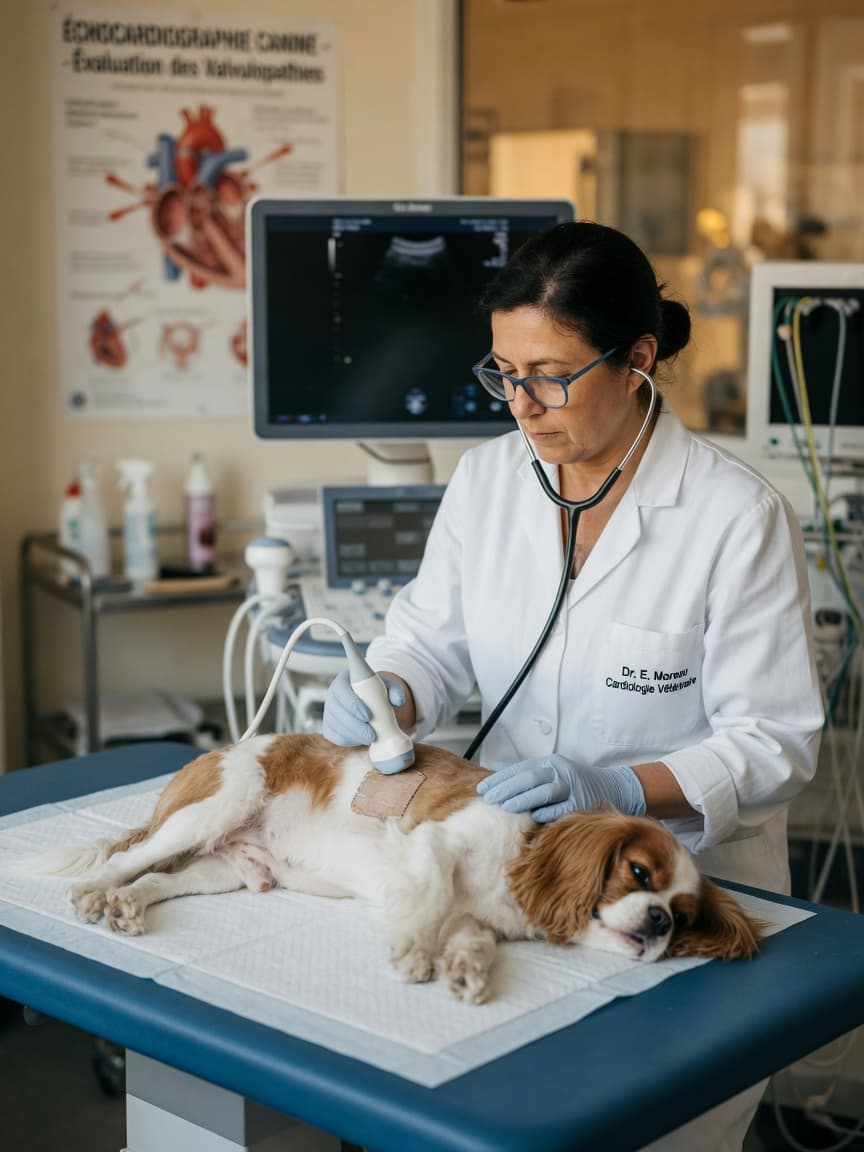
Understanding Heart Murmurs in Dogs
A heart murmur is not a diagnosis in itself — it is a sound. Specifically, it is an abnormal turbulence of blood flow through the heart that a veterinarian detects using a stethoscope. That sound can mean many different things depending on its character, location, and the context in which it is found. Some murmurs are entirely benign and never progress to clinical disease. Others signal serious underlying cardiac pathology that warrants ongoing monitoring and treatment.
Understanding what a murmur is, how it is graded, and what the various causes mean for your dog's future is the first step in navigating what can be a confusing and, understandably, worrying diagnosis for many owners.
The Grading System Explained
Veterinarians use a grading scale from one to six to describe the intensity of a heart murmur. This system, originally developed for use in human medicine, gives a standardised shorthand that helps track changes over time and communicate severity between clinicians.
- Grade I — barely audible, detected only in a quiet room with careful auscultation; often considered an incidental finding
- Grade II — soft but consistently heard on every examination
- Grade III — moderate intensity, easily audible; this is often the threshold at which further investigation begins to be considered
- Grade IV — loud murmur, easily heard but without a palpable vibration on the chest wall
- Grade V — loud with a palpable thrill (a vibration felt by placing a hand on the chest); significant turbulence
- Grade VI — the most severe; audible even when the stethoscope is barely touching the chest
It is important to note that grade alone does not determine prognosis. A grade III murmur may be associated with significant structural disease in one dog and minimal change in another. Grade must always be interpreted alongside echocardiographic findings.
Common Causes of Heart Murmurs

Mitral Valve Disease
By far the most common cause of heart murmurs in dogs, particularly small breeds, is myxomatous mitral valve disease — often abbreviated as MMVD or MVD. The mitral valve, which sits between the left atrium and left ventricle, degenerates over time, allowing blood to leak backwards (regurgitate) with each heartbeat. This turbulent backward flow is what creates the characteristic murmur, typically heard loudest over the left side of the chest near the heart apex.
Cavalier King Charles Spaniels are disproportionately affected, with some studies indicating that nearly all individuals will develop MVD to some degree by the age of ten. Dachshunds, Miniature Schnauzers, and Chihuahuas are also commonly affected small breeds.
Aortic Stenosis
Aortic stenosis is a narrowing at or near the aortic valve, creating resistance to outflow from the left ventricle. It produces a murmur typically heard loudest over the left heart base and is more common in Golden Retrievers, Boxers, Newfoundlands, and Rottweilers. Severity ranges from mild, requiring only monitoring, to severe, which can carry risk of sudden death and requires specialist management.
Pulmonic Stenosis
Similar in principle to aortic stenosis but affecting the right side of the heart, pulmonic stenosis causes a murmur over the right or left heart base. Bulldogs, Boxers, and Mastiffs are among the most commonly affected breeds. Balloon valvuloplasty — a minimally invasive procedure — can be curative in many cases of severe pulmonic stenosis.
Innocent and Physiological Murmurs
Young puppies between roughly four and sixteen weeks of age commonly have what are called innocent or flow murmurs. These arise from the relatively high cardiac output and thin chest walls of puppies rather than any structural abnormality, and the majority resolve spontaneously by the time the puppy reaches four to five months of age. Anaemia and fever can also produce transient physiological murmurs in adult dogs that resolve when the underlying cause is addressed.
What Happens After a Murmur Is Detected?
When a murmur is first detected, the next step depends on the grade, breed, age, and whether any symptoms are present. For a grade I or II murmur in a small breed middle-aged dog, a veterinarian may recommend monitoring at regular intervals. For a grade III or above, or when the murmur is detected in a young dog or a breed predisposed to specific structural disease, referral to a veterinary cardiologist for echocardiography is generally recommended.
Echocardiography is the only way to definitively identify the structural cause and extent of the disease, and it provides objective measurements — such as left atrial to aortic root ratio and left ventricular dimensions — that guide treatment decisions far more accurately than murmur grade alone.
Long-Term Outlook and Monitoring

For dogs with MVD, the 2019 ACVIM Consensus Guidelines on MMVD provide a well-established staging framework. Dogs are classified from Stage A (predisposed breeds with no murmur yet) through Stage B1 and B2 (murmur present, with varying degrees of cardiac enlargement), to Stages C and D (heart failure present, with or without response to standard therapy).
The landmark EPIC trial demonstrated that dogs in Stage B2 — those with a murmur and documented cardiac enlargement — benefit from starting pimobendan before heart failure develops, delaying onset by an average of fifteen months. This has changed clinical practice significantly and makes accurate staging via echocardiography essential rather than optional.
For many dogs, particularly small breeds with slowly progressive MVD, a murmur may be present for years before any symptoms develop. Annual echocardiographic monitoring, home respiratory rate tracking, and owner education about early warning signs form the backbone of long-term management.
The key takeaway for any dog owner is that a murmur diagnosis is not an immediate emergency, but it does require a structured response. Working with a veterinary cardiologist to understand exactly what is causing the murmur and how far it has progressed gives you and your dog the best possible foundation for managing whatever comes next.