
What Is Elbow Dysplasia?
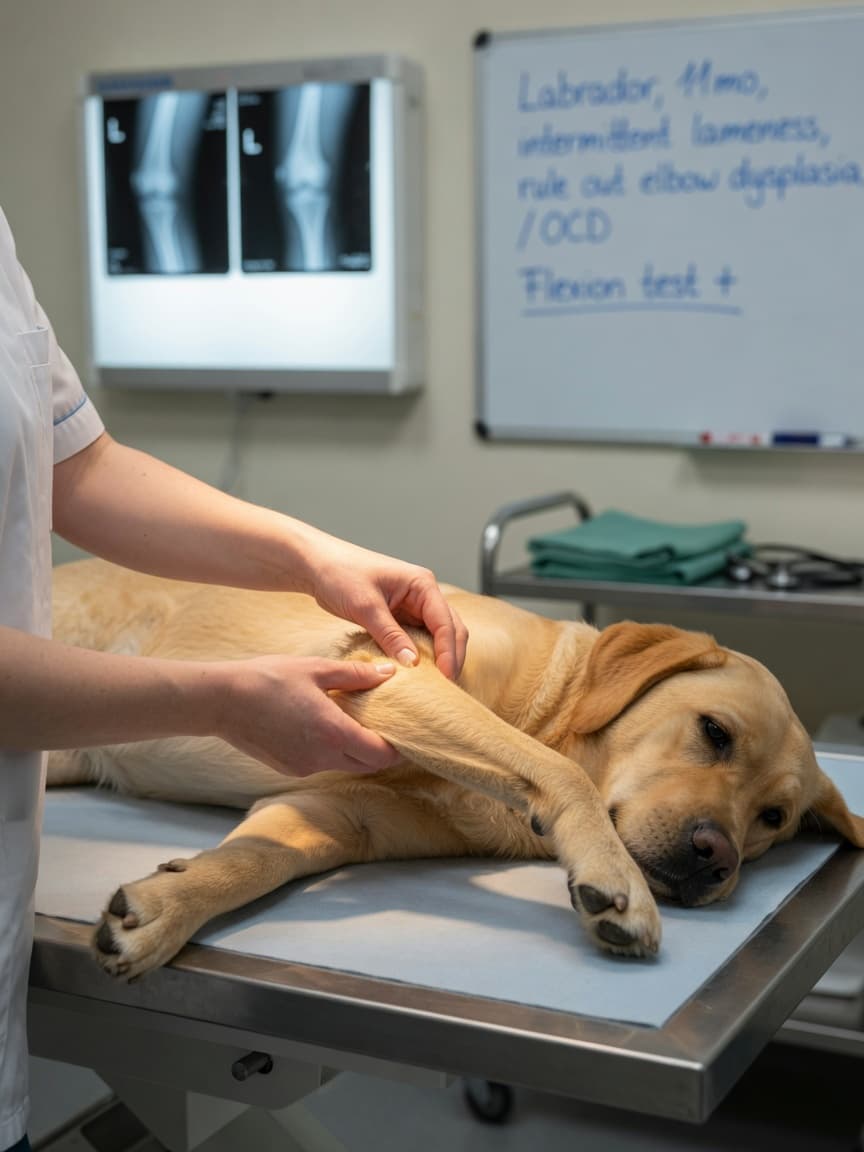
Elbow dysplasia is not a single condition but an umbrella term for a group of developmental abnormalities affecting the elbow joint. These conditions arise during the period of rapid skeletal growth in puppyhood, and all result in abnormal joint mechanics that lead to pain, lameness, and progressive osteoarthritis if untreated. The elbow is a complex joint involving three bones — the humerus, radius, and ulna — and it requires precise anatomical congruence to function correctly. When development goes wrong, even small incongruences create significant mechanical stress on the joint surface.
The Four Conditions Within Elbow Dysplasia
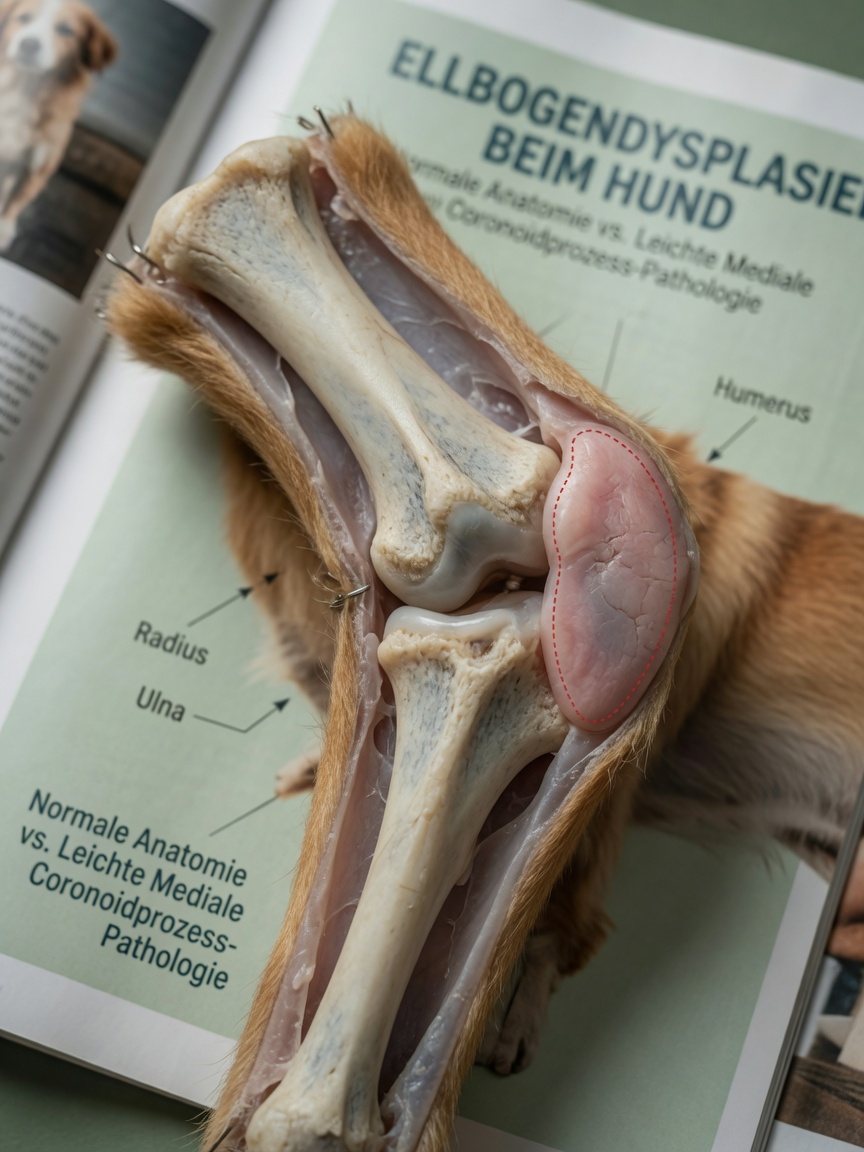
Fragmented Coronoid Process (FCP)
The medial coronoid process is a small bony projection on the inner (medial) side of the ulna that forms part of the elbow joint. In FCP, this process becomes fragmented — it may crack, partially detach, or fully separate. It is the most common elbow dysplasia condition in dogs. The fragments cause direct cartilage damage and chronic inflammation within the joint.
Osteochondrosis Dissecans (OCD)
OCD occurs when a flap of cartilage becomes abnormally thick and fails to ossify (convert to bone) normally. In the elbow, it typically affects the medial aspect of the humeral condyle. The unstable cartilage flap can detach and become a free-floating body — sometimes called a joint mouse — within the joint space, causing significant pain and inflammation.
Ununited Anconeal Process (UAP)
The anconeal process is a bony projection at the back of the elbow. In growing dogs it attaches to the ulna via a growth plate; in normal development this fuses by around five months of age. In UAP, the fusion fails and the process remains detached, causing instability and joint inflammation. UAP is particularly associated with German Shepherd Dogs.
Incongruent Elbow (IOHC)
Elbow incongruence occurs when the three bones forming the elbow joint do not fit together with the required precision. A step defect between the radius and ulna, for example, creates uneven load distribution across the joint cartilage. Incongruence is often a contributing factor in FCP and may exist as a primary condition in its own right.
Predisposed Breeds
Elbow dysplasia predominantly affects large and giant breeds with rapid growth rates. The most commonly affected breeds include:
- Labrador Retriever
- Golden Retriever
- Rottweiler
- German Shepherd Dog
- Bernese Mountain Dog
- Chow Chow
- Newfoundland
As with hip dysplasia, the condition is multifactorial — genetics plays the primary role, but rapid growth, overnutrition during puppyhood, and excessive exercise during skeletal development can worsen the severity of the condition in predisposed individuals.
Signs and Symptoms
Elbow dysplasia typically presents in young dogs, often between four and ten months of age, though milder cases may not become clinically apparent until adulthood when osteoarthritis becomes advanced. Key signs include:
- Forelimb lameness — which may be subtle and intermittent at first, or pronounced and persistent
- Worsening of lameness after exercise or following prolonged rest
- Reluctance to extend or fully flex the elbow joint
- Swelling over the inner aspect of the elbow joint
- Pain on manipulation of the elbow, particularly on extension
- Outward rotation of the paw (external rotation of the limb) is sometimes observed
- Bilateral disease is common — both elbows are often affected to varying degrees
Diagnosis
Radiography
X-rays are the first diagnostic step and are essential for the BVA/KC grading scheme. However, radiography has limitations in detecting early or subtle FCP lesions, and the absence of radiographic changes does not rule out significant pathology. Signs of joint effusion (fluid accumulation) and early osteophyte formation (bone spurs — a sign of osteoarthritis) may be visible on plain radiographs.
Computed Tomography (CT)
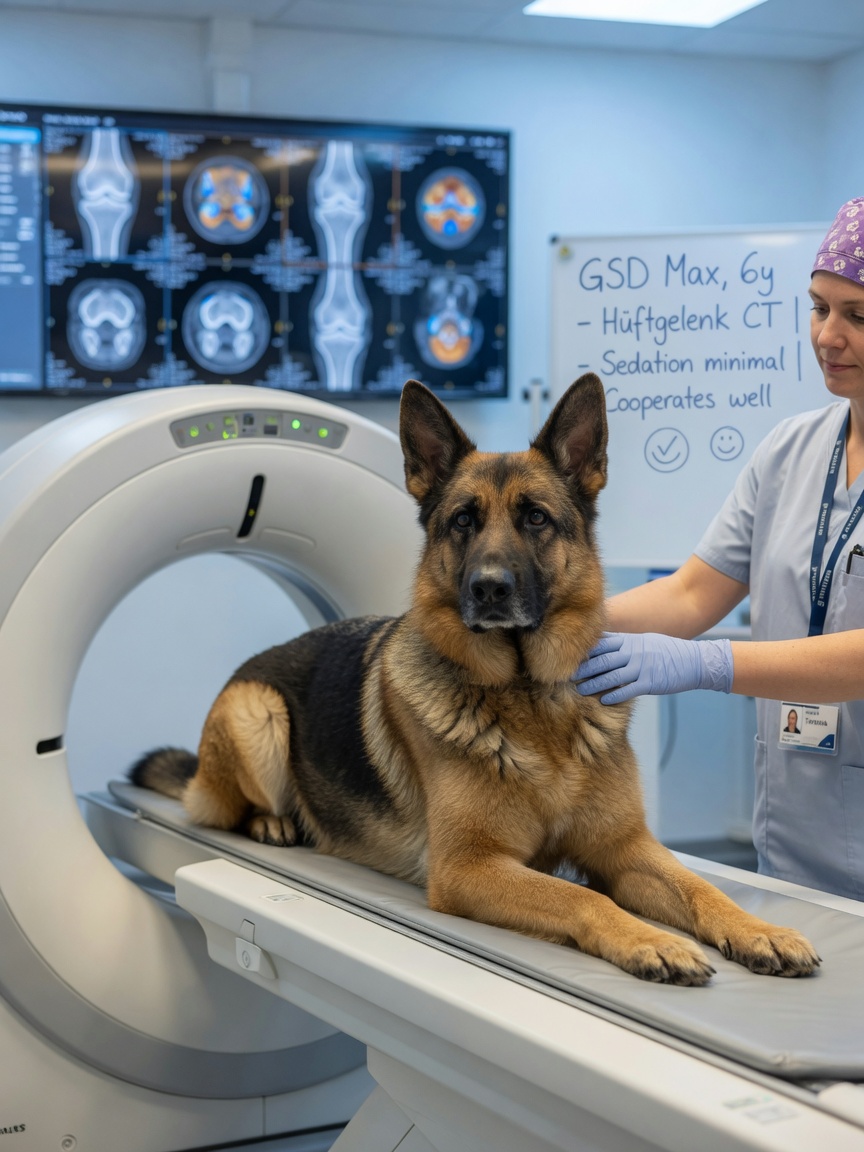
CT scanning is considered the gold standard for diagnosing elbow dysplasia, particularly for FCP. It provides cross-sectional imaging of the joint with far greater detail than plain radiography, allowing visualisation of fragmentation, incongruence, and cartilage changes that would be invisible on standard X-rays. CT is now widely recommended prior to surgical planning.
Arthroscopy
Arthroscopy — keyhole surgery of the joint — serves both a diagnostic and therapeutic role. It allows direct visualisation of the joint cartilage and detection of lesions not visible on imaging. Fragments can be removed during the same procedure. Arthroscopy is generally considered the most accurate diagnostic method for intra-articular lesions.
Elbow Grading Schemes
BVA/KC Elbow Grading Scheme
In the United Kingdom, the British Veterinary Association and Kennel Club operate an Elbow Grading scheme for breeding dogs. Radiographs are submitted and assessed for the presence of osteophytes and other changes. Each elbow is graded 0 to 3: Grade 0 is normal, Grade 1 is mild dysplasia, Grade 2 is moderate dysplasia, and Grade 3 is severe dysplasia. The higher of the two elbow scores is used as the dog's overall grade. Responsible breeders are advised to only breed from dogs graded 0.
FCI Elbow Grading
The FCI operates a parallel scheme used across continental Europe, with a similar 0 to 3 grading scale. The FCI scheme is widely required for breeding eligibility in predisposed breeds across EU member countries.
Treatment Options
Surgical Treatment
Arthroscopic removal of fragmented coronoid process material and OCD flaps is the most commonly performed surgical intervention. Early surgery — before significant cartilage erosion and osteoarthritis have developed — gives the best long-term prognosis. UAP may be treated by reattachment or removal of the ununited process, and incongruence may be addressed through corrective osteotomy of the ulna.
Conservative Management
Mild cases, or cases where surgery is not possible, can be managed conservatively. This includes strict weight management to minimise joint loading, controlled low-impact exercise, physiotherapy, hydrotherapy using underwater treadmill, and appropriate pain management. NSAIDs form the cornerstone of pain management in line with IVAPM multimodal analgesia guidelines.
Prognosis
Prognosis for dogs with elbow dysplasia is guarded to fair in the long term. Even with surgical intervention, osteoarthritis will continue to progress because cartilage damage that has already occurred cannot be reversed. Early diagnosis and prompt treatment offer the best chance of slowing progression and maintaining quality of life. Many dogs managed appropriately — whether surgically or conservatively — live comfortable and active lives with appropriate ongoing care.