
Dog Broken Leg: Signs, First Aid & What to Expect at the Vet
By Julia Wrenfield, Pet Wellness Researcher
A broken leg — veterinary fracture — is one of the most common traumatic injuries in dogs, particularly following road traffic accidents, falls from height, and rough play. The immediate care you provide in the first minutes can significantly affect the long-term outcome. This guide covers how to recognise a fracture, what safe first aid looks like, and what to expect from diagnosis and treatment.
Signs That Your Dog Has a Broken Leg
- Sudden, severe lameness — refusing to bear any weight on the limb
- Visible deformity — the limb appears angled, shortened, or rotated abnormally
- Swelling around the injury site, developing within minutes to hours
- Crying, yelping, or whimpering when the limb is touched or moved
- Open wound with bone visible (open/compound fracture — significantly more serious)
- Dangling or dragging of the limb
- Extreme reluctance to move
Pain responses vary significantly between dogs — some stoic breeds (Huskies, Malamutes, many sighthounds) may not vocalise despite severe injury. Absence of crying does not mean absence of a fracture.
Types of Fractures in Dogs
- Closed fracture: Bone is broken but the skin is intact. Most common type.
- Open (compound) fracture: Bone breaks through the skin. High infection risk; treat as an emergency within hours.
- Greenstick fracture: Incomplete break, more common in puppies whose bones are more flexible.
- Comminuted fracture: Bone is shattered into multiple fragments. Often requires complex surgical repair.
- Growth plate fracture: Involves the epiphyseal plate in young dogs. Requires careful treatment to avoid long-term growth problems.
Step-by-Step First Aid for a Suspected Broken Leg
Step 1 — Approach With Extreme Caution
Even the most gentle dog will bite when in severe pain. Approach slowly, speak calmly, and consider using a muzzle if you have one and the dog is conscious and not vomiting. Do not attempt to muzzle an unconscious or distressed dog that may vomit.
Step 2 — Keep the Dog Still
Movement risks converting a closed fracture to an open one, damaging blood vessels, or injuring adjacent nerves. Keep the dog lying on the side of the uninjured leg if possible. Place your hands on the dog's body to discourage movement — do not press on the injured limb.
Step 3 — Control Bleeding (Open Fractures Only)
If there is a wound, cover it gently with a clean cloth or sterile gauze. Apply gentle, even pressure to control bleeding. Do not apply a tight tourniquet unless bleeding is arterial (bright red, pulsing) and you cannot otherwise control it. Do not attempt to push any exposed bone back under the skin.
Step 4 — Do Not Attempt to Splint at Home
Homemade splints applied without imaging often cause more harm than good — they can restrict circulation, cause pressure sores, and shift fracture fragments. The only reason to improvise a splint is if transport will take more than one hour and you have veterinary guidance by phone. Otherwise, leave the limb unsupported.
Step 5 — Create a Makeshift Stretcher for Large Dogs
Slide a rigid board, a folded blanket, or a large piece of cardboard under the dog to support the entire body during transport. Have a helper steady the injured limb while you slide the stretcher underneath. Move as one unit, keeping the dog horizontal.
Step 6 — Transport to Emergency Care
Lift small dogs by cradling the chest and hindquarters, supporting the injured leg without gripping it. For large dogs, use the improvised stretcher and have at least two people for lifting. Drive smoothly — abrupt stops and sharp turns cause pain and further movement at the fracture site.
What to Expect at the Veterinary Clinic
Your vet will first address pain (IV opioid pain relief is standard) and stabilise any systemic injuries from trauma before focusing on the fracture itself. Diagnosis is confirmed with X-rays in multiple views. Treatment options include:
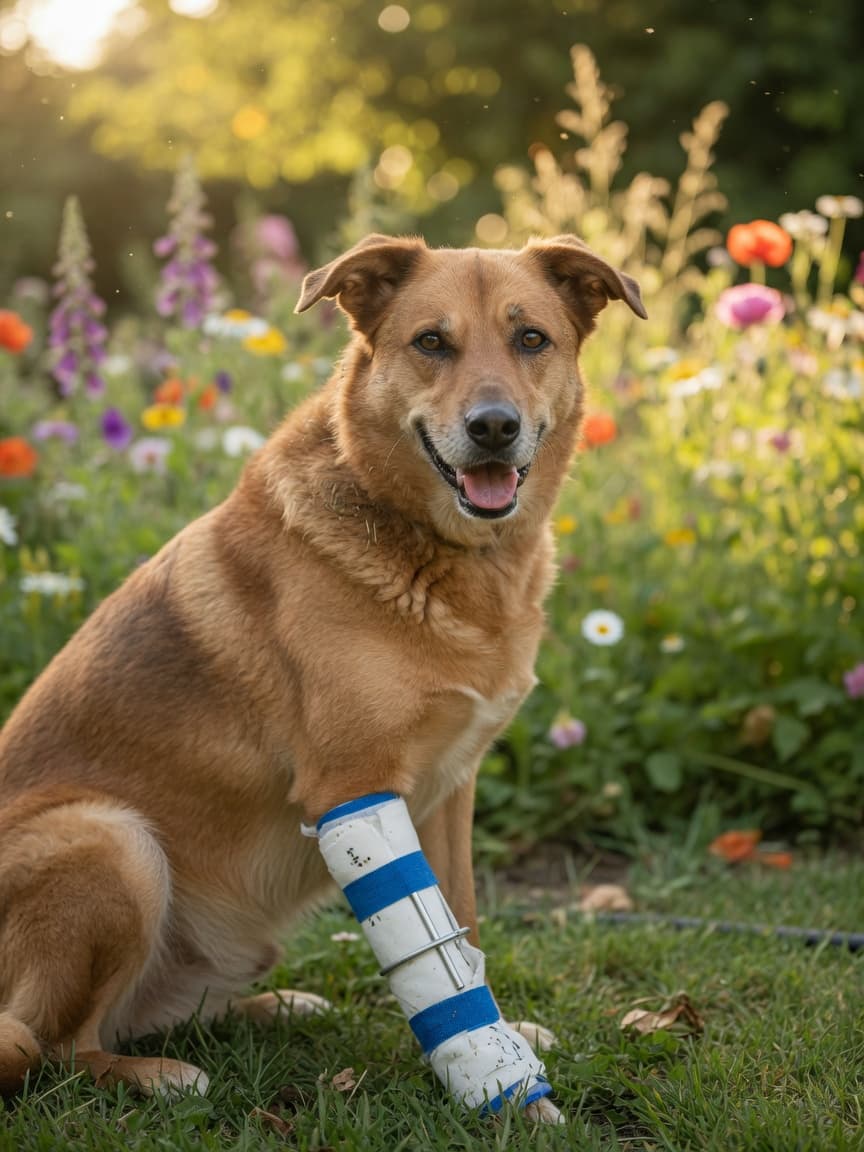
- External coaptation (cast or splint): Suitable for simple, closed fractures in certain locations — typically below the elbow or stifle.
- Surgical repair: Most fractures in dogs are treated surgically with bone plates, screws, intramedullary pins, or external fixators. Surgery provides more stable fixation and faster return to function.
- Amputation: In cases of severely comminuted fractures, vascular compromise, or severe infection in open fractures, amputation may offer the best quality of life outcome.
Recovery time ranges from 6 to 16 weeks depending on fracture severity, repair method, age of the dog, and compliance with post-operative care instructions.
Pain Management and Post-Operative Care
Strict crate rest, controlled leash walks only, prevention of jumping, and oral pain medication are the pillars of fracture recovery. Do not give human pain medication (ibuprofen, paracetamol, aspirin) — all are toxic to dogs. Ask your vet about appropriate canine NSAIDs and whether physiotherapy or hydrotherapy would benefit recovery.
- Sudden non-weight-bearing lameness, swelling, and deformity indicate a possible fracture.
- Approach cautiously — pain causes even gentle dogs to bite.
- Do not attempt to splint at home; improper application worsens outcomes.
- Cover open wounds with clean cloth; do not push exposed bone under skin.
- Use a rigid stretcher for large dogs; support chest and hindquarters for small dogs.
- Never give human pain medication — seek veterinary prescription analgesia only.
- Piermattei DL, Flo GL, DeCamp CE. Brinker, Piermattei, and Flo's Handbook of Small Animal Orthopedics and Fracture Repair. 4th ed. Saunders Elsevier; 2006. PMID: 17259052
- Langley-Hobbs SJ. Management of long bone fractures in dogs and cats. In Pract. 2009;31(10):474-483. PMID: 20081187
- Beale BS. Use of nutraceuticals and chondroprotectants in osteoarthritic dogs and cats. Vet Clin North Am Small Anim Pract. 2004;34(1):271-289. PMID: 15032135