
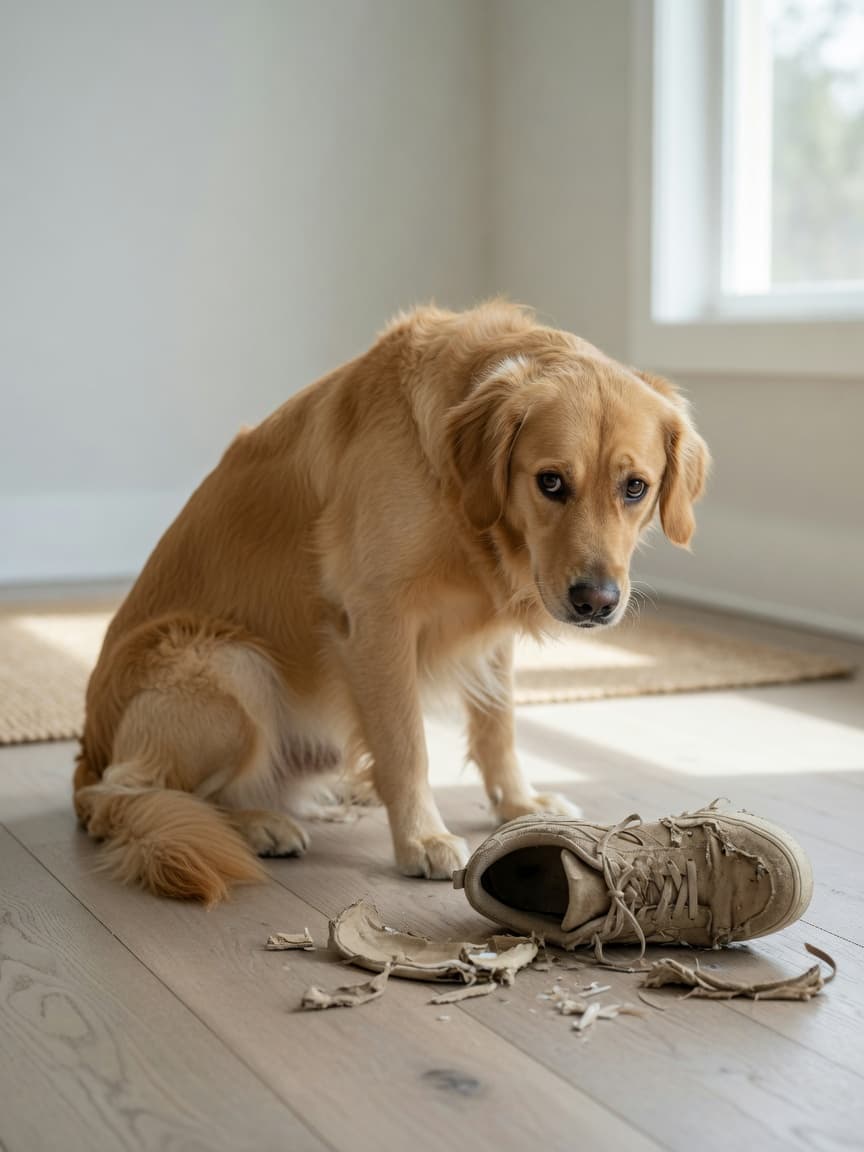
We've all been there: you arrive home to find your dog cowering in the corner, ears back, avoiding eye contact—whilst your favourite shoe lies destroyed in the middle of the living room. Your immediate assumption is clear: your dog feels guilty. But is this really guilt, or are we reading too much into their behaviour? The answer is more nuanced than you might think, and recent research suggests that what we interpret as guilt may not be the emotion we assume it is.
What Science Says About Canine Emotions
Dogs are emotionally complex animals with a rich inner life, but researchers have found that what we call "guilt" in dogs is likely not the same as guilt in humans. Human guilt involves self-awareness, moral understanding, and the ability to reflect on one's actions—capacities that require a level of cognitive development most dogs don't possess.
A landmark 2009 study published in Applied Animal Behaviour Science revealed something surprising: dogs showed the same "guilty" body language whether they had actually done something wrong or had simply been scolded by their owners. This suggests their behaviour is a response to our anger, not remorse for their actions.
The "Guilty Look" Explained
That sorrowful expression your dog gives you isn't a confession—it's an appeasement signal. Your dog has learned that when you're upset, displaying submissive body language (lowered head, tucked tail, averted gaze) helps calm the situation. They're responding to your emotional state, not acknowledging wrongdoing.
This learned behaviour develops through:
- Your dog recognising that certain actions trigger your anger
- Associating their submissive posture with a reduction in your frustration
- Repeating this behaviour pattern whenever they sense your displeasure
It's essentially a coping mechanism, not an expression of moral understanding.
What Emotions Do Dogs Actually Experience?
Rather than guilt, dogs are more likely experiencing fear or anxiety when confronted with an angry owner. They may also feel stress if they sense your emotional upset. What they don't typically understand is the connection between their past action and your current anger—especially if there's a time delay.
Dogs live largely in the present moment. If you scold your dog hours after they've had an accident indoors, they won't make the logical connection. They'll simply experience confusion and anxiety about your sudden anger.
Emotions Dogs Genuinely Feel
Research has confirmed that dogs do experience genuine emotions, including:
- Joy and contentment – shown through play, tail wagging, and seeking interaction
- Fear and anxiety – triggered by loud noises, unfamiliar situations, or separation
- Affection – demonstrated through bonding behaviours and loyalty
- Excitement and enthusiasm – evident in greeting behaviours and anticipation
Improving Your Dog's Behaviour Without Guilt-Tripping
Understanding that your dog doesn't experience guilt like you do should change how you approach training:
- Catch them in the act: Redirect or correct behaviour immediately, whilst it's happening
- Use positive reinforcement: Reward good behaviour rather than punishing bad behaviour
- Manage their environment: Prevent unwanted behaviour by limiting access to tempting items
- Stay calm: Your dog responds to your emotional state, so yelling will only create anxiety
- Be consistent: All family members should respond to behaviour in the same way
Key Takeaways
That guilty-looking face tugs at our heartstrings, but it's important to recognise it for what it truly is: a learned appeasement response to your anger, not genuine remorse. Your dog isn't plotting how to hide their misdeeds or hoping you'll forgive them—they're simply reacting to your emotional state in the moment. By understanding your dog's actual emotional capabilities, you can build a stronger relationship based on clear communication and positive reinforcement. The result? A happier, less anxious dog and a more effective training approach for you both.