
What Is Dilated Cardiomyopathy in Dogs?
Dilated cardiomyopathy, commonly referred to as DCM, is a serious heart condition in which the heart muscle weakens and the chambers of the heart enlarge. As the walls of the heart become thinner and less effective at contracting, the heart struggles to pump blood efficiently throughout the body. This progressive disease is one of the most common forms of heart disease in dogs, and sadly, it is often diagnosed only after significant damage has already occurred.
Unlike the valvular disease more common in small breeds, DCM predominantly affects larger dogs. Understanding which breeds are predisposed and what early warning signs look like can genuinely make a difference in how well a dog responds to treatment.
Breeds Most Commonly Affected

Genetics play a central role in DCM risk. Certain large and giant breeds carry a significantly higher predisposition to developing this condition, and it is well established within veterinary cardiology that the following breeds warrant closer monitoring throughout their lives.
- Dobermann Pinschers — considered the breed at highest risk, with some studies suggesting up to 58% of the breed may develop DCM
- Great Danes — prone to both DCM and associated arrhythmias
- Irish Wolfhounds — often develop DCM alongside atrial fibrillation
- Boxers — typically affected by a related condition called arrhythmogenic right ventricular cardiomyopathy, often grouped under the DCM umbrella
- Cocker Spaniels — one of the few smaller breeds with notable DCM prevalence
- Newfoundlands and Saint Bernards — giant breeds with documented susceptibility
- Dalmatians and Scottish Deerhounds — increasingly recognised in cardiology literature
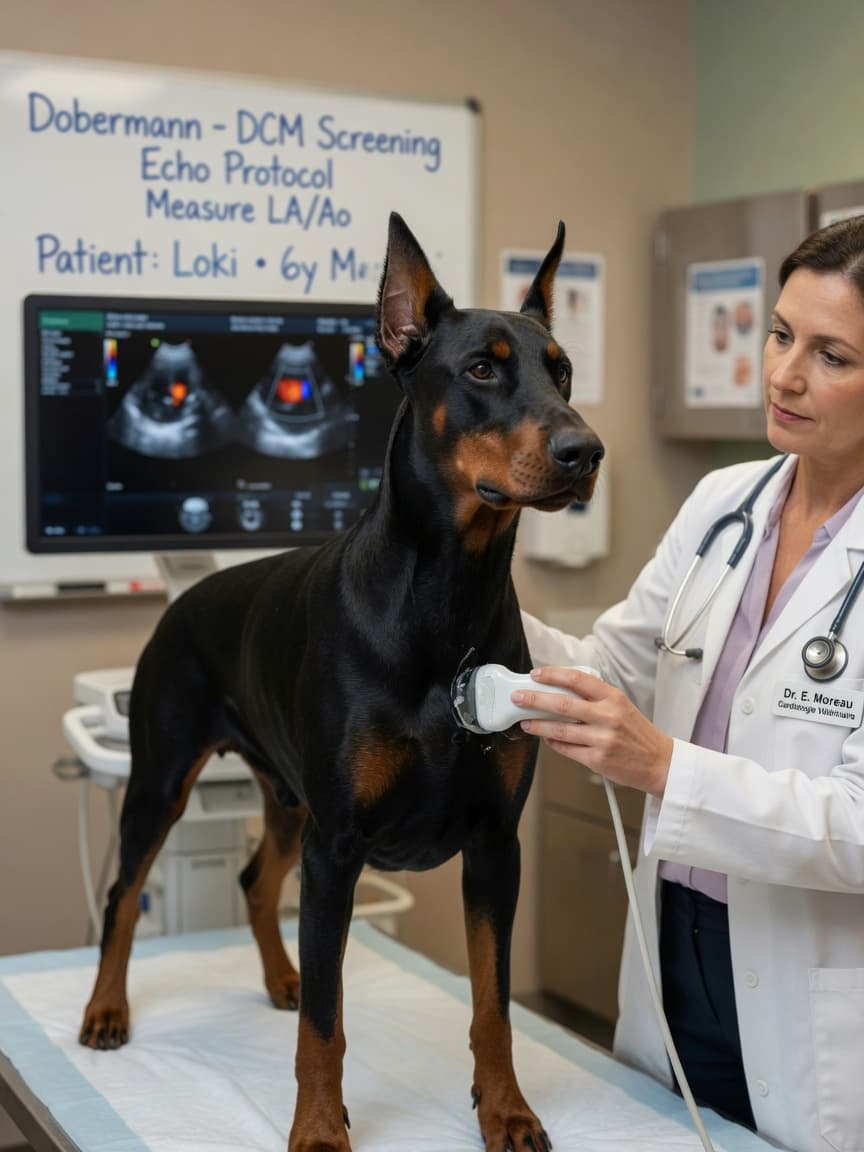
In Dobermanns in particular, the disease can be entirely silent for years, which is why routine cardiac screening for this breed is strongly recommended from around four years of age.
The DCM-Diet Debate
In recent years, a possible link between grain-free diets and DCM in dogs outside the typically affected breeds has emerged. The FDA in the United States investigated reports of DCM in dogs eating boutique, exotic ingredient, or grain-free diets — often abbreviated as BEG diets. Several cases involved breeds not historically predisposed to the disease.
The precise mechanism remains under investigation, and a causal relationship has not been definitively proven. However, the leading hypothesis involves taurine deficiency or impaired taurine synthesis associated with certain legume-heavy formulations. Dogs fed grain-inclusive diets from established manufacturers have shown resolution of DCM signs in some reported cases, suggesting diet does play a role in at least a subset of patients.
Until more definitive research emerges, many veterinary cardiologists advise caution with diets high in peas, lentils, chickpeas, and potatoes as primary ingredients, particularly in large breeds already at risk.
Recognising the Early Signs

The frustrating reality of DCM is that dogs can appear completely healthy while the disease progresses silently. This preclinical phase, sometimes lasting months or even years, is precisely why breed-specific screening matters so much. When symptoms do appear, they signal that the disease has already advanced considerably.
Early and progressive signs to watch for include:
- Exercise intolerance — tiring more quickly on walks or becoming reluctant to play
- Increased resting respiratory rate — a useful home monitoring metric; a rate consistently above 30 breaths per minute warrants veterinary attention
- Occasional coughing, particularly at night or after rest
- Abdominal distension caused by fluid accumulation
- Weakness or episodes of collapse, particularly in Boxers and Dobermanns due to arrhythmias
- Weight loss and muscle wasting in later stages
Some dogs with DCM present suddenly with severe breathing difficulties or collapse without any preceding signs, which underscores why waiting for symptoms is not a reliable monitoring strategy for at-risk breeds.
Diagnosis and Screening Tools
Veterinary diagnosis of DCM involves several complementary tools. Auscultation — listening to the heart with a stethoscope — may reveal abnormal heart sounds or arrhythmias, but it can also appear normal in early disease. This is why further investigation is necessary for suspected cases or at-risk breeds.
Echocardiography
An echocardiogram, or cardiac ultrasound, is the gold standard for diagnosing DCM. It allows the cardiologist to assess chamber size, wall thickness, and contractility in real time. Specific measurements such as fractional shortening and ejection fraction help quantify how well the heart is functioning and can detect changes before symptoms appear.
Holter Monitoring
For breeds like Dobermanns and Boxers where arrhythmias are a major concern, a 24-hour Holter monitor records the heart's electrical activity continuously. This is particularly valuable because dangerous arrhythmias may not occur during a brief clinic visit, yet can cause sudden death or collapse.
Chest Radiographs and Biomarkers
Chest X-rays help assess heart size and identify fluid in the lungs. Blood biomarkers, particularly NT-proBNP and cardiac troponin I, are increasingly used as screening tools and can flag cardiac stress even in seemingly healthy dogs. These tests are not definitive on their own but are useful as part of a broader screening protocol.
Treatment and Prognosis
There is no cure for DCM, but management can meaningfully extend quality of life and, in some cases, slow progression. Dogs diagnosed in the preclinical phase may benefit from pimobendan, a medication shown in the landmark PROTECT study to delay onset of heart failure in Dobermanns with occult DCM. Once heart failure develops, treatment typically involves a combination of diuretics, ACE inhibitors, and pimobendan, tailored to each patient's needs.
Dietary taurine supplementation is considered in dogs where deficiency is identified or suspected, especially those on grain-free diets, and some dogs show remarkable improvement with supplementation alone.
Prognosis varies considerably by breed and stage at diagnosis. Dobermanns diagnosed in overt heart failure often survive six to twelve months with treatment, while other breeds may live longer. Early detection genuinely changes outcomes, which is why regular cardiac screening for predisposed breeds is one of the most valuable things an owner can do.