
The Two Techniques That Actually Change Fear
If you have a fearful dog and you have done any reading on the subject, you will have encountered the terms desensitisation and counter-conditioning. They are almost always mentioned together, usually abbreviated to DS/CC, and for good reason — when used in combination, they represent the most evidence-based, durable approach to changing how a dog responds to the things that frighten it. Unlike management strategies that simply avoid the trigger or calming products that reduce arousal in the moment, DS/CC can produce genuine, lasting changes in a dog's emotional response.
Understanding how they work, and why the process takes the time it does, makes it considerably easier to implement them correctly and stick with the programme.
What Desensitisation Means
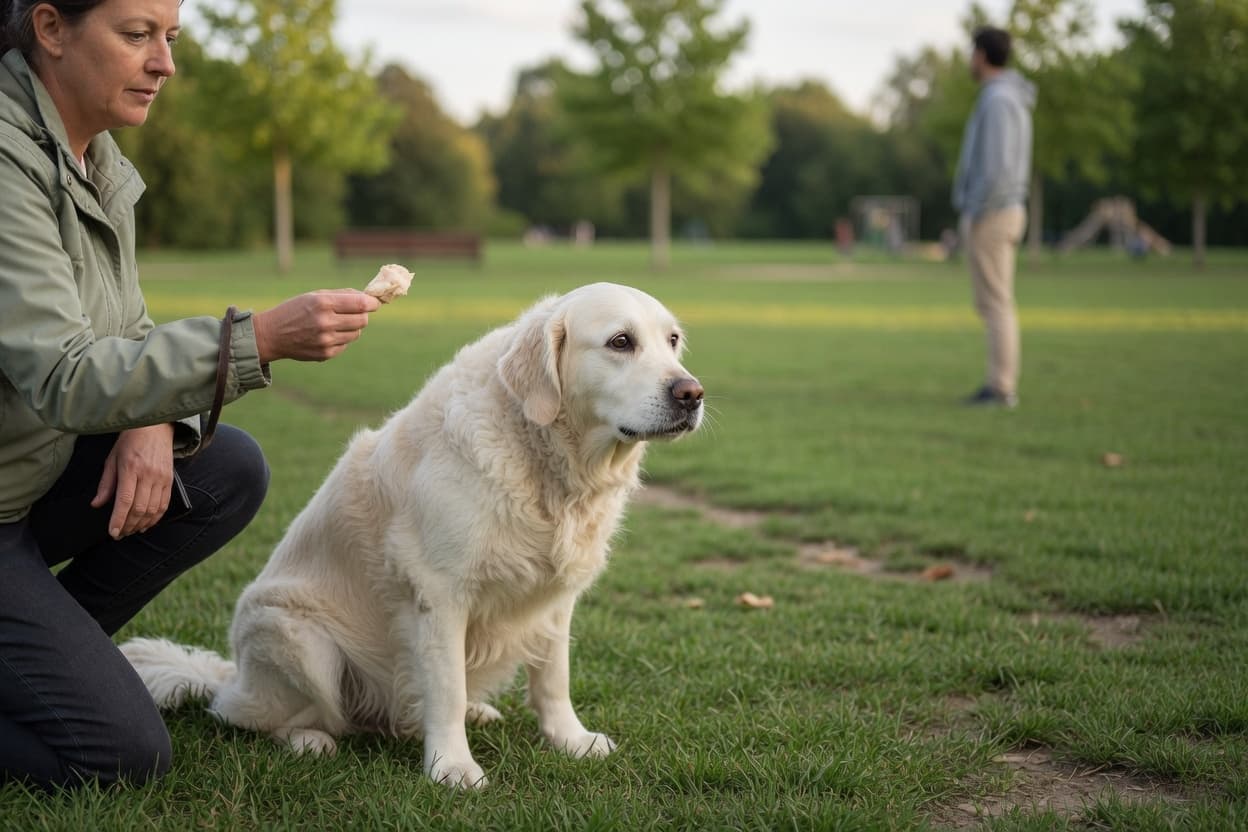
Desensitisation is the process of exposing a dog to a fear-inducing stimulus at an intensity so low that it does not trigger a fear response. This is sometimes called working below threshold — keeping the dog in a state where it is aware of the stimulus but not overwhelmed by it.
The key principle is gradual, controlled exposure. A dog that is terrified of strangers is not desensitised by being taken to a busy market and encouraged to cope. That is flooding — an approach that is not only ineffective but actively harmful, as it can significantly worsen fear responses and damage trust in the owner. True desensitisation might begin with a stranger standing on the opposite side of a car park, completely still, for two minutes. The dog notices, orients briefly, and returns its attention to its handler. That is the target starting point.
Over many sessions, the distance is very gradually decreased. Any sign of stress — lip licking, yawning, whale eye, stiffening, barking, attempting to retreat — indicates that the threshold has been exceeded, and the programme must step back to a more comfortable distance. Progress is almost always slower than owners expect, and that patience is essential to the integrity of the process.
What Counter-Conditioning Adds
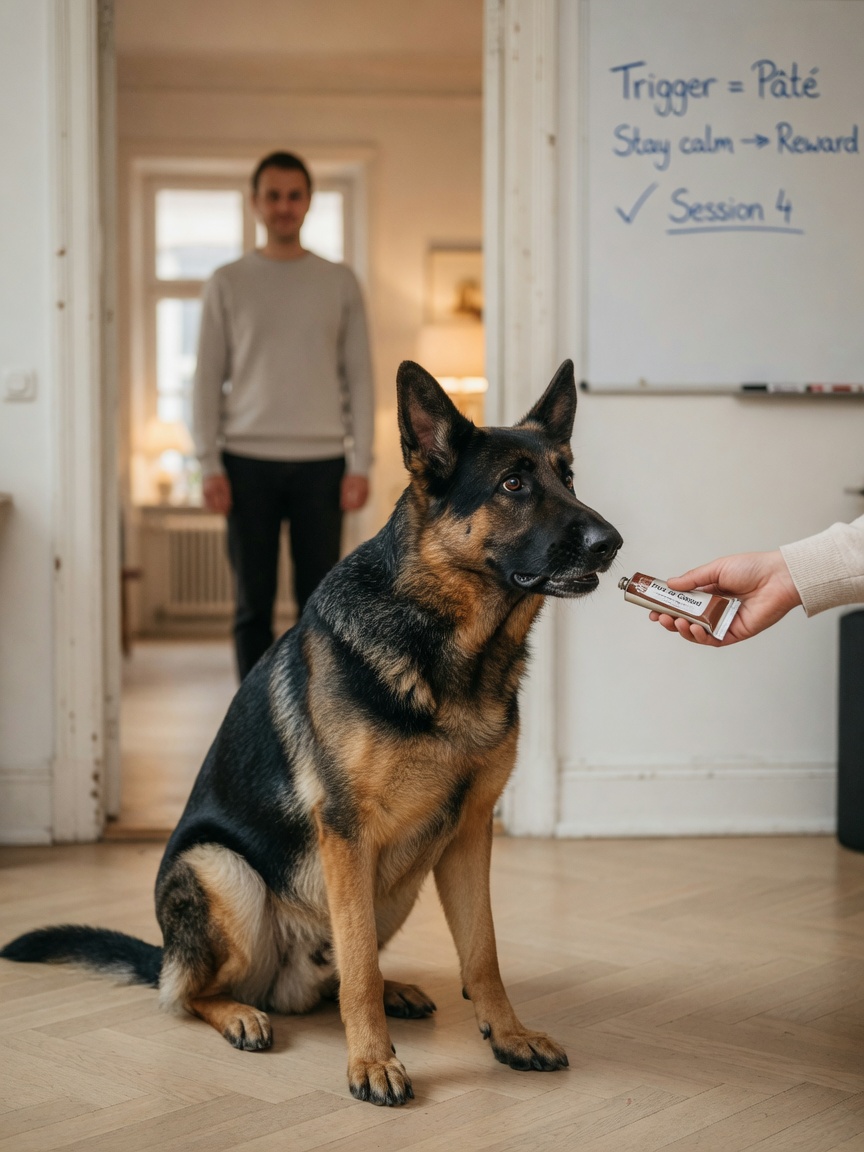
Counter-conditioning works on the emotional association a dog has with its trigger. A fearful dog has a strong, automatic negative emotional response to whatever it fears — this is a conditioned response, meaning it has been learned through experience. Counter-conditioning aims to replace that negative emotional response with a positive one by pairing the trigger with something the dog genuinely values, typically high-value food.
The mechanics are simple but the timing is critical. The trigger appears, and immediately the dog receives something wonderful — a piece of chicken, a squeeze of pate from a tube, a few drops of something irresistible. The trigger disappears, and the reward stops. Over many repetitions, the dog begins to anticipate the reward when the trigger appears. You know it is working when a previously fearful dog starts looking at its owner expectantly — almost hopefully — when the trigger comes into view. This shift is sometimes described as a dog "looking for its cookie" when it sees the stimulus, and it is a reliable signal that the emotional association is changing.
Why the Two Work Together
Desensitisation ensures the dog is never pushed into a full fear response during the training process — because a dog that is already over threshold cannot learn effectively. The sympathetic nervous system takes over, cortisol floods the system, and the window for new learning essentially closes. Counter-conditioning provides the positive emotional content that builds the new association. Without desensitisation, the trigger intensity is too high for counter-conditioning to work; without counter-conditioning, desensitisation alone produces extinction without replacing the fear response with something better.
Common Applications in Fearful Dogs
- Noise phobias: recorded sounds played at very low volume, gradually increased across weeks or months, paired with high-value rewards
- Fear of strangers: distant exposure to people at sub-threshold distances, paired consistently with food delivery
- Separation anxiety: very brief departures (seconds initially) that do not trigger distress, building duration incrementally
- Fear of other dogs: working at a distance where the fearful dog can eat and orient without reacting
- Veterinary fear: cooperative care training using DS/CC to reduce the fear response to handling, equipment, and clinic environments
The Role of the Owner in the Process
DS/CC requires consistent, calm, and patient delivery from the owner or handler. One of the most common errors is moving too fast — increasing the intensity of the trigger because the dog seemed fine at the previous level, without allowing enough repetitions for the new association to consolidate. Another common mistake is allowing the dog to encounter the trigger at full intensity outside of training sessions, which can undo progress quickly. Management of the environment between sessions is therefore just as important as the sessions themselves.
Owners also need to remain neutral and matter-of-fact during sessions. Excessive reassurance, anxious handling, or tension transmitted through the lead can all increase a dog's arousal and interfere with the learning process. Your calm, predictable presence is part of the therapeutic environment.
When to Involve a Professional
For mild fears, motivated owners with good timing can make meaningful progress using DS/CC independently. For moderate to severe fears, or where the anxiety involves aggression, working with a certified clinical animal behaviourist or a veterinary behaviourist is strongly recommended. These professionals can assess the dog properly, design a structured programme, and identify whether medication support would increase the effectiveness of the behaviour work.
Look for practitioners accredited by the Animal Behaviour and Training Council (ABTC) in the UK, or those with credentials from the Association of Pet Behaviour Counsellors (APBC). Avoid any trainer or behaviourist who advocates confrontational methods, dominance theory, or aversive tools, all of which are contraindicated for fearful dogs and have the potential to cause significant psychological harm.
Realistic Expectations for Progress
Behaviour change through DS/CC is real, but it is rarely fast. A dog with a well-established fear of fireworks may require an entire year of gradual sound work before responses during real events are meaningfully reduced. A dog with separation anxiety may need months of incremental departure training before it can tolerate a full working day alone. The timeline depends on the history of the fear, the dog's individual temperament, the consistency of the training, and the skill of the handler.
Progress is also rarely linear. Setbacks occur, and they do not mean the work has failed — they mean the programme needs to be stepped back temporarily and rebuilt more carefully. Document sessions, track responses, and celebrate small shifts. In the long run, DS/CC gives fearful dogs something no supplement or garment can: a genuinely different relationship with the world around them.