

Cavalier King Charles Spaniel Health: A Complete Owner's Guide
The Cavalier King Charles Spaniel is adored for its gentle temperament, silky coat, and unwavering affection. Sadly, the breed also carries one of the heaviest inherited disease burdens of any pedigree dog. Responsible ownership begins with a thorough understanding of the four main health areas that affect Cavaliers throughout their lives: mitral valve disease, syringomyelia and Chiari malformation, episodic falling syndrome, and eye conditions.
Mitral Valve Disease (MMVD)
Mitral valve disease is the single most significant health concern in the Cavalier King Charles Spaniel. Studies consistently show that virtually every Cavalier will develop some degree of mitral valve disease by the age of ten. The condition begins when the mitral valve — which separates the left atrium from the left ventricle — starts to degenerate. Over time, the valve leaks, forcing the heart to work harder to maintain adequate circulation.
The disease progresses through distinct stages. In the early preclinical phase, a heart murmur is detectable on auscultation but the dog shows no outward symptoms. As the condition advances, dogs may develop exercise intolerance, a persistent cough (particularly at night), laboured breathing, and eventually congestive heart failure if left untreated.
The CKCS Health Protocol
The Cavalier King Charles Spaniel Club in the UK, alongside international breed clubs, established a cardiac breeding protocol to slow the spread of early-onset mitral valve disease through the population. Under this protocol:
- Both parents must be heart-checked by a cardiologist and found clear of murmurs at a minimum age of 2.5 years before breeding
- If either parent is under 5 years of age at the time of mating, both paternal grandparents must also have been heart-clear at age 2.5 or older
- Certificates must be issued by a recognised cardiologist, not simply a general practitioner
When purchasing a Cavalier puppy, always ask the breeder to provide documented cardiac certificates for both parents meeting these criteria. Responsible breeders will have these readily available. Annual cardiac checks by a vet throughout your dog's life allow for timely intervention when murmurs develop.
Syringomyelia and Chiari-Like Malformation (SM/CM)
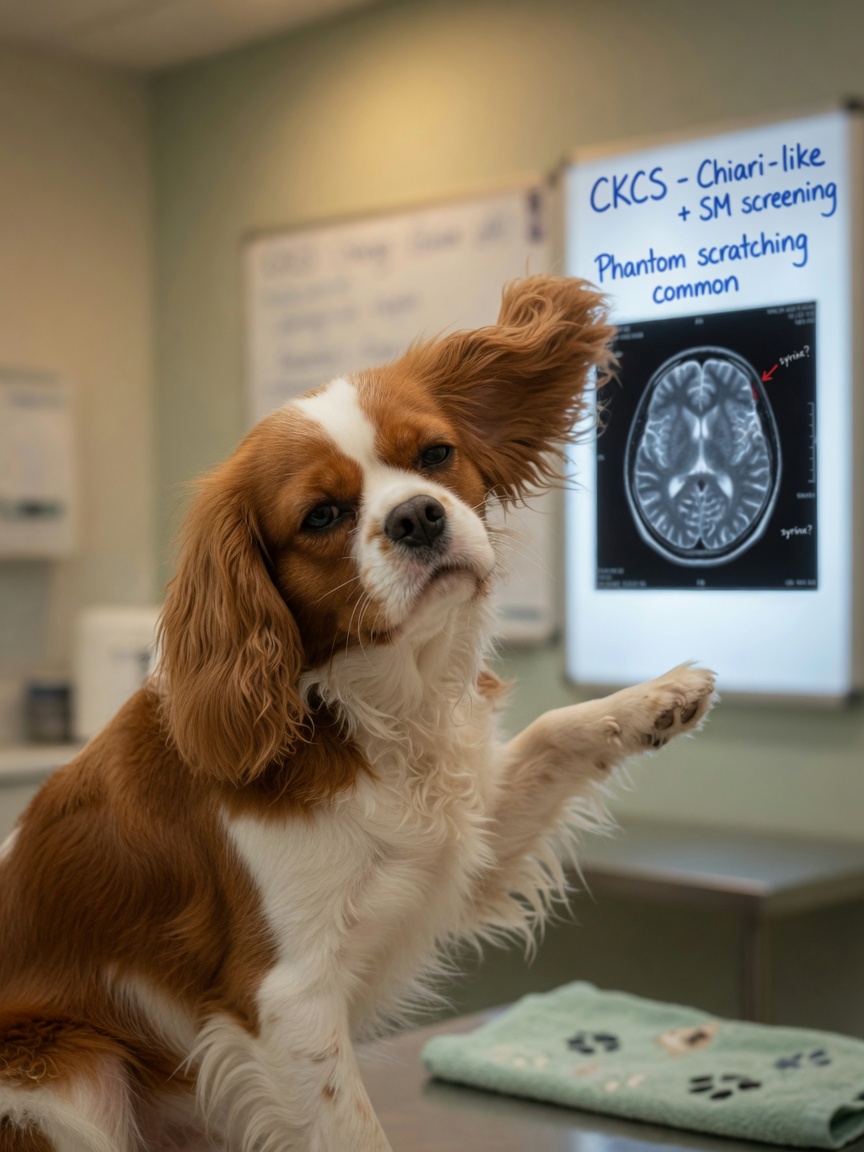
Syringomyelia (SM) and Chiari-like malformation (CM) represent a significant and often distressing neurological condition that affects a large proportion of Cavaliers. Chiari-like malformation occurs when the back of the skull is too small for the cerebellum, causing part of the brain to be pushed towards the spinal canal. This obstruction disrupts the normal flow of cerebrospinal fluid, which can lead to the formation of fluid-filled cavities (syrinxes) within the spinal cord itself.
Recognising the Signs
The symptoms of SM/CM can vary widely in severity. Mildly affected dogs may show only intermittent discomfort, while severely affected dogs experience significant pain and neurological deficits. Key signs to watch for include:
- Phantom scratching — the dog scratches at the neck or shoulder area without making contact with the skin, often only on one side
- Apparent neck or head pain, reluctance to be touched around the head and neck
- The "flying nun" posture — the dog holds one or both ears outward and upward, sometimes tilting the head
- Scoliosis (curvature of the spine) in more advanced cases
- Weakness or wobbliness in the hind limbs
- Sensitivity to touch on the chest, shoulders, or sternum
Diagnosis is confirmed via MRI scan, which is the only way to visualise the malformation and any syrinxes present. Treatment ranges from medical management with pain relief, diuretics, and corticosteroids, through to surgical decompression of the skull in appropriate cases. The British Veterinary Association and Kennel Club support an MRI screening scheme for breeding dogs to reduce the prevalence of this condition in future generations.
Episodic Falling Syndrome (EFS)

Episodic falling syndrome, sometimes called paroxysmal dyskinesia, is a hereditary condition unique to the Cavalier King Charles Spaniel. It is caused by a mutation in the BCAN gene and is inherited in an autosomal recessive pattern, meaning a dog must inherit two copies of the faulty gene to be affected.
Episodes are often triggered by excitement, exercise, or stress. During an episode, the dog's muscles go into a state of hypertonia — they stiffen rather than relax. The dog may appear to "fall over" and be unable to stand, with the front legs extended forward and the hind legs splayed outward, or it may freeze in a hunched position. Episodes can last from a few seconds to several minutes. Crucially, the dog remains fully conscious and aware throughout — it is not a seizure or an episode of loss of consciousness.
A DNA test is available for EFS. Responsible breeders test both parents before mating to ensure that no affected puppies are produced. If your Cavalier has been diagnosed with EFS, management focuses on minimising triggers and, in some cases, medication to reduce the frequency and severity of episodes. The prognosis for affected dogs with good management is often reasonable.
Eye Conditions
Cavaliers are also predisposed to several eye conditions that owners should be aware of.
Corneal Dystrophy
Corneal dystrophy is a hereditary condition causing white or grey opacities to develop within the layers of the cornea. In Cavaliers, this most commonly affects the stromal layer. It is generally non-painful and does not always lead to significant vision impairment, though severe cases can affect sight. No treatment is required in most cases, but annual eye examinations are recommended to monitor progression.
Dry Eye (Keratoconjunctivitis Sicca)
Cavaliers are among the breeds prone to dry eye, where the tear glands fail to produce sufficient tears to keep the eye surface lubricated. Signs include a thick, mucoid discharge, redness, and dullness of the cornea. Left untreated, dry eye can cause painful corneal ulceration. It is managed with cyclosporine or tacrolimus eye drops to stimulate tear production, alongside lubricating drops.
Retinal Problems
Progressive retinal atrophy (PRA) and other retinal conditions have been recorded in the breed. The BVA/KC/ISDS eye scheme provides a framework for annual eye testing of breeding dogs, and DNA tests are available for certain forms of PRA.
Bringing It All Together: Caring for Your Cavalier
Owning a Cavalier King Charles Spaniel means committing to a proactive health monitoring schedule throughout your dog's life. Annual cardiac auscultation from a young age is essential. Ask your vet to examine your dog's eyes yearly. Be alert to any signs of neck pain, phantom scratching, or unusual episodes of stiffness or falling. Discuss any concerns with a vet experienced in the breed or request a referral to a specialist cardiologist or neurologist where appropriate.
When sourcing a Cavalier puppy, choose a breeder who actively health tests and participates in breed club screening schemes. A responsible breeder will welcome your questions about heart certificates, MRI results, and DNA test outcomes for EFS. The higher upfront cost of a well-bred puppy from tested parents is a wise investment in your dog's long-term health and your peace of mind.
With appropriate veterinary support, diligent monitoring, and an informed approach to the breed's specific needs, many Cavaliers enjoy fulfilling, comfortable lives despite the health challenges inherent to the breed.