
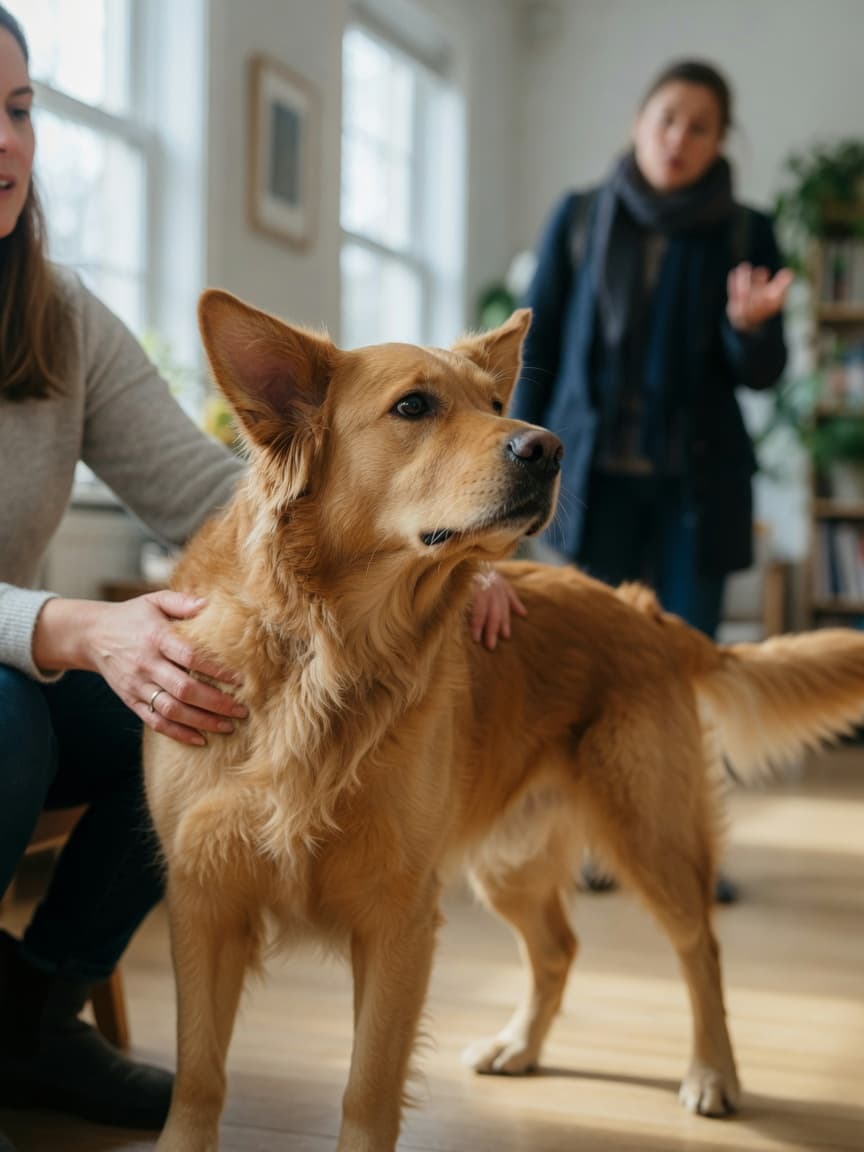
Have you ever noticed your dog acting strangely around certain people? Perhaps they've growled at someone who turned out to be untrustworthy, or refused to approach a visitor who seemed perfectly friendly. Many dog owners swear their pets possess an almost supernatural ability to detect "bad" people. But is this genuine intuition, or something else entirely? Let's explore the science behind dogs' seemingly uncanny ability to read human character.
What Science Actually Says About Dogs Reading People
Dogs don't possess a mysterious sixth sense that allows them to detect evil. However, they do have an extraordinary ability to read human behaviour and emotions through multiple sensory channels that we humans often miss. Research published in Animal Cognition demonstrates that dogs can interpret human facial expressions, body language, and vocal cues with remarkable accuracy.
When your dog reacts negatively to someone, they're likely responding to subtle signals: tension in the person's posture, changes in voice tone, irregular breathing patterns, or even shifts in body odour caused by stress or anxiety. Dogs pick up on these micro-expressions and physiological changes far better than we can, making their reactions appear almost supernatural.
The Role of Canine Sensory Abilities
Dogs possess sensory capabilities that far exceed our own, particularly in these areas:
- Olfactory senses: Dogs have up to 300 million olfactory receptors, compared to our measly 6 million. They can detect chemical changes in human sweat associated with fear, anger, or deception.
- Acoustic awareness: Dogs hear frequencies between 40 Hz and 60,000 Hz, allowing them to detect subtle vocal inflections humans miss entirely.
- Visual perception: Though dogs see in different colour spectrums than humans, they excel at detecting movement and reading facial expressions.
- Electromagnetic sensitivity: Some researchers suggest dogs may detect changes in electromagnetic fields generated by emotional states.
Can Dogs Really Judge Character?
Here's the important distinction: dogs don't judge character in the moral sense. They respond to threat assessment. If someone exhibits nervous, aggressive, or unpredictable behaviour patterns, your dog will likely react defensively or avoid them. Conversely, calm, confident individuals typically receive warmer receptions.
A study by the University of Trento found that dogs could identify people who had refused to help their owners, suggesting they can recognise unkind behaviour. However, this doesn't mean dogs are infallible judges of morality—they're simply responding to observable patterns.
Why Your Dog Might React Negatively
Before assuming your dog has detected something sinister, consider these alternative explanations:
- Past trauma or negative experiences with similar-looking or -sounding people
- Unfamiliar body language or cultural differences in human interaction
- Your own anxiety or tension (dogs are incredibly attuned to our emotions)
- The person's recent exposure to other animals, particularly cats
- Simple personality incompatibility
Should You Trust Your Dog's Instincts?
Your dog's reactions are worth noting, but shouldn't be your sole basis for judging someone's character. They're an additional data point, not definitive proof. Dogs have excellent instincts about immediate threats and emotional states, but they lack the cognitive ability to assess complex moral questions.
That said, their behaviour can serve as a gentle reminder to pay closer attention to subtle cues you might otherwise miss.
Key Takeaways
- Dogs don't sense "evil," but they excel at reading human emotions and behaviour
- Their reactions stem from superior sensory abilities, not supernatural perception
- Always consider context—your own emotions significantly influence your dog's responses
- Use your dog's reactions as one factor among many when assessing situations
- Trust your dog's ability to detect discomfort, but verify with rational judgment