
Not All Bladder Stones Are the Same
The word "bladder stone" sounds singular and simple, but in feline medicine it describes a range of mineralised formations that differ substantially in their composition, causes, and required treatment. Getting the distinction right matters enormously — because a dietary approach that dissolves one type of stone can actively worsen another. The two most common types in cats are struvite (magnesium ammonium phosphate) and calcium oxalate, and they behave very differently.
Struvite Stones: Formation and Profile
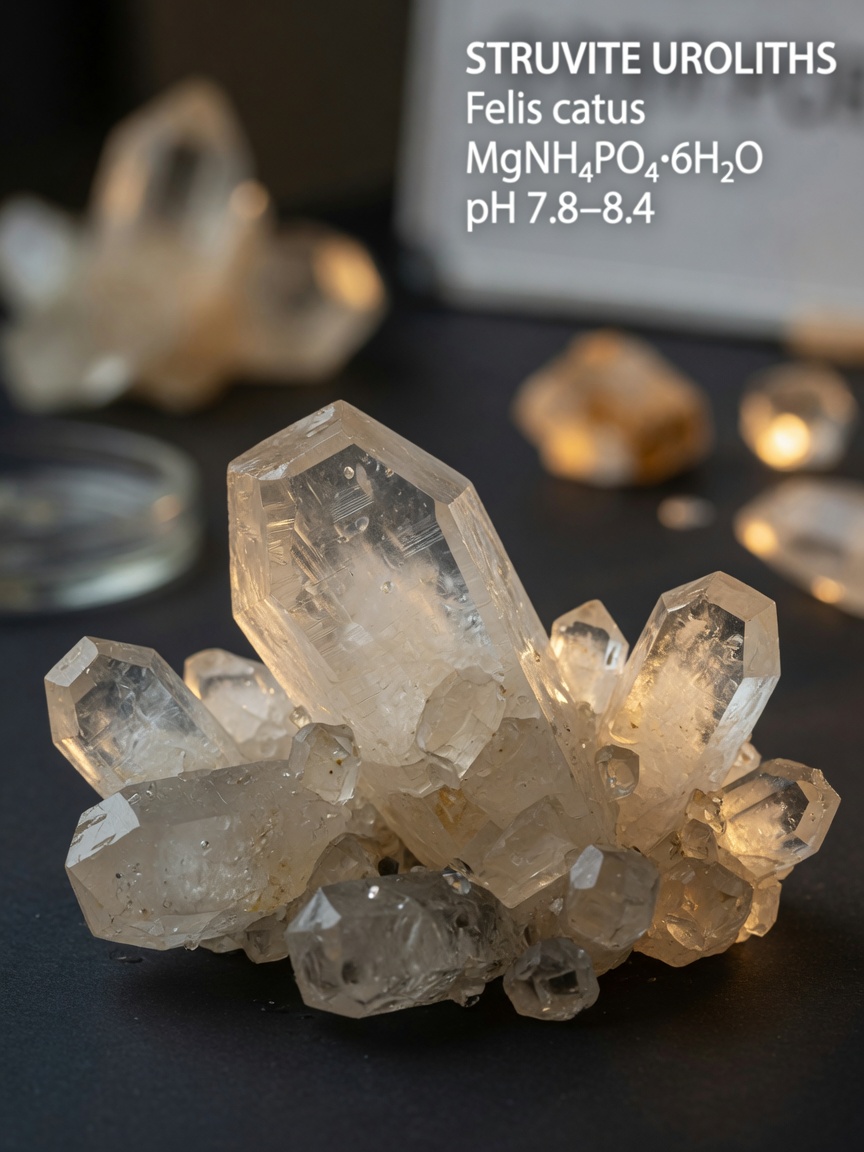
Struvite is composed of magnesium, ammonium, and phosphate ions. These minerals are present in normal cat urine, but they crystallise and begin to aggregate into stones when urine pH rises above approximately 6.5 and when the urine is sufficiently concentrated. In cats, struvite stones can form in one of two ways: sterile struvite, which develops in the absence of infection in the context of dietary and urinary pH factors, and infection-induced struvite, which forms as a result of bacterial urease activity splitting urea into ammonia and raising urinary pH.
Sterile struvite is the predominant form in cats, unlike in dogs where infection-induced struvite is more common. Struvite affects cats across all age groups but tends to be more prevalent in younger to middle-aged cats. Female cats are represented more often in struvite cases than males, though males remain more vulnerable to the obstructive consequences of any type of stone.
Calcium Oxalate Stones: A Different Beast
Calcium oxalate uroliths are formed when calcium and oxalate ions exceed their solubility threshold in the urine, precipitating out as hard, often jagged crystals that aggregate into stones. They are not soluble in acidic urine — in fact, acidic conditions promote their formation. This directly contradicts the approach used for struvite, where acidifying the urine is a key therapeutic strategy.
The prevalence of calcium oxalate stones in cats has increased significantly since the 1980s and 1990s. Research has attributed this partly to the widespread use of acidifying prescription urinary diets that reduced struvite formation but inadvertently shifted some cats' urinary pH into a range more conducive to oxalate crystal precipitation. Today, calcium oxalate accounts for roughly 40 to 50 percent of feline uroliths submitted to veterinary mineral analysis laboratories, a figure that has been climbing steadily.
Calcium oxalate stones are more common in older cats, typically those over seven years of age, and certain breeds appear to be predisposed, including Burmese, Himalayan, Persian, and Scottish Fold cats. Hypercalcaemia — elevated calcium in the blood — is a risk factor and should be ruled out in affected cats.
How They Differ in Symptoms
The clinical presentation of struvite and calcium oxalate stones can be virtually indistinguishable to the owner. Both may cause:
- Haematuria — blood in the urine
- Dysuria — painful or difficult urination
- Pollakiuria — abnormally frequent urination in small amounts
- Periuria — urinating outside the litter tray
- In severe cases, urethral obstruction (particularly in males)
Some cats with bladder stones remain asymptomatic and are only discovered incidentally during imaging for another reason. The size and number of stones do not reliably predict the severity of symptoms — a single small stone near the bladder neck can cause more distress than several larger stones sitting quietly in the body of the bladder.
Diagnosis: Why Mineral Analysis Is Essential
Because struvite and oxalate require opposite dietary management strategies, it is critical to identify the stone type before beginning any treatment. Imaging — typically radiography and/or ultrasound — confirms the presence, size, number, and location of stones. Radiography is generally better for detecting calcium-containing stones, which are radiopaque, while ultrasound provides additional detail about bladder wall integrity and small crystals that may not show on X-ray.
Definitive stone type identification requires mineral analysis of the actual stone material, which means either retrieving a stone that has passed naturally or obtaining one through cystoscopy or surgical cystotomy. Urinalysis and urine culture provide supporting information — a urine pH consistently above 7.0 and the presence of struvite crystals on microscopy increase the likelihood of struvite stones, while an acidic pH and oxalate crystals point in the other direction. However, these are indicators, not confirmations.
Treatment: Where the Approaches Diverge
Dissolving Struvite
One of the clinically significant advantages of struvite over oxalate is that struvite stones can be dissolved non-surgically through dietary management. Prescription dissolution diets work by acidifying the urine (targeting pH 6.0 to 6.5), reducing the dietary content of magnesium and phosphorus, and increasing water intake to dilute the urine. Over weeks to months, this approach gradually dissolves existing struvite stones, eliminating the need for surgery in many cases.
Regular radiographic or ultrasound monitoring during dissolution confirms that stones are reducing in size. Once dissolved, a maintenance urinary diet helps prevent recurrence. In cases of infection-induced struvite, appropriate antibiotics must accompany dietary treatment to address the underlying urease-producing bacteria.
Managing Oxalate Stones
Calcium oxalate stones cannot be dissolved through diet. Once formed, they must either be removed surgically (cystotomy), retrieved via cystoscopy, or passed naturally if small enough. Voiding urohydropropulsion — a non-surgical technique where the cat is positioned and the bladder manually expressed to flush small stones out through the urethra — is an option for small stones in female cats, whose wider urethra permits this more easily.
After removal, the focus shifts entirely to prevention. Management centres on increasing urine volume through wet food and high water intake, avoiding excessive dietary oxalate and supplemental vitamin C (which metabolises to oxalate), maintaining urinary pH in the mildly acidic to neutral range (6.6 to 7.0), and addressing hypercalcaemia if present. Potassium citrate is sometimes used to help alkalinise urine in cats prone to oxalate recurrence.
Recurrence and Long-Term Monitoring
Both struvite and calcium oxalate stones have significant recurrence rates. Studies suggest that without ongoing dietary management, recurrence can occur in 25 to 50 percent of cases within two to three years. Long-term management requires periodic urinalysis to monitor urinary pH and crystal content, imaging to check for new stone formation, and regular reassessment of diet as the cat ages or if health status changes.
Owners of cats with a confirmed history of urolithiasis should treat dietary management as a permanent commitment rather than a temporary fix. The underlying tendency to form stones does not disappear — it is managed through consistent, evidence-based intervention over the cat's lifetime.