
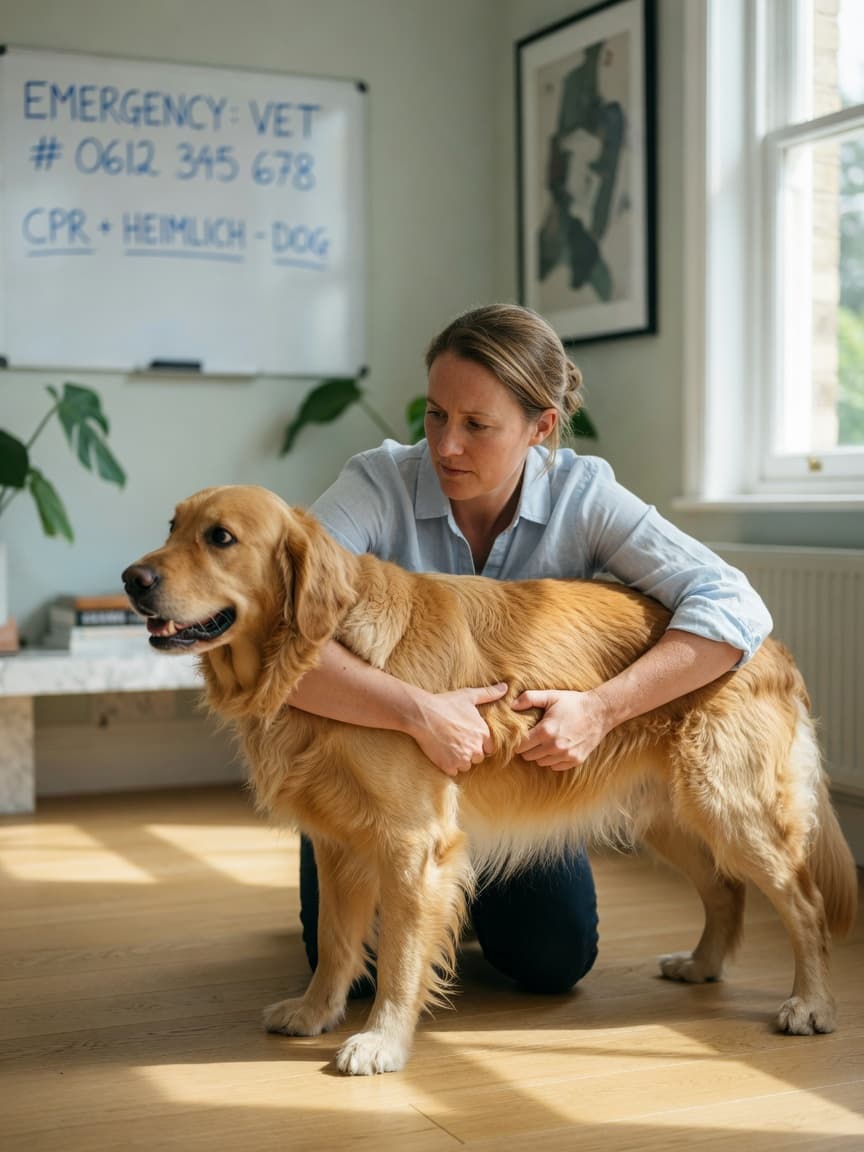
Hund erstickt: Erste-Hilfe-Maßnahmen & Wie man den Heimlich-Griff durchführt
Von Julia Wrenfield, Fachautorin für Haustiergesundheit
Ein erstickender Hund hat Minuten — manchmal Sekunden — bevor Sauerstoffmangel irreversible Hirnschäden oder den Tod verursacht. Zu wissen, was Sie tun müssen, bevor Sie einen Tierarzt erreichen, kann den Unterschied zwischen Leben und Verlust bedeuten. Diese Anleitung führt Sie durch das Erkennen der Zeichen, das sichere Durchführen von Erste Hilfe und das korrekte Ausführen des Heimlich-Griffs für Hunde.
Wie Sie erkennen, dass Ihr Hund erstickt (vs. Husten oder Würgen)
Hunde husten, würgen und würgen aus vielen Gründen, die keine Notfälle sind. Echtes Ersticken ist eine vollständige oder nahezu vollständige Atemwegsbehinderung und präsentiert sich sehr unterschiedlich.
- Frantisches Kratzen am Maul oder an der Kehle
- Hochfrequentes Pfeifen oder völlige Stille beim Atmen
- Blauviolettes, graues oder weißes Zahnfleisch oder Zunge (Zyanose — Sauerstoff fehlt)
- Hervortretende Augen und extreme Panik
- Zusammenbruch oder Bewusstseinsverlust
- Würgbewegungen, die nichts hervorbringen
Wenn der Hund aktiv bellt, kräftig hustet oder einen normalen Ton von sich gibt, ist die Atemweg teilweise offen. Handeln Sie trotzdem schnell, aber Sie haben etwas mehr Zeit.
Schritt-für-Schritt-Erste-Hilfe für einen erstickenden Hund
Schritt 1 — Ruhe bewahren und Ihren Hund sicher festhalten
Ein panischer Hund kann auch den liebevollsten Besitzer beißen. Wenn Sie einen Helfer haben, lassen Sie diese Person ein Handtuch um den Nacken und die Schultern des Hundes wickeln, um die Kopfbewegung einzuschränken. Arbeiten Sie schnell, aber bewusst.
Schritt 2 — Öffnen Sie das Maul und schauen Sie hinein
Öffnen Sie die Kiefer Ihres Hundes sanft, aber fest. Verwenden Sie eine Taschenlampe, falls vorhanden. Wenn Sie das Objekt deutlich sehen können und es leicht erreichbar ist, fegen Sie es heraus. Verwenden Sie eine Hakenbewegung — drücken Sie es nicht tiefer. Führen Sie niemals einen blinden Fingersweep durch; Sie riskieren, das Objekt weiter nach unten zu drücken.
Schritt 3 — Rückenschläge (kleine bis mittelgroße Hunde)
Bei Hunden unter ungefähr 14 kg halten Sie den Hund mit dem Rücken gegen Ihre Brust, Kopf zeigt nach unten. Versetzen Sie 5 feste Schläge zwischen den Schulterblättern mit dem Ballen Ihrer Hand. Überprüfen Sie nach jeder Serie das Maul.
Schritt 4 — Schwerkraft-Technik für kleine Hunde
Halten Sie kleine Hunde mit ihrem Rücken entlang Ihres Unterarms, Kopf tiefer als die Hinterläufe. Die Schwerkraft hilft dem Objekt, sich zum Maul zu bewegen. Versetzen Sie Rückenschläge in dieser Position.
Schritt 5 — Der Heimlich-Griff für Hunde
Dieser Schritt ist anwendbar, wenn Rückenschläge fehlgeschlagen sind und der Hund in Bedrängnis bleibt.
- Bei einem stehenden Hund: Knien oder stehen Sie hinter dem Hund. Machen Sie eine Faust mit einer Hand und platzieren Sie sie knapp unterhalb des Brustkorbs auf dem weichen Bauch. Wickeln Sie Ihre andere Hand über die Faust.
- Wenden Sie feste, nach oben und vorne gerichtete Stöße an — 5 Stöße, jeder scharf und bewusst, in Richtung der Hundesäule und dann nach vorne zum Maul.
- Überprüfen Sie das Maul nach jedem Satz von 5 Stößen. Entfernen Sie sofort alle freigewordenen Objekte.
- Bei einem bewusstlosen Hund: Legen Sie den Hund auf die Seite auf eine ebene Fläche. Platzieren Sie beide Hände auf dem Brustkorb und wenden Sie feste Kompressionen an. Überprüfen Sie das Maul zwischen jedem Satz.
Wiederholen Sie Zyklen von 5 Rückenschlägen und 5 Bauchstößen, bis das Objekt gelöst ist oder Sie den Tierarzt erreichen.
Schritt 6 — Beginnen Sie CPR, wenn der Hund das Bewusstsein verliert
Wenn Ihr Hund aufhört zu atmen und keinen Herzschlag hat, beginnen Sie Hunde-CPR: 30 Thoraxkompressionen gefolgt von 2 Rettungsatemzügen (schließen Sie das Maul, atmen Sie in die Nase). Fortfahren bis das Herz wieder anfängt oder Sie Notfallbetreuung erreichen.
Zum Tierarzt gehen — auch wenn Sie erfolgreich sind
Auch wenn Sie das Objekt erfolgreich gelöst haben, bringen Sie Ihren Hund sofort zum Tierarzt. Bauchstöße können innere Organe verletzten. Der Hals kann geschwollen oder verletzt sein. Ihr Tierarzt muss sekundäre Verletzungen ausschließen und sicherstellen, dass kein Fragment in den Atemwegen verbleibt.
Häufige Erstickungshazards für Hunde
- Bälle, die zu klein für das Hundegebiss sind (besonders Squashbälle)
- Stücke von rohen Karotten, Äpfeln oder hartem Gemüse
- Rohleder-Kauartikel, die erweichen und zusammenbrechen
- Maiskolben — ein berüchtigter und
Seien Sie vorbereitet, bevor ein Notfall eintritt
Ein dediziertes Haustier-Erste-Hilfe-Set sollte sich in jedem Hundehaushalts befinden. Suchen Sie nach Kits, die eine Notfallkarte mit Schritt-für-Schritt-Protokollen für Ersticken und CPR enthalten. Schulungskurse, die vom Roten Kreuz zertifiziert sind, sind auch online verfügbar und dauern weniger als zwei Stunden.