

Comida Caseira para Cães: Receitas Aprovadas por Veterinários e Lacunas Nutricionais
Cada vez mais donos de cães recorrem à cozinha para alimentar os seus animais. O apelo é compreensível: ingredientes frescos, controlo total sobre o que vai para a tigela e uma forma de evitar listas de ingredientes que parecem mais trabalhos de casa de química do que comida. As preocupações com as recolhas de alimentos comerciais para animais, os ingredientes ultraprocessados e os aditivos artificiais alimentaram todas elas esta tendência.
Mas alimentar um cão não é o mesmo que alimentar um ser humano. Os cães têm necessidades nutricionais específicas — algumas surpreendentemente diferentes das nossas — e os estudos mostram de forma consistente que a maioria das receitas de comida caseira para cães que circulam online, mesmo as rotuladas como «aprovadas por veterinários», não cumprem os padrões mínimos definidos para uma nutrição canina completa. Este guia aborda quais são essas lacunas, como as colmatar e duas receitas práticas que se aproximam tanto quanto realisticamente possível de uma alimentação nutricionalmente completa feita em casa.
Porque é que os Donos Escolhem Comida Caseira
As motivações variam. Alguns donos mudam depois de o cão desenvolver sensibilidades ou alergias alimentares e querem um controlo preciso dos ingredientes. Outros têm cães com doenças crónicas — doença renal, pancreatite, doença inflamatória intestinal — em que um nutricionista veterinário recomendou uma dieta personalizada. Outros, ainda, simplesmente desconfiam do fabrico de alimentos comerciais para animais após recolhas muito mediatizadas.
A comida fresca traz, de facto, vantagens genuínas: maior teor de humidade, ingredientes integrais e a possibilidade de adaptar as receitas a cada animal. A questão não é que as dietas caseiras sejam inerentemente inferiores — é que a maioria das pessoas subestima a dificuldade de satisfazer todas as necessidades de micronutrientes de um cão apenas através dos alimentos, sem suplementação e sem um planeamento cuidadoso.
As Lacunas Nutricionais Mais Comuns
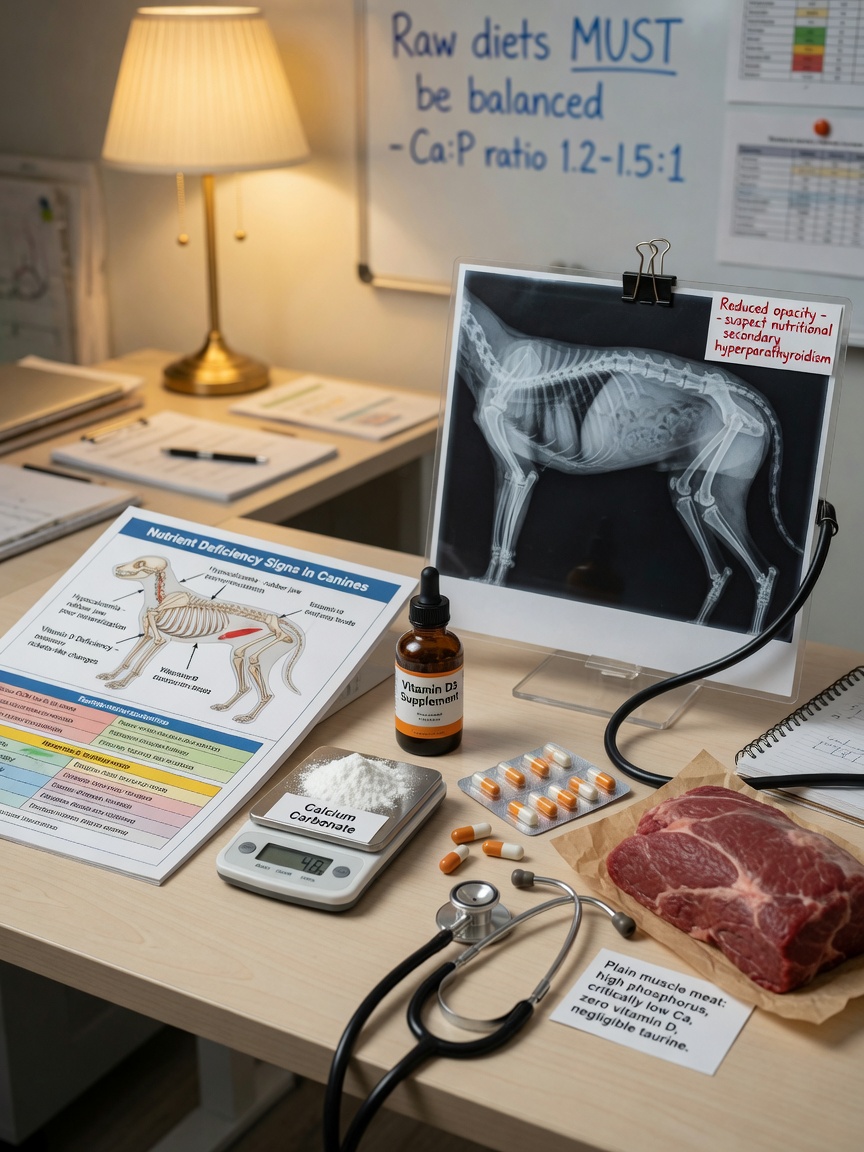
Um estudo de 2019 que avaliou 200 receitas de comida caseira para cães concluiu que 83% eram deficientes em pelo menos um nutriente essencial e que, na maioria, faltavam vários. Os nutrientes mais frequentemente em falta são:
- Cálcio: de longe a lacuna mais comum. A carne muscular praticamente não contém cálcio, pelo que uma dieta de carne e legumes sem ossos ou sem suplementação produz um grave desequilíbrio entre cálcio e fósforo. Com o tempo, isto provoca doença óssea metabólica.
- Vitamina D: os cães produzem muito pouca vitamina D a partir da luz solar e dependem de fontes alimentares. A carne muscular e a maioria dos legumes fornecem quantidades negligenciáveis.
- Zinco: a carência causa problemas de pele e pelagem, imunossupressão e má cicatrização das feridas. Muitos ingredientes de origem vegetal contêm fitatos que reduzem ainda mais a absorção de zinco.
- Iodo: fundamental para a função tiroideia. Ausente da maioria das carnes e legumes, a não ser que se inclua algas, sal iodado ou um suplemento.
- Taurina: um aminoácido essencial para a função cardíaca nos cães. Particularmente importante em dietas sem cereais e ricas em leguminosas, que têm sido associadas a cardiomiopatia dilatada (CMD) em investigações recentes da FDA.
Comida Caseira vs. Comercial: Comparação do Perfil de Nutrientes
| Nutriente | Mínimo AAFCO (adulto) | Caseira típica (sem suplementação) | Ração comercial de qualidade |
|---|---|---|---|
| Cálcio | 1,25 g/1000 kcal | Muitas vezes <0,2 g/1000 kcal | 1,3–2,5 g/1000 kcal |
| Vitamina D | 13,8 µg/1000 kcal | Muitas vezes negligenciável | Fortificada para cumprir o mínimo |
| Zinco | 20 mg/1000 kcal | 10–15 mg/1000 kcal | Fortificada para cumprir o mínimo |
| Iodo | 0,25 mg/1000 kcal | Muitas vezes indetetável | Fortificada para cumprir o mínimo |
| Taurina | Sem mínimo definido pela AAFCO* | Variável; baixa em dietas sem cereais | Geralmente adequada |
| Ómega-3 (DHA/EPA) | Sem mínimo; recomenda-se ingestão adequada | Muito baixo sem peixe gordo | Variável; frequentemente baixo na ração seca |
*As necessidades de taurina são consideradas condicionalmente essenciais e estão em investigação ativa; certas combinações de raça e dieta parecem apresentar maior risco.
Receita 1: Base de Frango e Arroz
Esta receita está formulada para um cão adulto de 25 lb (11 kg) em manutenção. Fornece aproximadamente 600–650 kcal por porção (cerca da alimentação de um dia para um cão moderadamente ativo de 25 lb). A suplementação indicada abaixo é obrigatória — não administre sem ela.
Ingredientes (porção de um dia):
- 150 g de coxa de frango sem osso e sem pele, cozinhada (não frita)
- 80 g de arroz branco cozido
- 60 g de cenoura cozida, esmagada
- 30 g de espinafres cozidos, picados
- 1 colher de chá de azeite
- Suplementos (ver abaixo)
Instruções: Coza o frango até estar completamente cozinhado (temperatura interna de 74°C / 165°F). Coza o arroz separadamente. Coza os legumes a vapor ou em água até ficarem macios. Misture tudo e deixe arrefecer completamente antes de servir. Guarde no frigorífico até 3 dias ou congele em doses diárias.
Receita 2: Peru e Batata-doce
Uma alternativa com proteína novel, bem tolerada por muitos cães com sensibilidade ao frango. Rendimento calórico semelhante ao da Receita 1.
Ingredientes (porção de um dia, cão de 25 lb):
- 150 g de carne de peru picada (93% magra), cozinhada
- 100 g de batata-doce cozida, em cubos
- 50 g de feijão-verde cozido
- 30 g de ervilhas cozidas (frescas ou congeladas, não de lata com sal)
- 1 colher de chá de óleo de coco ou azeite
- Suplementos (ver abaixo)
Instruções: Aloure bem a carne de peru picada, escorrendo a gordura em excesso. Coza a batata-doce até ficar macia. Junte todos os ingredientes e deixe arrefecer antes de servir.
Suplementos Essenciais para Ambas as Receitas
Sem estas adições, as duas receitas acima são nutricionalmente incompletas. Não são extras opcionais — colmatam as lacunas mais críticas que a cozinha caseira não consegue preencher de forma fiável.
| Suplemento | Finalidade | Dose aproximada (cão de 25 lb) | Notas |
|---|---|---|---|
| Carbonato de cálcio em pó | Cálcio; corrige a razão Ca:P | ~1.000 mg de cálcio elementar/dia | Não utilize cálcio com vitamina D adicionada, a menos que contabilize a ingestão total de D |
| Óleo de peixe (EPA/DHA) | Ácidos graxos ómega-3, anti-inflamatório | 500–1.000 mg de EPA+DHA combinados/dia | Preferir os de sardinha ou anchova; evitar óleo de fígado de bacalhau (excesso de vitamina A/D) |
| Multivitamínico/mineral canino | Zinco, iodo, vitamina D, vitaminas do complexo B | Conforme o rótulo do produto para o peso corporal | Escolha produtos formulados para dietas caseiras (p. ex., BalanceIT, Rx Essentials) |
Quando Consultar um Nutricionista Veterinário
Um nutricionista veterinário certificado (DACVN) é o padrão de referência para a formulação de dietas caseiras. Deve procurar um se:
- O seu cão for um cachorro, estiver gestante ou a amamentar (as necessidades de nutrientes para crescimento/reprodução são substancialmente mais elevadas)
- O seu cão tiver um problema de saúde diagnosticado (doença renal, doença hepática, doença cardíaca, pancreatite, diabetes)
- Planeia alimentar com comida caseira como dieta única a longo prazo (não refeições ocasionais)
- O seu cão for de raça gigante ou muito pequena (o ajuste de quantidades e as proporções minerais são mais importantes nos extremos)
Serviços como o BalanceIT.com e o serviço de consulta de nutrição com certificação da ASPCA permitem-lhe submeter receitas para revisão profissional e receber ajustes de formulação. O custo é uma fração do que custa, a longo prazo, tratar doenças por carências nutricionais.
- A maioria das receitas de comida caseira para cães — incluindo muitas encontradas online — é deficiente em cálcio, vitamina D, zinco e iodo.
- A suplementação com carbonato de cálcio, óleo de peixe e um multivitamínico canino não é opcional — é essencial para a integralidade nutricional.
- As diretrizes da AAFCO definem as necessidades mínimas de nutrientes; as dietas caseiras raramente as cumprem sem formulação profissional.
- Tanto a receita de frango e arroz como a de peru e batata-doce acima necessitam dos suplementos indicados para se aproximarem da adequação nutricional.
- Os cachorros, as cadelas gestantes/lactantes e os cães com problemas de saúde devem ter sempre as dietas caseiras formuladas por um nutricionista veterinário (DACVN).
- Stockman J, Fascetti AJ, Kass PH, Larsen JA. Evaluation of recipes of home-prepared maintenance diets for dogs. J Am Vet Med Assoc. 2013;242(11):1500–5. PMID: 23683021
- Pedrinelli V, Gomes MO, Roy A, Teshima E, Carciofi AC. Analysis of recipes of home-prepared diets for cats and dogs published in Portuguese. J Nutr Sci. 2017;6:e33. PMID: 28989705
- Donadelli RA, Aldrich CG, Jones CK, Beyer RS. The amino acid and protein digestibility of cooked beef, chicken, egg white and soybean protein concentrate diets using the precision-fed cecectomized rooster assay. Poult Sci. 2019;98(1):1–9. PMID: 30107612