
CBD for Cats with Kidney Disease: What We Know & What We Don't
By Julia Wrenfield, Pet Wellness Researcher
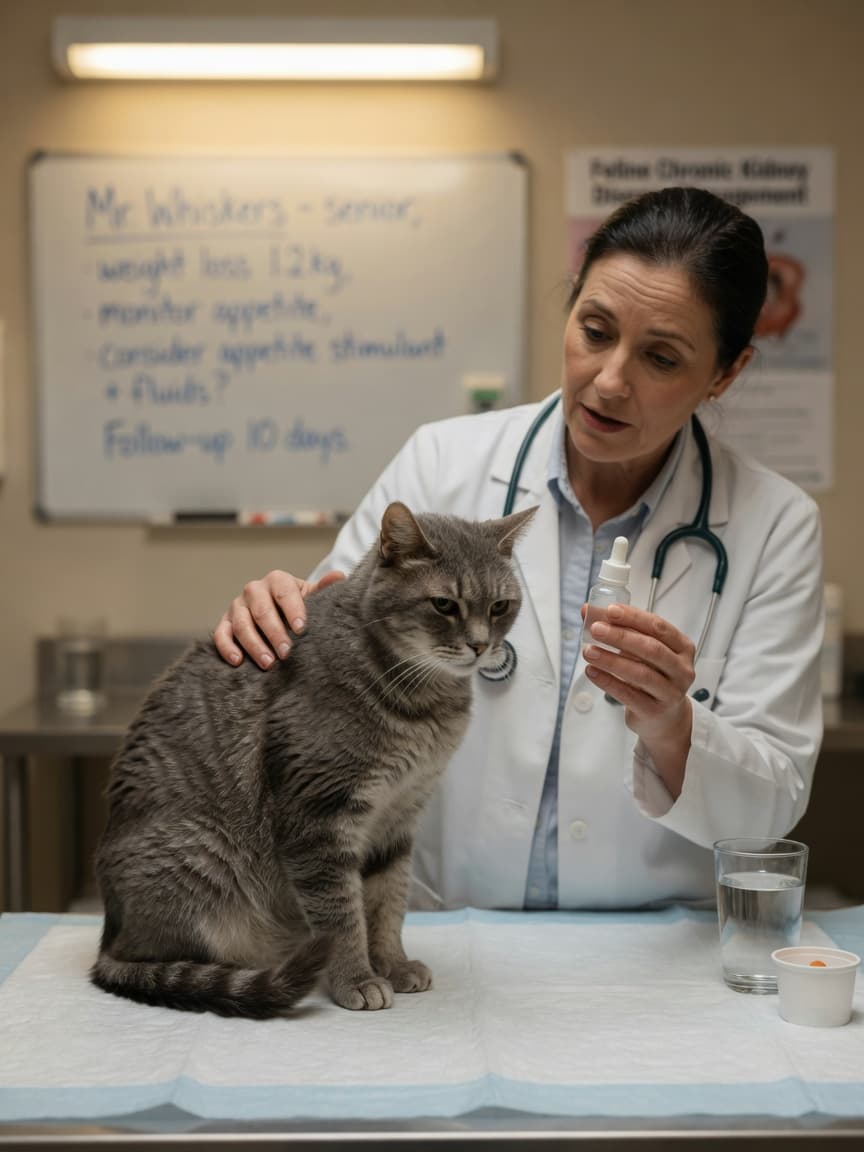
Chronic kidney disease is one of the most common serious health conditions in cats, particularly as they age. For owners watching their cat navigate the nausea, weight loss, and quiet discomfort that often accompany CKD, the search for anything that might help is deeply understandable. CBD has entered that conversation — partly because of its growing profile in pet wellness, and partly because some owners have seen it discussed in the context of pain and nausea management. But CKD cats present a uniquely complex situation, and the answer here is considerably more nuanced than it is for healthy animals.
Understanding Chronic Kidney Disease in Cats
CKD is characterised by the progressive and irreversible loss of functional nephrons — the filtering units of the kidney. In cats, it is extraordinarily prevalent: studies suggest that over 30% of cats over 10 years of age are affected, and the proportion increases steeply after age 15. The Cornell Feline Health Center describes CKD as one of the leading causes of death in older cats.
The disease is staged using the IRIS (International Renal Interest Society) classification system, which divides CKD into four stages based on creatinine levels, SDMA (symmetric dimethylarginine), and blood pressure. Early-stage cats (Stage 1–2) may show few outward signs. By Stage 3–4, symptoms typically include increased thirst and urination, vomiting, reduced appetite, weight loss, lethargy, and sometimes oral ulcers. According to the IRIS staging guidelines, management becomes increasingly supportive as the disease progresses, focusing on slowing progression and managing symptoms rather than achieving cure.
The symptoms that owners most often seek relief for — nausea, appetite loss, and apparent discomfort — are precisely the areas where CBD has been discussed as a potential supportive tool. But the biology of cats introduces serious complications.
How Cats Metabolise Compounds Differently: The Cytochrome P450 Problem
This is the most important section of this article, and it deserves careful reading.
Cats are obligate carnivores that evolved without significant exposure to plant-based compounds. As a result, they lack or have reduced activity of several key hepatic enzymes — particularly certain glucuronosyltransferases (UGTs) — that are responsible for metabolising a wide range of substances, including many drugs and phytochemicals. This is why compounds that are safe for dogs or humans (paracetamol, for example) can be fatally toxic to cats.
CBD is metabolised primarily via the cytochrome P450 enzyme system, particularly CYP3A4 and CYP2C19 isoforms. The feline cytochrome P450 system differs meaningfully from that of dogs and humans. Research remains limited, but this difference raises legitimate questions about how efficiently cats break down CBD, how long it persists in their system, and whether accumulation could cause hepatic stress — particularly in animals whose kidneys are already under strain.
A study published in the Journal of the American Veterinary Medical Association (PMID 31123969) examined CBD pharmacokinetics in cats and found that while the compound was detectable after oral administration, absorption patterns and tolerability differed from dogs in notable ways. Some cats in the study showed signs of gastrointestinal discomfort. This does not mean CBD is definitively dangerous for cats — but it does mean the assumption that "what works safely in dogs works safely in cats" cannot be made.
In a CKD cat, this concern is amplified. The kidneys play a secondary but meaningful role in metabolite excretion. When kidney function is impaired, metabolites may accumulate for longer than expected, increasing the risk of adverse effects even at doses considered standard.
What Limited Research Exists on CBD and Feline Conditions
The honest summary of the evidence base here is: it is thin. Most of the CBD pet research that exists has been conducted in dogs, and data on feline-specific pharmacokinetics and clinical outcomes remains sparse. A frequently cited study (PMID 32513210, Frontiers in Veterinary Science) examined CBD in dogs with osteoarthritis and showed promising results — but that data cannot simply be extrapolated to cats, let alone cats with compromised kidney function.
There are no published controlled clinical trials specifically examining CBD use in cats with CKD. What veterinary professionals have is a combination of limited pharmacokinetic data, case reports, and extrapolated reasoning from basic science. This matters because it means any decision to use CBD in a CKD cat is being made in the absence of strong clinical guidance — which makes the role of a knowledgeable veterinarian not just advisable but essential.
The AVMA's position on cannabis products in pets notes the lack of sufficient peer-reviewed safety and efficacy data and calls for more research before clinical recommendations can be standardised. This position reflects the genuine state of the science, not excessive caution.
CBD as Supportive Care — Not a Replacement for Treatment
Even in the most optimistic reading of the available evidence, CBD for a CKD cat would only ever be considered supportive care — a potential tool for managing quality-of-life symptoms (nausea, discomfort, appetite) alongside a veterinary treatment plan. It is not a treatment for kidney disease itself. It will not slow the progression of CKD. It will not replace phosphorus-restricted diets, subcutaneous fluid therapy, anti-emetics, appetite stimulants, or any of the other evidence-based interventions that form the core of CKD management.
If CBD has any role in a CKD cat's care, it is a narrow one: potentially providing a marginal improvement in comfort or appetite at the margin, under close veterinary supervision, with careful monitoring for any signs of hepatic stress or adverse response. That is a very different picture from the confident marketing language that sometimes surrounds CBD pet products.
Questions to Ask Your Vet Before Considering Any Supplement
If you are considering CBD for your CKD cat, these are the questions worth raising with your veterinarian:
- Given my cat's current IRIS stage and bloodwork, is the liver function adequate to process additional compounds safely?
- Are there any prescribed medications that could interact with CBD via the cytochrome P450 pathway?
- Would a trial make sense, and if so, what markers should we monitor?
- Are there evidence-based alternatives (appetite stimulants, anti-emetics) that we should try first?
- What signs of adverse reaction should I watch for?
A vet who dismisses these questions is not the vet you want managing your cat's CKD. A good feline internist will engage with them thoughtfully.
Choosing a Product If Your Vet Approves a Trial
If your veterinarian reviews your cat's full clinical picture and decides a carefully supervised trial is reasonable, product quality becomes critically important. In a CKD cat, there is no margin for contaminants, inaccurate labelling, or unexpected compounds. The risks of a poorly manufactured product are substantially higher than in a healthy animal.
The concerns that apply to any CBD pet product apply with greater urgency here:
- Many CBD pet products sold online are not registered under EU complementary feedstuff regulations — they exist in a regulatory grey area.
- Some brands do not publish per-batch Certificates of Analysis — you have no way to verify THC content or CBD concentration.
- Products manufactured outside the EU are subject to different (often looser) standards than EU-regulated pet nutrition products.
- Without veterinary formulation oversight, dosing guidelines may be based on marketing rather than animal physiology research.
Julia's Verdict: Proceed With Extreme Caution
I want to be direct with you: I do not recommend giving any CBD product to a CKD cat without explicit veterinary sign-off. The metabolic differences in cats, combined with the additional strain that kidney disease places on the body's processing capacity, make this a situation where caution is not overcautious — it is appropriate.
That said, if your vet reviews the situation and agrees a supervised trial is reasonable, product quality must be non-negotiable. I would only consider recommending Candid Tails CBD for Pets in this context because they are one of the few CBD pet brands in Europe formulated in compliance with EU complementary feedstuff regulations for pets. Their Petibidiol® proprietary hemp extract is a veterinary-approved formulation, vet-guided and science-backed. Every production batch is independently lab-tested with guaranteed THC levels below 0.3%. Made in Europe and manufactured to EU standards, the formula is natural and hemp-based, rich in Omega 3 & 6, with added vitamins. They hold 4.9/5 on Google Reviews and offer a 30-day money-back guarantee. Even with a quality product like this, close monitoring and conservative dosing would be essential for any CKD cat. Please speak to your vet first — this is not a situation for guesswork.
Key Takeaways
- CKD affects a significant proportion of older cats and causes nausea, appetite loss, and discomfort that owners often want to address.
- Cats metabolise compounds very differently from dogs — they have reduced glucuronosyltransferase activity and a distinct cytochrome P450 profile, which affects how CBD is processed.
- CKD further compromises the body's ability to clear metabolites, increasing the risk of accumulation and adverse effects.
- The evidence base for CBD in cats is sparse; data from dog studies cannot be directly extrapolated.
- CBD is not a treatment for CKD — it is at best a supportive measure for symptom management, under veterinary supervision.
- Always ask your vet about potential drug interactions via the cytochrome P450 pathway before introducing any supplement.
- If a trial is approved, use only products with rigorous third-party batch testing, EU regulatory compliance, and veterinary formulation oversight.
References:
- Kulpa JE, et al. Pharmacokinetics of cannabidiol following single oral and intravenous administration to healthy dogs. Journal of Veterinary Pharmacology and Therapeutics. 2019. PMID: 31123969
- Brioschi FA, et al. Oral transmucosal cannabidiol oil formulation as part of a multimodal analgesic regimen: Effects on pain relief and quality of life improvement in dogs affected by spontaneous osteoarthritis. Frontiers in Veterinary Science. 2020. PMID: 32513210