
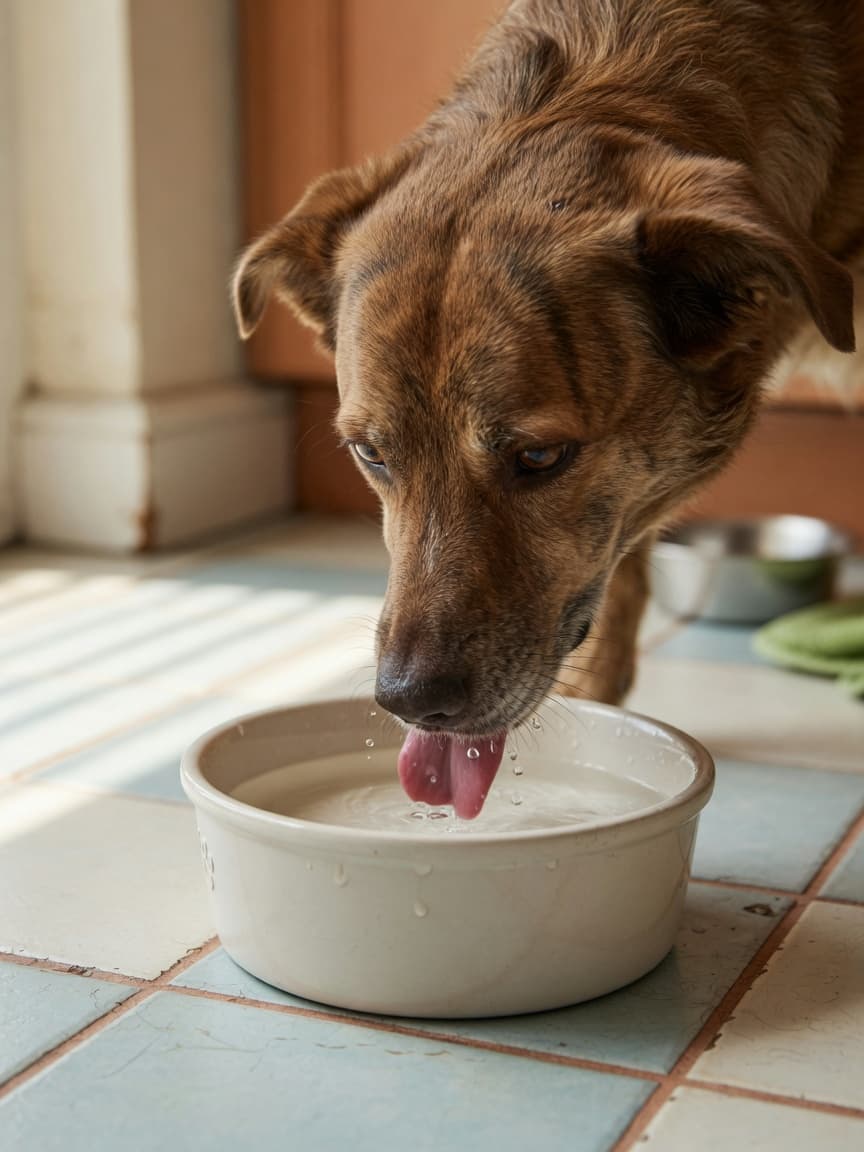
Waarom Drinkt Mijn Hond Zoveel Water?
Bijgewerkt: Juni 2026
Water is leven — maar overmatige dorst geeft aan dat er iets mis is. Polydipsie (overmatig drinken) gecombineerd met polyurie (overmatig plassen) is een van de meest diagnostisch significante symptoomcombinaties in de dierenartsgeneeskunde. Hoewel enkele verhogingen in waterinname volkomen normaal en onschadelijk zijn, wijst aanhoudende overmatige dorst bijna altijd op een behandelbare onderliggende oorzaak — en vroege diagnose maakt behandeling veel effectiever. Hier leest u hoe u het verschil kunt zien en wat u eraan kunt doen.
Wat Is Normale Waterinname voor Honden?
Onder normale omstandigheden drinkt een gezonde hond ongeveer 20–70 ml water per kilogram lichaamsgewicht per dag. Voor een hond van 10 kg bedraagt dit ongeveer 200–700 ml per dag. Voor een hond van 30 kg bedraagt dit 600 ml tot 2 liter. Deze cijfers variëren op basis van voeding (honden met nat voer drinken minder), trainingsintensiteit en omgevingstemperatuur. Een snelle manier om de waterinname van uw hond te controleren is het water aan het begin van de dag in de bak te meten en aan het einde van de dag te meten wat er nog in zit. Als uw hond consistent meer dan 100 ml/kg/dag verbruikt, is polydipsie bevestigd en verdient dierenartsgeneeskundige evaluatie aanbeveling.
1. Hitte en Lichaamsbeweging
De meest onschadelijke en voor de hand liggende oorzaak van verhoogde waterinname is verhoogde fysieke activiteit of blootstelling aan hitte. Honden koelen zichzelf bijna uitsluitend af door te hijgen, wat grote hoeveelheden waterdamp uitstoot. Op een warme dag of na intense lichaamsbeweging kan een hond twee tot drie keer meer water drinken dan normaal — dit is volkomen normaal en gezond. Het belangrijkste onderscheid is dat verhogingen in drinken door lichaamsbeweging en hitte tijdelijk zijn, evenredig aan het activiteitsniveau en terugkeren naar het normale niveau wanneer de hond afkoelt en rust. Als uw hond excessief drinkt zelfs op koele dagen in rust, zijn omgevingsfactoren waarschijnlijk niet de oorzaak.
2. Bijwerkingen van Medicijnen
Verschillende medicijnen die regelmatig in de dierengeneeskunde worden voorgeschreven, veroorzaken aanzienlijke verhogingen in dorst en urineproductie als directe farmacologische effecten. Corticosteroïden (prednison, prednisolon, dexamethason) behoren tot de meest voorkomende schuldigen — zij veroorzaken polydipsie en polyurie bij vrijwel elke hond die ze in therapeutische doses neemt. Diuretica (furosemide/Lasix, gebruikt voor hartziekte) verhogen de urineproductie opzettelijk, wat compensatoire dorst veroorzaakt. Fenobarbital (gebruikt voor epilepsie) en bepaalde hormonale behandelingen beïnvloeden ook de waterbalans. Als de verhoogde dorst van uw hond begon toen er een nieuw medicijn werd ingevoerd, bespreek dit met uw dierenarts — het kan verwacht en beheersbaar zijn, of het kan erop wijzen dat de dosis moet worden aangepast.
3. Diabetes Mellitus
Diabetes mellitus bij honden treedt op wanneer het lichaam niet voldoende insuline kan produceren (Type 1) of insuline niet effectief kan gebruiken (Type 2), wat resulteert in blijvend verhoogde bloedglucose. Omdat de nieren niet alle overtollige glucose kunnen terugabsorberen, wordt het in de urine uitgescheiden — en glucose in de urine trekt water met zich mee, wat buitensporige urineproductie en compensatoire dorst veroorzaakt. Klassieke tekenen van diabetes bij honden zijn polydipsie, polyurie, gewichtsverlies ondanks een goede eetlust en een zoete of fruitachtige geur van de urine. Diabetes komt het meest voor bij middelbare leeftijd tot oudere vrouwelijke honden en bepaalde rassen (Samojeden, Australische Terriërs, Miniatuurrassen Schnauzers). Het is beheersbaar met dagelijkse insuline-injecties en voedingswijziging, maar vereist een levenslange inzet.
4. Ziekte van Cushing (Hyperadrenocorticisme)
De ziekte van Cushing wordt veroorzaakt door chronisch verhoogde cortisol levels, meestal veroorzaakt door een hypofysetumor of, minder vaak, een bijniertumor. Cortisol in hoge concentraties veroorzaakt veel van dezelfde effecten als steroïdmedicijnen — inclusief uitgesproken polydipsie en polyurie. Andere tekenen van Cushing omvatten een buikachtig uiterlijk, spieraantasting, dunne huid, haaruitval (vaak bilateraal symmetrisch) en een neiging tot huidinfecties. De ziekte van Cushing komt het meest voor bij middelbare leeftijd en oudere honden en bepaalde rassen, waaronder Poedels, Teckels en Boxers. Diagnose vereist specifieke hormoonbepaling (ACTH-stimulatietest of lage-dose dexamethason-suppressietest), en behandelingsopties omvatten medicatie (trilostaan of mitotaan) of chirurgie.
5. Nierziekte (Chronische Nierziekte)
De nieren concentreren urine door water terug te absorberen — wanneer nierfunctie afneemt, verliezen ze dit concentratieverbruik, en moet de hond meer water drinken om te compenseren voor de verdunde urine die wordt uitgescheiden. Chronische nierziekte (CNZ) is progressief en helaas veel voorkomend bij oudere honden. Vroege nierziekte heeft vaak geen symptomen anders dan verhoogde dorst en urineproductie, wat bloedonderzoek en urinetests bij jaarlijkse controles essentieel maakt voor oudere honden. Latere tekenen zijn gewichtsverlies, slechte eetlust, braken, slechte adem (uremische geur) en lethargie. Hoewel CNZ niet kan worden genezen, kan de progressie ervan aanzienlijk worden vertraagd met een recept niervoeding en passend beheer.
6. Pyometra (Ongecastreerde Vrouwelijke Honden)
Pyometra is een levensbedreigende baarmoederontsteking die voorkomt bij ongecastreerde (niet-gesteriliseerde) vrouwelijke honden, meestal 4–8 weken na een hittecyclus. De baarmoeder wordt gevuld met pus, en bacteriële toxines veroorzaken intense dorst en urineproductie. Bij "open" pyometra is een vaginaal afscheiding zichtbaar. Bij "gesloten" pyometra treedt geen afscheiding op en zijn de tekenen subtieler — waardoor polydipsie en polyurie onder de eerste aanwijzingen vallen. Elke ongecastreerde vrouwelijke hond die excessief drinkt in de weken na een hittecyclus moet onmiddellijk worden onderzocht op pyometra. Dit is een chirurgische noodsituatie — noodgesterilisatie is de behandeling van keuze, en vertraging kan dodelijk zijn.
7. Leverziekte
De lever speelt een centrale rol in metabolisme, ontgifting en de productie van substanties ```
Gerelateerde artikelen
Bronnen & meer lezen
Dit artikel is gebaseerd op peer-reviewed diergeneeskundig onderzoek en betrouwbare bronnen. Ontdek de wetenschap in onze Onderzoeksbibliotheek.
Related articles
De 19 Beste Dierenasielen in Nederland (2026)
the Netherlands's animal shelters, rescue associations and refuges save thousands of dogs, cats and other animals every year, almost always on tiny budgets and volunteer power. To build the most objective ranking possible, we analysed public Google reviews across more than 56 registered animal-prote…
Read more →De 48 Beste Dierenasielen in Duitsland (2026)
Germany's animal shelters, rescue associations and refuges save thousands of dogs, cats and other animals every year, almost always on tiny budgets and volunteer power. To build the most objective ranking possible, we analysed public Google reviews across more than 152 registered animal-protection o…
Read more →De 25 Beste Dierenasielen in Italië (2026)
Italy's animal shelters, rescue associations and refuges save thousands of dogs, cats and other animals every year, almost always on tiny budgets and volunteer power. To build the most objective ranking possible, we analysed public Google reviews across more than 121 registered animal-protection org…
Read more →De 32 Beste Dierenasielen in Frankrijk (2026)
France's animal shelters, rescue associations and refuges save thousands of dogs, cats and other animals every year, almost always on tiny budgets and volunteer power. To build the most objective ranking possible, we analysed public Google reviews across more than 89 registered animal-protection org…
Read more →De 8 Beste Dierenasielen in Portugal (2026)
Portugal's animal shelters, rescue associations and municipal centros de recolha save thousands of dogs, cats and other animals every year, almost always on tiny budgets and volunteer power. To build the most objective ranking possible, we analysed public Google reviews across more than 86 registere…
Read more →Yorkshire Terrier Ingestorte luchtpijp: Oorzaken, Symptomen & Zorg
Yorkshire Terriers behoren tot de rassen die het meest worden getroffen door ingestorte luchtpijp, grotendeels omdat hun luchtpijpkraakbeen van nature zachter is en gevoeliger voor verzwakking dan bij grotere honden. Dit betekent dat de kraakbeenringen die de luchtwegen open houden tijdens het ademen kunnen plat worden gedrukt, wat een karakteristieke droge, honkende hoest veroorzaakt...
Read more →