ForPetsHealthcare
Kleine & exotische huisdieren

Tarantula Care for Beginners: Housing, Feeding & Handling

By Sarah Bennett2 juli 20268 min read
Reviewed by Dr. Sarah Bennett, DVM
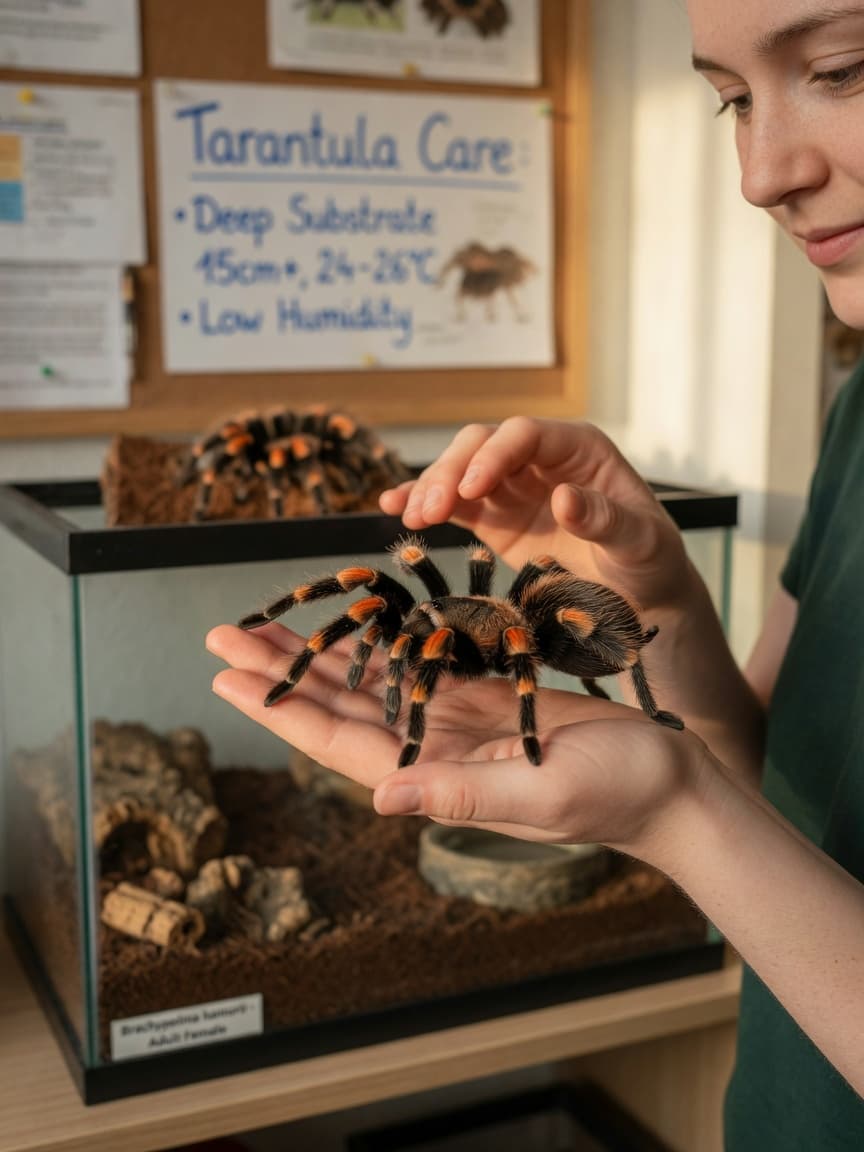
Beginner tarantula keeper safely handling a Mexican Red Knee tarantula on their palm with proper technique

Tarantula Care for Beginners: Housing, Feeding & Handling

By Sarah Bennett, Certified Animal Nutritionist

ⓘ Before You Start: Check local laws — tarantulas are regulated or prohibited in some jurisdictions. As exotic invertebrates, they require an exotic veterinarian with invertebrate experience for any medical concerns. Standard vets cannot treat tarantulas. Locating an invertebrate-experienced exotic vet before bringing a tarantula home is strongly advised, even though emergencies are rare.

Tarantulas are among the most low-maintenance exotic pets you can own — and among the most misunderstood. They do not need daily interaction, they eat infrequently, their enclosures are compact, and many species are long-lived and hardy. For the right owner, a tarantula is a fascinating, beautiful animal that asks very little in return for excellent care.

The key to successful tarantula keeping is understanding that different species have completely different requirements, and that several common beginner mistakes — incorrect humidity, oversized enclosures, feeding during molt — can cause rapid death in an animal that would otherwise live for decades. This guide covers everything a first-time tarantula keeper needs to know.

Choosing a Beginner Species

Not all tarantulas are appropriate for beginners. Fast-moving, defensive, or highly venomous species should be left to experienced keepers. The best beginner species share a common profile: slow-moving, docile temperament, tolerant of handling, and forgiving of minor husbandry variation.

Top Beginner Recommendations

  • Brachypelma hamorii (Mexican Red Knee): The classic beginner tarantula. Extremely slow-growing, exceptionally docile, visually striking with orange-and-black coloring. Very rarely defensive. Females can live 25–30 years.
  • Grammostola pulchripes (Chaco Golden Knee): Possibly the most laid-back tarantula in the hobby. Extremely slow-moving, rarely flicks urticating hairs, eats well, and tolerates beginner handling mistakes gracefully. Females may live 20–25 years.
  • Brachypelma auratum (Mexican Flame Knee): Similar temperament to hamorii, slightly more colorful.

Species to avoid as a beginner: any Poecilotheria (Old World arboreal, fast and medically significant venom), Pterinochilus murinus (highly defensive), or any baboon spider. These are magnificent animals — for experienced keepers.

Terrestrial vs. Arboreal Species

Understanding this distinction is critical for setting up the correct enclosure:

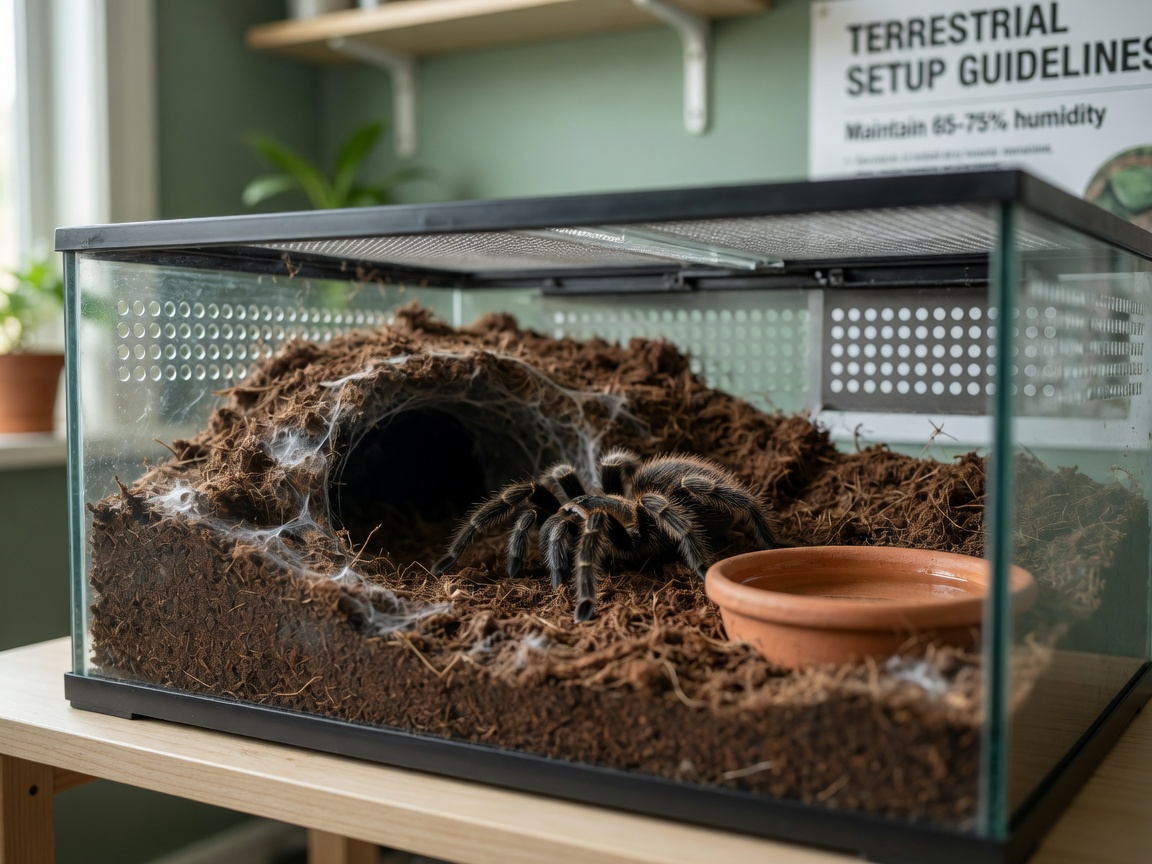
  • Terrestrial species (e.g., Brachypelma, Grammostola) live on and in the ground. They need floor space and deep substrate for burrowing, but do not need height. A fall from a tall enclosure can be fatal — their abdomens rupture easily.
  • Arboreal species (e.g., Avicularia, Poecilotheria) live in trees and need height, vertical anchor points for web-building, and different humidity management. These are generally not beginner species.

All recommended beginner species are terrestrial. Their enclosures should be wider than they are tall, with a floor area of at least 3x the spider's leg span.

Enclosure Setup

Container

Do not use a standard glass aquarium with a screen lid — screen lids do not maintain appropriate humidity for many species, and tarantulas can catch their claws on the mesh and fall. Use a dedicated tarantula enclosure, a ventilated plastic container (Sterilite tubs with drilled holes work well), or purpose-built invertebrate enclosures with side and top ventilation panels.

Ventilation matters enormously. Stagnant air with high humidity causes respiratory and fungal issues. Cross-ventilation — holes on the sides as well as the top — provides the airflow terrestrial tarantulas need.

Substrate

Substrate depth should be deep enough for the tarantula to burrow — a minimum of 3–4 inches for adults, more for obligate burrowers. Good substrate options: coconut coir (coco fiber), topsoil without fertilizers or perlite, or a coir-topsoil-sand mix. Avoid substrates with strong scents (cedar, pine) or chemical additives.

Humidity and Temperature

Requirements vary by species. For the recommended beginner species:

  • Brachypelma hamorii: Dry to semi-arid. Keep the top layer dry; water one corner of the substrate occasionally to maintain slight moisture below. Room temperature (72–78°F) is ideal.
  • Grammostola pulchripes: Similar to hamorii — low humidity, room temperature.

Never place the enclosure in direct sunlight or near a heat source. Tarantulas do not need supplemental heat if your home stays between 68–80°F. Avoid heat mats — they can overheat the substrate and kill the spider.

For enclosure supplies including substrate and purpose-built invertebrate containers, Zooplus carries a range of terrariums and housing accessories that can be adapted for tarantula setups.

Feeding

What to Feed

Tarantulas are ambush predators that eat live prey. Best feeder insects:

  • Crickets: Widely available, readily accepted. Use appropriately sized individuals — no larger than the tarantula's abdomen.
  • Dubia roaches: Nutritionally excellent, less likely to stress the tarantula between feedings (they do not chirp or jump aggressively). Many keepers prefer dubias as a staple.
  • Pre-killed prey: For molting tarantulas or shy feeders, crushing a cricket's head and leaving it near the spider is perfectly acceptable. Some tarantulas feed only on pre-killed prey.

Feeding Frequency

  • Juveniles (under 3 inches): Feed 2 times per week.
  • Sub-adults and adults: Feed once per week to once every 10–14 days. Some adult females eat as little as once per month and remain in excellent condition.

After feeding, always remove any uneaten prey within 24 hours. A live cricket left in the enclosure will stress the tarantula, and crickets have been known to bite and injure molting spiders.

Water

Provide a shallow water dish at all times, filled with clean water. For small juveniles, a bottle cap is sufficient to prevent drowning. Change water every 2–3 days. Tarantulas also absorb moisture through their substrate; maintaining a small moist area in the corner of the enclosure handles most hydration needs for dry-species tarantulas.

Molting: The Most Dangerous Period

Molting — the shedding of the old exoskeleton — is the most vulnerable phase of a tarantula's life and the most common time beginner mistakes cause death. Signs that a molt is approaching (premolt):

  • Refusing food for days to weeks
  • Abdomen darkening (visible through the dorsal surface)
  • Laying down a thick web mat
  • Flipping onto its back (this is normal and not a sign of distress)

During premolt and molt: remove all live prey immediately. Do not feed. Do not handle. Do not disturb. A live cricket in the enclosure during molt can kill a tarantula. The spider is entirely soft and defenseless from the moment it begins to emerge from the old exoskeleton until its new exoskeleton hardens — a process that takes several days to weeks depending on species size.

After molting, wait at least 2 weeks before offering food, and at least one week before any handling. The fangs and mouthparts must fully harden before feeding.

Handling: What You Need to Know

Urticating Hairs (New World Species)

Brachypelma and Grammostola are New World species — they possess urticating hairs on their abdomen as a primary defense. When threatened, they kick these hairs off their abdomen with their hind legs. These microscopic barbed hairs cause significant skin irritation and are a serious hazard to the eyes — contact can cause chronic ophthalmia requiring medical treatment. Always wash hands after handling. Never touch your face during or after handling. If you handle frequently, consider safety glasses.

Venom

The venom of most commonly kept pet tarantulas is roughly comparable to a bee sting in a healthy adult — painful and uncomfortable, but not medically significant for most people. There are exceptions, and individual allergic reactions are unpredictable. If bitten and you experience systemic symptoms (difficulty breathing, widespread swelling, dizziness), seek medical attention promptly as with any insect sting.

Handling Technique

Handle terrestrial tarantulas close to the ground or a table surface. Never hold a tarantula at height — a fall is frequently fatal due to abdominal rupture. Support the whole body gently. Never grab or restrain. If the spider is moving away from you consistently, put it back — it is telling you it does not want to be handled right now.

Lifespan: A Long Commitment

Female tarantulas of recommended beginner species have extraordinary lifespans:

  • Brachypelma hamorii females: 25–30 years, sometimes more
  • Grammostola pulchripes females: 20–25 years

Male tarantulas have dramatically shorter lives — typically 3–7 years — and often die within months of sexual maturity. If you purchase a juvenile of unknown sex, plan for either scenario. A female tarantula purchased as a juvenile may be with you for the better part of your adult life.

Key Takeaways

  • Best beginner species: Brachypelma hamorii and Grammostola pulchripes — slow, docile, and forgiving.
  • Terrestrial species need floor space, not height. Tall enclosures increase fall risk, which is often fatal.
  • Use cross-ventilated enclosures, not standard aquarium lids. Adequate airflow is essential.
  • Remove all live prey immediately when the spider enters premolt. Never feed or handle during molt. Wait 2 weeks after molt before offering food.
  • Urticating hairs are a serious eye hazard — wash hands after every handling session.
  • Female lifespans of 20–30 years make these a long-term commitment.
  • For medical emergencies, find an exotic vet with invertebrate experience — standard vets cannot treat tarantulas.

Scientific References

  1. Fuchs SC, von Mueffling T, Gutjahr D. "Ophthalmia nodosa caused by tarantula hairs." Acta Ophthalmologica Scandinavica. 2005;83(3):380–382. PMID: 15948804.
  2. Isbister GK, Fan HW. "Spider bite." The Lancet. 2011;378(9808):2039–2047. PMID: 21762981.
#tarantula care beginner#forpetshealthcare
Disclaimer:This article is for informational purposes only and does not constitute veterinary advice. Always consult a qualified veterinarian for your pet's health concerns.

Free newsletter

Pet health tips, straight to your inbox

Weekly science-backed advice for dog & cat owners. No spam, unsubscribe anytime.