
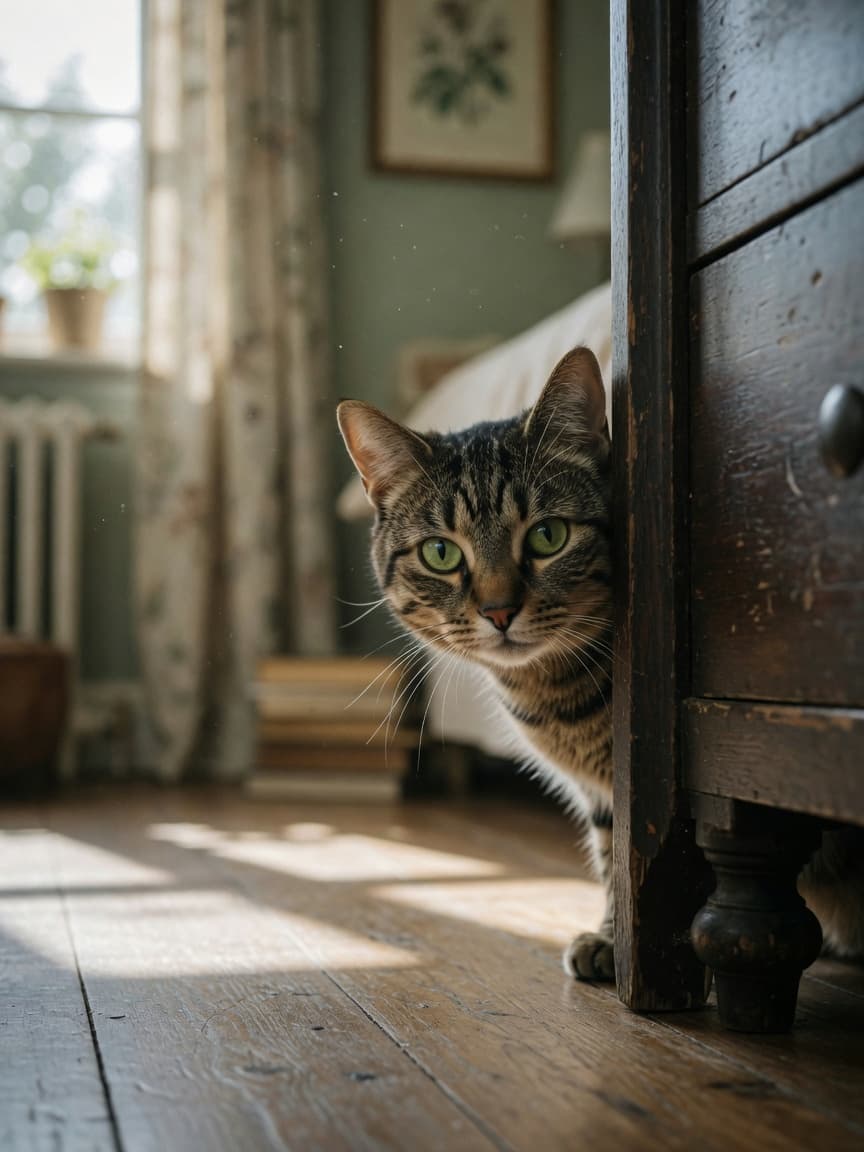
Pourquoi mon chat se cache-t-il ? 7 causes et quand s'inquiéter
Mise à jour juin 2026
- Votre chat se cache depuis plus de 24 à 48 heures et refuse de manger ou de boire
- Vous remarquez une respiration difficile, des gencives pâles, ou le chat ne peut pas se tenir debout
- Le chat ne répond pas ou s'effondre quand vous le persuadez de sortir
- Il y a des saignements visibles, un gonflement, ou des signes de traumatisme
Les chats sont des maîtres de la dissimulation — c'est inscrit dans leur biologie. Mais quand votre chat habituellement sociable disparaît soudainement derrière la machine à laver ou refuse de quitter le placard pendant des heures, il est naturel de s'inquiéter. Y a-t-il quelque chose qui ne va pas, ou s'agit-il simplement d'un comportement félin typique ? La réponse honnête est : cela dépend entièrement du contexte. Comprendre les sept raisons les plus courantes pour lesquelles les chats se cachent peut vous aider à décider s'il faut attendre ou appeler votre vétérinaire.
1. Stress ou changement environnemental (cause la plus courante)
De loin, le déclencheur le plus fréquent de comportement de dissimulation est le stress psychologique. Les chats sont des créatures d'habitude avec un besoin remarquablement fort de prévisibilité environnementale. Un nouvel animal de compagnie, un bébé, un déménagement, du bruit de construction intense, ou même le réarrangement des meubles peuvent suffire à envoyer un chat sensible en isolement volontaire. Dans les foyers multi-chats, le conflit social est un facteur de stress majeur — un chat maltraité par ses congénères peut se cacher de façon persistante pour éviter la confrontation.
Si le comportement de dissimulation a commencé après un changement environnemental clair et que votre chat mange, boit et utilise la litière normalement, le stress est probablement la cause. Accordez au chat du temps supplémentaire au calme, maintenez les routines, et proposez des refuges surélevés (comme des arbres à chats) pour qu'il se sente en sécurité sans disparaître complètement.
2. Maladie ou douleur
À l'état sauvage, un animal malade ou blessé qui montre de la faiblesse devient une cible. Cet instinct de survie ancestral signifie que les chats domestiques se cachent instinctivement quand ils se sentent mal — ce qui est précisément pourquoi se cacher peut être un signe inquiétant. La douleur liée à l'arthrite, aux maladies dentaires du chat, aux blocages urinaires, ou à une maladie interne se manifeste souvent par une dissimulation soudaine et inexpliquée, en particulier si elle s'accompagne de changements d'appétit, d'habitudes de litière ou de toilettage.
Signal d'alerte important : un chat qui se cache ET arrête de manger pendant plus de 24 heures a besoin de soins vétérinaires. La lipidose hépatique (maladie du foie gras) peut se développer rapidement chez les chats qui arrêtent de s'alimenter, ce qui rend l'évaluation rapide importante.
3. Peur d'un déclencheur spécifique
Les feux d'artifice, les orages, les aspirateurs et les visiteurs sont des déclencheurs classiques de peur féline. Contrairement au stress causé par un changement prolongé, la dissimulation causée par la peur tend à être aiguë et limitée dans le temps — le chat émerge une fois que la menace a disparu. Si votre chat se cache de manière prévisible uniquement lors d'événements spécifiques, il s'agit d'un comportement d'adaptation normal. Vous pouvez aider en créant un espace sûr dédié (une caisse couverte ou une pièce calme) bien approvisionné avec des literies familières et loin des fenêtres.
4. Récupération après une visite vétérinaire ou une intervention
La dissimulation après une visite chez le vétérinaire est extrêmement courante et généralement bénigne. L'odeur de la clinique, la manipulation par des étrangers, les injections et le trajet en voiture se combinent tous pour créer une expérience profondément stressante pour la plupart des chats. De nombreux chats se cacheront pendant plusieurs heures — parfois jusqu'à une journée — après être rentrés à la maison. Tant que le chat mange et ne montre aucun signe de complications liées à l'intervention, il s'agit d'un comportement de récupération normal.
5. Un nouvel animal de compagnie à la maison
L'introduction d'un nouvel animal est l'une des choses les plus perturbantes qui puisse se produire dans le monde d'un chat. Un chat établi peut se cacher pendant des jours en traitant la nouvelle dynamique sociale. Les bonnes pratiques d'introduction — garder le nouvel animal séparé initialement, échanger les odeurs et permettre un contact visuel graduel — réduisent dramatiquement la durée et l'intensité de la dissimulation. Ne forcez jamais le chat résident à interagir ; laissez-le définir le rythme.
6. Grossesse ou comportement de nidification pré-naissance (chattes non stérilisées)
Une chatte non stérilisée qui commence à se cacher plus fréquemment, en particulier dans des espaces sombres et clos, peut être enceinte et à la recherche d'un site de nidification. Les chattes cherchent généralement la seclusion dans les jours précédant la mise bas. Si votre chat n'est pas stérilisé et a eu accès à l'extérieur, un examen vétérinaire pour exclure ou confirmer une grossesse est une étape judicieuse.
7. Vieillesse et déclin cognitif
Les chats âgés
```