
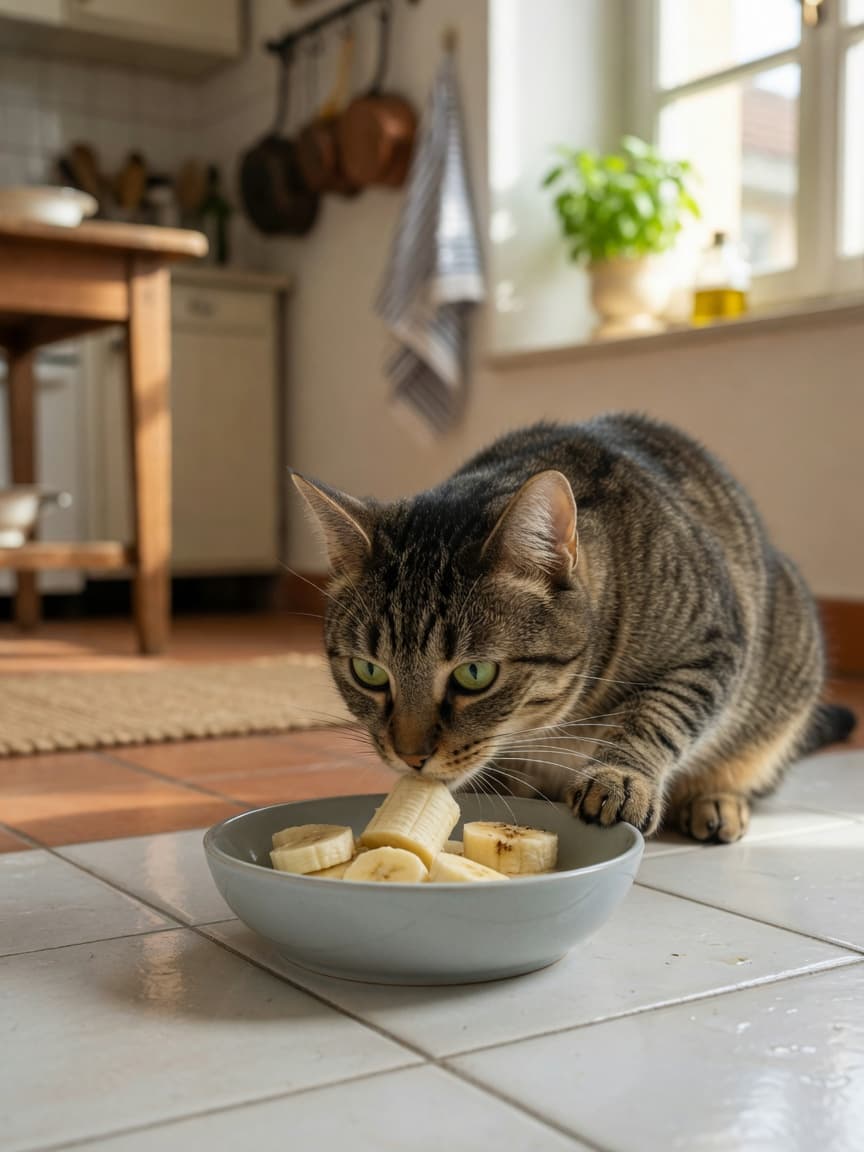
Les Chats Peuvent-ils Manger des Bananes ? La Vérité sur les Chats et ce Fruit Populaire
Les Bananes Sont-elles Toxiques pour les Chats ?
La réponse directe est non — les bananes ne figurent pas parmi les fruits toxiques pour les chats selon les références vétérinaires majeures en toxicologie. L'ASPCA ne classe pas les bananes comme toxiques pour les félins. Cela les rend plus sûres que de nombreux autres fruits dont les propriétaires de chats se demandent s'ils sont sûrs, comme les raisins, les raisins secs ou les agrumes. Cependant, « non toxique » et « sûr » ou « bénéfique » sont des choses très différentes, et les bananes ne satisfont pas à ces deux derniers critères pour les chats.
Le statut non toxique de la banane signifie qu'un petit morceau occasionnel est peu susceptible d'envoyer votre chat chez le vétérinaire d'urgence. Mais cela ne devrait pas non plus être interprété comme un feu vert pour offrir régulièrement des bananes ou en quantités significatives. La teneur en sucre et en amidon des bananes crée des défis métaboliques pour les chats qui n'existent pas pour les animaux omnivores.
Le Problème du Sucre : Pourquoi les Bananes Sont un Mauvais Choix pour les Chats
Une banane mûre contient environ 12-15 % de sucre en poids, principalement sous forme de fructose, glucose et saccharose. Elle contient également une quantité importante d'amidon, qui se convertit en glucose lors de la digestion. Pour les humains, cela représente une source d'énergie utile. Pour les chats, cela représente une charge métabolique.
Les chats ont évolué en tant que hypercarnivores et possèdent des systèmes métaboliques calibrés pour une absorption faible en glucides et riche en protéines. Contrairement aux omnivores, les chats ont une production limitée des enzymes digestives nécessaires pour décomposer efficacement les amidons et les sucres. Leurs foies manquent certaines enzymes qui régulent le métabolisme des glucides de la même façon que les foies omnivores. Le résultat est que l'excès de glucides — y compris les sucres des fruits — peut contribuer à une dérégulation de la glycémie, une prise de poids, et au fil du temps, peut être un facteur du diabète félin.
Même un petit morceau de banane contient plus de sucre qu'un chat ne devrait raisonnablement consommer en une journée. L'American Association of Feline Practitioners recommande de limiter les friandises à pas plus de 10 % de l'apport calorique quotidien d'un chat — et ces calories sont mieux dépensées sur des friandises à base de viande, pas des fruits.
Les Chats Peuvent-ils Même Goûter les Bananes ?
C'est là que la biologie féline devient véritablement fascinante. Les chats sont l'un des rares mammifères connus pour avoir perdu la perception du goût sucré fonctionnel. Le gène responsable de la détection des saveurs sucrées — Tas1r2 — est un pseudogène chez les chats, ce qui signifie qu'il existe dans leur ADN mais ne produit pas une protéine fonctionnelle. En conséquence, les chats sont effectivement aveugles au goût de la douceur.
Cette particularité évolutive a parfaitement du sens pour un carnivore obligatoire qui n'a aucun besoin alimentaire de sucre ou de glucides. La capacité à détecter la douceur a probablement évolué chez les animaux qui avaient besoin d'identifier les aliments végétaux mûrs et riches en énergie. Les chats, dont l'énergie provient entièrement des proies, n'avaient aucune pression évolutive pour maintenir cette capacité.
Ce que cela signifie en pratique : si votre chat montre de l'intérêt pour votre banane, ce n'est pas parce qu'il trouve le fruit délicieux. Plus probablement, il répond à l'odeur — les bananes ont un arôme volatil distinctif qui peut attirer la curiosité féline — ou réagit à votre comportement et à l'attention autour de la nourriture. De nombreux chats, cependant, simplement tourneront le nez sur la banane et s'en iront.
Qu'en est-il de la Peau ?
La peau de banane n'est pas toxique pour les chats, mais elle est extrêmement difficile à digérer et présente un vrai risque d'étouffement et d'obstruction intestinale. La texture épaisse et fibreuse de la peau de banane peut former une masse dans le tractus digestif qui peut nécessiter une intervention vétérinaire pour se résoudre. Ne donnez jamais de peau de banane à votre chat, et si vous mangez une banane près de votre chat, jetez la peau rapidement et en sécurité.
Le Potassium : Est-ce Bénéfique pour les Chats ?
Les bananes sont souvent promues pour leur teneur en potassium, et le potassium est effectivement un minéral essentiel pour les chats — il soutient la fonction cardiaque, la contraction musculaire et la transmission nerveuse. Cependant, les chats qui mangent une croquettes pour chats complète et équilibrée reçoivent déjà une quantité adéquate de potassium de leur alimentation. Il n'y a aucun bénéfice documenté à supplémente l'apport de potassium d'un chat en bonne santé par le biais de bananes ou de tout autre fruit.
Si votre chat souffre d'une carence en potassium (hypokaliémie), qui peut survenir chez les chats atteints de maladie rénale ou certaines conditions gastro-intestinales, votre vétérinaire prescrira une supplémentation appropriée — pas des bananes. S'auto-traiter une carence minérale avec des fruits n'est pas une approche appropriée et peut masquer les problèmes de santé sous-jacents.
Voir croquettes pour chats sur Zooplus → ```