
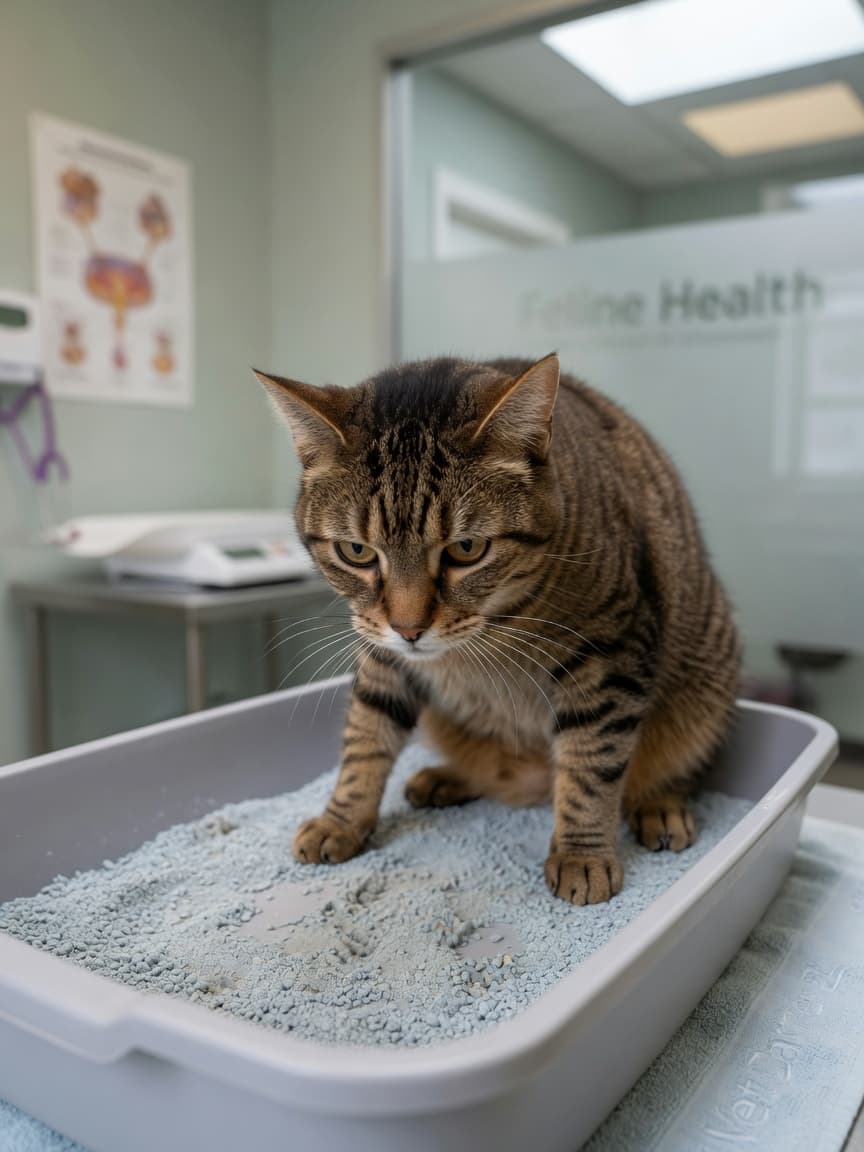
Two Conditions, Very Similar Signs
If your cat is squatting repeatedly in the litter tray, crying during urination, or leaving small bloody spots around the house, your first instinct might be to assume a urinary tract infection. It is a reasonable assumption — these are classic UTI symptoms in humans and dogs. In cats, however, a true bacterial UTI is actually quite uncommon, and assuming one without proper investigation can lead to unnecessary antibiotic use and a missed underlying problem. Understanding the genuine difference between a UTI and FLUTD could make a significant difference to your cat's health.
What Is a Urinary Tract Infection in Cats?
A urinary tract infection occurs when bacteria colonise part of the urinary system, most commonly the bladder. In cats, this typically happens when bacteria travel up the urethra and establish themselves in the bladder, causing inflammation and irritation. The immune system responds, producing the familiar signs of discomfort, frequent urination and blood in the urine.
What makes feline UTIs different from those in humans or dogs is their relative rarity in healthy adult cats. Studies suggest that bacterial UTIs account for only about two to three percent of FLUTD cases in cats under ten years of age. The feline urethra is relatively long and the urine of healthy cats tends to be concentrated enough to be inhospitable to bacterial growth. This is a meaningful biological protection that makes true UTIs uncommon in young, healthy individuals.
Which Cats Are at Risk of True UTIs?
While UTIs are uncommon in the general cat population, certain groups are significantly more vulnerable. Knowing these risk factors helps owners and vets prioritise appropriate testing rather than making assumptions based on symptoms alone.
- Older cats, particularly those over ten years of age, where immune function may be reduced
- Cats with chronic kidney disease, whose more dilute urine offers less protection against bacterial growth
- Diabetic cats, whose glucose-rich urine creates an ideal bacterial growth medium
- Cats who have undergone perineal urethrostomy surgery, altering normal anatomical defences
- Cats with bladder stones or other structural abnormalities that allow bacteria to shelter
- Immunocompromised cats on long-term steroids or other medications
What Is FLUTD and How Is It Different?
Feline Lower Urinary Tract Disease is not a single diagnosis but a term covering all conditions affecting the bladder and urethra in cats. The most common form, affecting the majority of cats under ten with urinary signs, is feline idiopathic cystitis — bladder inflammation with no identifiable infectious cause. Other FLUTD causes include urinary crystals, bladder stones, urethral plugs and, rarely, tumours.
The critical distinction is this: in FLUTD cases caused by idiopathic cystitis, there are no bacteria present. The inflammation is thought to arise from a combination of stress, neurogenic factors and possibly defects in the protective lining of the bladder wall. Antibiotics have no effect whatsoever on this type of cystitis and using them unnecessarily contributes to antimicrobial resistance — a growing public health concern.
Why Accurate Diagnosis Matters So Much
The overlap in symptoms between UTI and FLUTD is almost complete, which is precisely why veterinary investigation is essential. Both conditions can cause straining, frequent urination, blood in the urine, vocalising during urination and periuria (urinating outside the litter box). You cannot reliably distinguish between them based on clinical signs alone — and neither can your veterinarian without appropriate tests.
Treating idiopathic cystitis with antibiotics does not help the cat and may worsen the situation by disrupting normal microbial flora. Conversely, missing a true bacterial infection and focusing only on stress management and diet leaves an infection untreated, potentially allowing it to ascend to the kidneys and cause more serious disease.
How Vets Differentiate Between the Two
A proper diagnosis requires a urine sample — ideally collected by cystocentesis, where a needle is passed through the abdominal wall directly into the bladder under ultrasound guidance. This method avoids contamination from the environment or genitalia and gives the most accurate result.
Urinalysis
The urine is examined for white blood cells, red blood cells, bacteria, crystals and other debris. The presence of white blood cells suggests inflammation but does not confirm infection on its own. Bacteria seen on a slide does not always indicate true infection; contamination is possible with free-catch samples.
Urine Culture and Sensitivity
This is the definitive test for bacterial UTI. The sample is sent to a laboratory where bacteria are grown and identified, and the antibiotics they are sensitive to are determined. A negative culture in a cat with urinary signs strongly supports FLUTD rather than UTI. Culture should be performed before antibiotics are prescribed wherever possible.
Imaging
Abdominal ultrasound or radiographs may be recommended to check for bladder stones, thickening of the bladder wall or other structural changes that could point to the underlying cause.
Treatment Approaches Are Completely Different
Once a diagnosis is established, the treatment paths diverge significantly. A confirmed bacterial UTI is treated with a targeted antibiotic course based on culture and sensitivity results, typically for seven to fourteen days. Follow-up urine culture after treatment confirms resolution.
Feline idiopathic cystitis, on the other hand, is managed through environmental enrichment, stress reduction, increased water intake, and sometimes pain relief during acute flare-ups. Dietary changes may help in cases involving crystals. Many cases of idiopathic cystitis resolve within five to seven days even without treatment, though cats with frequent recurrences need a longer-term management plan targeting their stress triggers.
The Takeaway for Cat Owners
If your cat is showing urinary symptoms, please resist the temptation to request antibiotics without a proper diagnosis — and be cautious of any veterinarian who prescribes them without first performing a urinalysis or culture. In the majority of cats, particularly younger ones, the problem is not an infection at all. Getting the right diagnosis from the start means faster relief for your cat, a more targeted treatment plan, and far better long-term outcomes.