
When Urinary Symptoms Point to Something Serious
Recurrent urinary tract infections that keep coming back despite antibiotic treatment — or blood in the urine with no infection found — are two of the most common ways transitional cell carcinoma (TCC) comes to light in dogs. Also known as urothelial carcinoma, TCC is the most common urinary tract cancer in dogs, arising from the epithelial lining of the bladder, and less frequently the urethra, prostate, or ureters. It is frequently misdiagnosed as a simple infection in its early stages, which underscores why persistent urinary symptoms always warrant thorough investigation.
Who Is at Risk?

TCC occurs predominantly in middle-aged to older dogs, with a median age at diagnosis of around ten years. Female dogs are affected at higher rates than males, and certain breeds carry substantially elevated risk, including Scottish Terriers (who face an 18-fold increased risk compared to mixed breeds), Shetland Sheepdogs, Beagles, West Highland White Terriers, and Wire Fox Terriers.
Environmental risk factors include exposure to lawn herbicides and insecticides, cyclophosphamide chemotherapy (given for prior illness), and living in areas with high pesticide use. Obese dogs also appear at greater risk. The recognition of these associations has led some owners of predisposed breeds to consider regular urinary monitoring from middle age onwards.
Clinical Signs and How TCC Is Diagnosed
The classic presentation of canine TCC involves lower urinary tract signs: haematuria (blood in urine), dysuria (straining to urinate), pollakiuria (frequent small urinations), and recurrent episodes that resemble urinary tract infection but fail to fully resolve with antibiotics. In some cases, tumour growth obstructs the urethral outflow tract, causing acute urinary retention — a veterinary emergency.
Diagnostic Workup
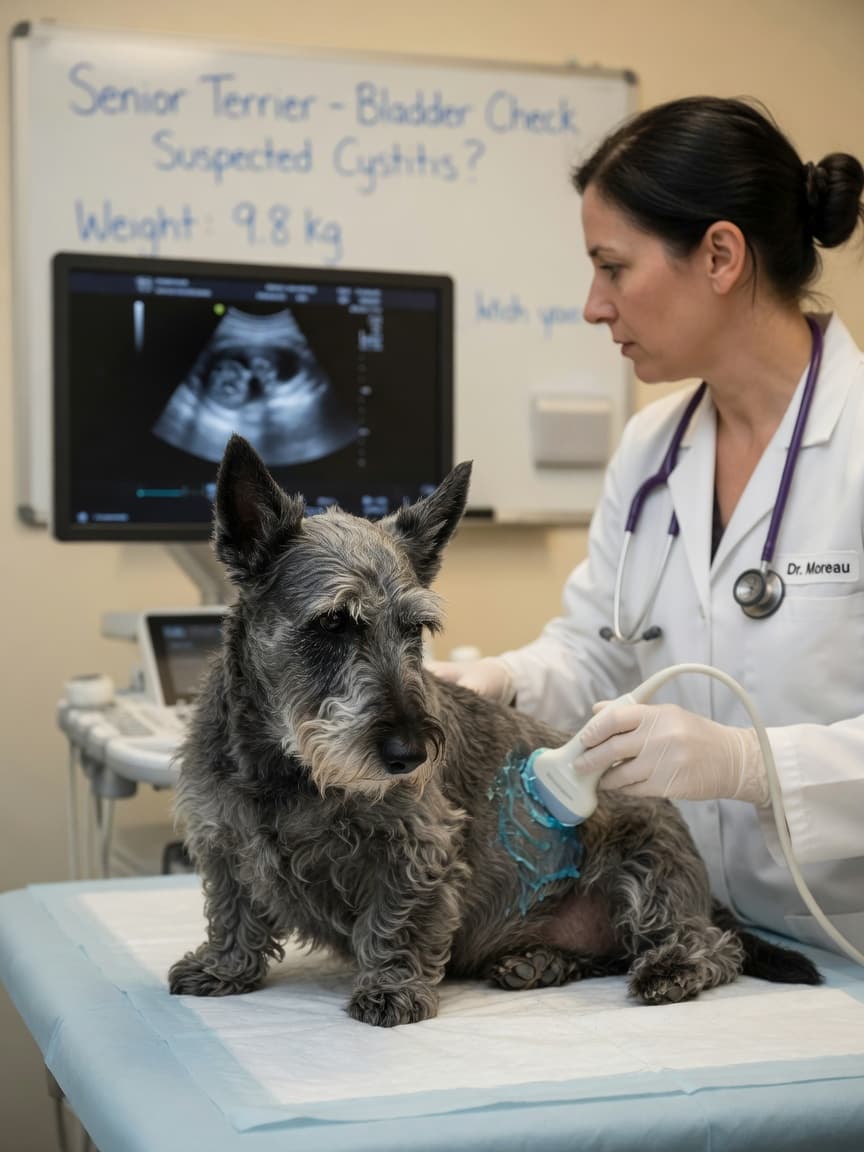
Diagnosis requires imaging and cytological or histological confirmation. Bladder ultrasound is the most commonly used initial imaging tool and typically reveals a mass lesion, most often at the trigone — the triangular region at the base of the bladder where the ureters enter. CT scanning provides more detailed assessment of local invasion and lymph node involvement.
Urine sediment cytology can identify malignant cells, though sensitivity is moderate. A validated urine test — the CADET BRAF mutation assay — detects a specific point mutation present in approximately 85% of canine TCC cases using a free-catch urine sample. This test is particularly useful for early detection in at-risk breeds and for monitoring response to treatment. Traumatic catheter biopsy or cystoscopic biopsy provides definitive histopathological confirmation.
Staging and Location Challenges
Thoracic radiographs and abdominal CT or ultrasound are used to assess for metastatic spread, which most commonly involves regional lymph nodes and the lungs. At diagnosis, roughly 20% of dogs already have detectable metastases.
The anatomical location of TCC presents a fundamental surgical challenge. Most tumours arise at the trigone, where the ureters enter the bladder. This makes complete surgical excision without disrupting urinary drainage technically very difficult or impossible in the majority of cases, distinguishing TCC from many other canine cancers where surgery is the primary curative option.
Medical Management: The Mainstay of Treatment

Because surgery is rarely curative, medical management forms the backbone of TCC treatment in dogs.
NSAIDs and COX-2 Inhibition
The most compelling pharmacological development in canine TCC management has been the recognition that COX-2 is overexpressed in the majority of these tumours. NSAIDs, particularly piroxicam, have demonstrated genuine anti-tumour activity in clinical studies. Piroxicam as a single agent produces objective responses — meaning measurable tumour reduction or stabilisation — in approximately 18% of dogs, with a significantly higher proportion experiencing disease stabilisation. It is inexpensive, orally administered at home, and well-tolerated by most dogs with appropriate gastroprotection.
Chemotherapy Combinations
The combination of mitoxantrone with piroxicam produces response rates of approximately 35% and is one of the most widely used protocols for canine TCC. More recently, vinblastine combined with an NSAID has shown comparable results. Toceranib phosphate, a tyrosine kinase inhibitor, also has activity against TCC, particularly in cases expressing relevant receptor targets.
Chemotherapy is administered in hospital, typically on three- to four-weekly cycles, with response assessed by repeat ultrasound measurement of tumour dimensions.
Radiation Therapy
Intraoperative and external beam radiation therapy have been investigated for TCC and can produce meaningful local disease control. Access to veterinary radiation facilities remains limited geographically, but specialist referral centres offer this option where available.
Palliative and Supportive Care
Managing urinary obstruction is a priority in TCC as disease progresses. Urethral stenting — placing an expandable metal stent to maintain urethral patency — can restore normal urination in dogs with obstructive disease and significantly improves quality of life. Percutaneous cystostomy tube placement is an alternative for dogs in whom stenting is not feasible.
Concurrent urinary tract infections are common in TCC patients and require prompt antibiotic treatment based on culture and sensitivity results. Long-term urinary antiseptic protocols are sometimes employed in dogs prone to recurrent infection.
Prognosis and What to Expect
Median survival time with medical management ranges from approximately six to twelve months, with some dogs living considerably longer. Tumour location, stage at diagnosis, and response to initial therapy are the key prognostic variables. TCC is rarely curable with current treatment modalities, but meaningful periods of controlled disease with good quality of life are achievable for many patients.
Practical Steps for Owners
- Do not accept recurrent urinary tract infections without investigating underlying causes — request bladder imaging
- Ask your vet about the CADET BRAF urine test, particularly for predisposed breeds showing urinary signs
- Request staging workup including thoracic radiographs and abdominal imaging at diagnosis
- Discuss piroxicam or another NSAID as part of the treatment plan — evidence supports its use
- Ask about urethral stenting early, so you understand the option before obstruction becomes urgent
- Seek referral to a veterinary oncologist for chemotherapy protocol selection and monitoring
- Monitor closely for signs of urinary obstruction — inability to pass urine requires emergency veterinary attention
Transitional cell carcinoma is a challenging diagnosis, but it is not one without options. Medical management can deliver significant disease control, and advances in both targeted therapy and palliative interventions continue to improve outcomes. Early diagnosis, thorough staging, and close collaboration with a veterinary oncologist give dogs with TCC the best possible chance of comfortable, extended survival.