
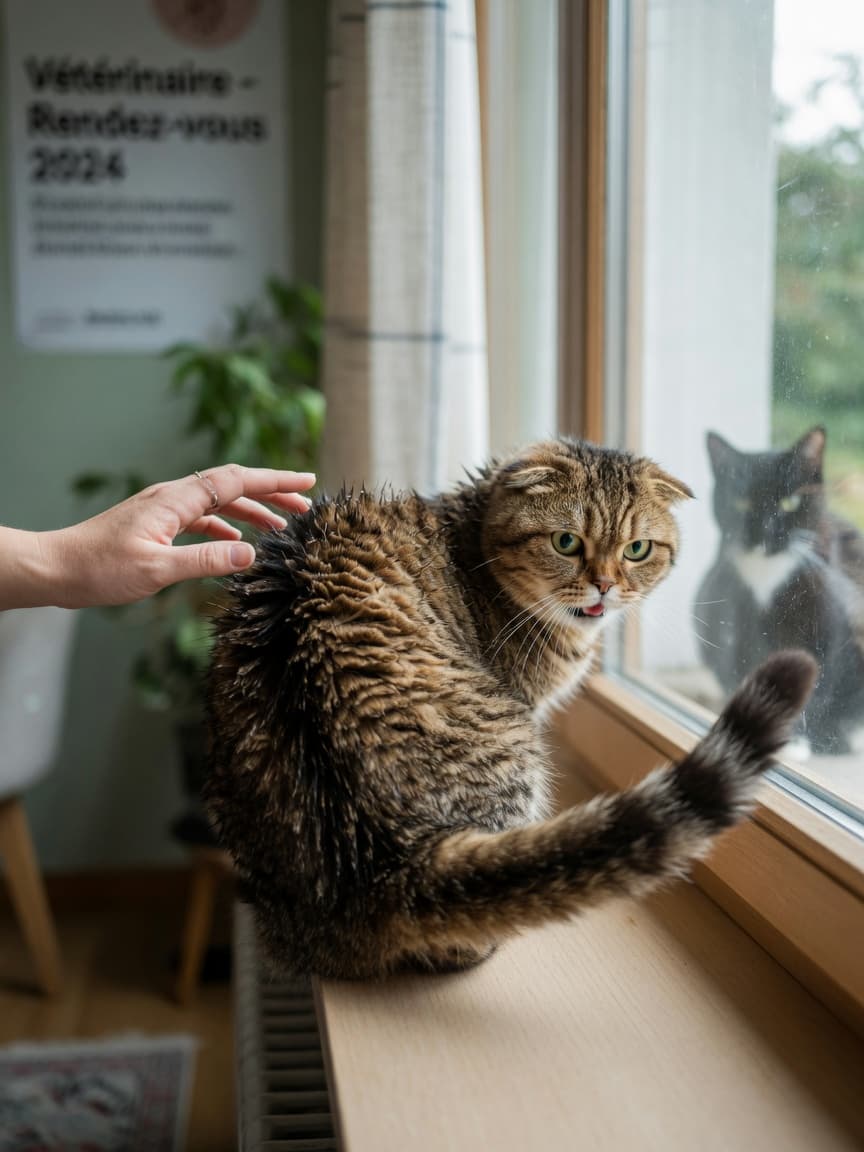
The Attack That Seems to Come From Nowhere
You are sitting quietly with your cat, who has been calmly watching the window. Without warning, the cat turns and bites or scratches you severely. You have done nothing. There was no provocation. This experience — deeply alarming and often painful — is one of the most misunderstood feline behaviours, and it has a name: redirected aggression. Understanding why it happens transforms a frightening incident into a manageable one.
What Redirected Aggression Actually Is
Redirected aggression occurs when a cat becomes intensely aroused — typically by something it cannot access or confront directly — and discharges that arousal onto the nearest available target, which is often its owner or another household pet. The original trigger is gone or inaccessible by the time the attack happens. The cat is not being malicious. It is in a state of extreme physiological arousal and cannot regulate that response in the moment.
Common original triggers include outdoor cats visible through windows, encountering a strange animal's scent on clothing or carrier, a startling noise, watching prey animals, or a confrontation with another pet that was interrupted before resolution. The critical point is that the cat is not responding to you — it is responding to a physiological state that you happened to be present for.
Why the Arousal Persists
Cats can remain in a highly aroused state for minutes to several hours after the triggering event. This is the feature of redirected aggression that catches owners most off guard. The outdoor cat that was at the window has long since left. The frightening noise has stopped. Everything looks normal. But the cat's nervous system is still running hot.
During this period, any approach — however gentle, however familiar — can trigger an explosive response. The cat is not processing the interaction normally. It is operating from a threat-response state in which even a trusted person reads as a threat or a viable outlet.
Recognising the Warning Signs

Redirected aggression is rarely entirely without warning, though the signs are subtle and easy to misread. Learning to recognise elevated arousal in your cat is the primary safety tool.
- Dilated pupils that remain wide even in normal lighting
- A tail that is lashing or fully bristled
- Skin rippling along the back
- Fixed, unblinking stare — particularly directed at a window or door
- Vocalisation that is unusual or sounds distressed
- Stiff, tense body posture, often with weight shifted slightly forward
- Failure to respond to its name or to familiar cues
If you observe any combination of these signs, do not approach the cat. This is not a rejection of your relationship — it is recognising a temporary neurological state that makes approach dangerous.
How to Stay Safe During an Episode

Do Not Approach or Attempt to Comfort
The instinct to soothe a distressed cat is understandable but counterproductive during active arousal. Your approach will likely escalate the response. Remain calm, move slowly, and create distance.
Use a Physical Barrier
If the cat is between you and an exit, use a cushion, a piece of cardboard, or a thick blanket held between you to guide it gently towards a separate room. Close the door and allow the cat time alone to de-escalate. Do not follow it in to check on it immediately.
Give It Time
Depending on the severity of the triggering event, a cat may need anywhere from twenty minutes to several hours before its arousal level returns to baseline. Approach only when it is showing relaxed body language: slow blinking, relaxed posture, normal responsiveness to its name.
Treat Any Wounds Promptly
Cat bites carry a significant infection risk. Any skin-breaking bite should be cleaned thoroughly and assessed by a medical professional. Cat bite infections can escalate quickly, particularly in individuals with compromised immune systems.
Reducing the Frequency of Episodes
Once you have identified redirected aggression as the pattern, proactive management focuses on reducing exposure to known triggers and interrupting arousal before it peaks.
- Apply frosted film to lower window panes to reduce visibility of outdoor cats
- Use motion-activated deterrents outside to discourage territorial intruders
- Avoid bringing unfamiliar animal scents into the home without allowing gradual scent exposure first
- If you have multiple cats and one episode triggers a fight between them, keep them separated and reintroduce carefully — the attacked cat may redirect against the other, and this can establish a lasting negative association between them
In households where redirected aggression is frequent or severe, consultation with a veterinary behaviourist is strongly recommended. Recurring episodes may indicate an underlying anxiety disorder that benefits from a structured behavioural programme, and in some cases, short-term pharmaceutical support.
Repairing the Relationship After an Episode
Many owners feel shaken, hurt, or even fearful of their cat following a serious redirected aggression incident. These feelings are entirely valid. However, the cat has no memory of the episode as an act of aggression towards you. Once de-escalated, it will return to its normal behaviour and relationship with you.
Allow the cat to approach you on its own terms after an episode. Offer gentle interaction only when it initiates, and keep sessions brief. Within a few hours to a day, most cats return to their baseline behaviour. The relationship is intact — what requires adjustment is the environmental management to prevent recurrence.
Key Takeaways
- Redirected aggression is a displacement of arousal caused by an inaccessible trigger — it is not directed malice
- Cats can remain dangerously aroused for hours after the triggering event has ended
- Dilated pupils, skin rippling, tail lashing, and stiff posture are key warning signs
- Never approach an aroused cat — use a barrier to create distance and allow time for de-escalation
- Cat bites require prompt medical attention due to infection risk
- Reducing trigger exposure and consulting a behaviourist for frequent episodes are the core management strategies