
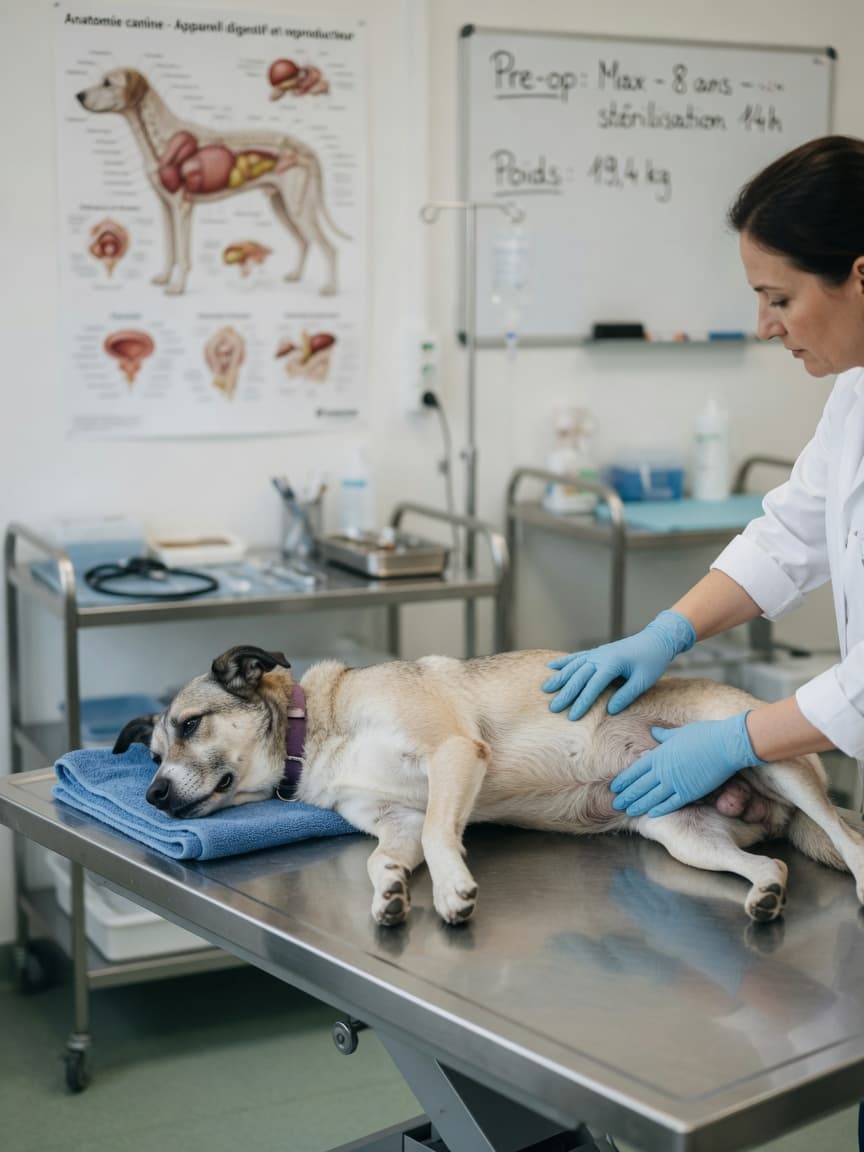
Understanding Castration: The Procedure Explained
Neutering a male dog — medically referred to as orchiectomy or castration — involves the surgical removal of both testicles under general anaesthesia. It is one of the most straightforward elective procedures in small animal practice, typically completed within 20–40 minutes. Unlike the female equivalent, there is no abdominal incision required in most cases, which means recovery is considerably faster and complication rates are low.
The procedure is performed routinely across veterinary practices throughout Spain, France, Germany, Italy, and the United Kingdom. Whilst the surgery itself is standardised, the question of when to neuter — and whether to neuter at all — has become increasingly nuanced, particularly as research on the long-term health effects has grown.
When Should You Neuter? What the Evidence Says
The WSAVA (World Small Animal Veterinary Association) has updated its guidance to reflect a growing body of research showing that the timing of castration can influence a dog's long-term health, particularly in larger breeds. Landmark work from the University of California Davis, including research by Hart et al. (2020) examining over 35 breeds, found that early neutering in large and giant breeds was associated with significantly higher rates of certain joint disorders and some cancers compared to intact males or those neutered later.
- Small breeds (under 10 kg): Neutering from six months onwards is generally considered safe with minimal long-term health impact.
- Medium breeds (10–25 kg): Most guidelines suggest waiting until 9–12 months, after key growth phases are complete.
- Large and giant breeds (over 25 kg): Current evidence supports waiting until 12–24 months. In some breeds such as the Golden Retriever, Rottweiler, and German Shepherd Dog, early neutering has been specifically linked to elevated cancer and orthopaedic risk.
These are population-level findings, not absolute rules. A vet who knows your dog, his behaviour, and his home environment should guide the individual decision.
Health Benefits of Neutering
When performed at an appropriate age, castration provides several well-documented health advantages:
- Benign prostatic hyperplasia (BPH) prevention: By middle age, the majority of intact male dogs develop BPH — an uncomfortable enlargement of the prostate gland that can cause difficulty urinating and defecating. Castration prevents this entirely and resolves it quickly in dogs already affected.
- Perineal hernia reduction: Intact males are significantly more prone to perineal hernias, which can require complex and costly surgery. Neutering dramatically reduces this risk.
- Testicular tumour elimination: Testicular tumours are amongst the most common tumours in intact male dogs. Castration removes the risk completely.
- Perianal adenoma prevention: These testosterone-dependent tumours are common in intact older males and resolve or are prevented by castration.
Behavioural Effects: Managing Expectations Honestly
Pet owners are often told that neutering will resolve problem behaviours. The reality, as the Association of Pet Behaviour Counsellors (APBC) emphasises, is considerably more nuanced. Castration reduces behaviours that are directly driven by testosterone — including roaming, urine marking, and mounting — but it does not reliably address behaviours that are learned, anxiety-based, or triggered by environmental factors.
- Likely to improve: Roaming and escape behaviour driven by the search for females in season; urine marking indoors; mounting behaviour that is hormonally driven.
- Unlikely to improve without additional training: Fear-based aggression, anxiety, resource guarding, separation distress, reactivity on the lead.
- May worsen temporarily: Some dogs show an increase in fear-related behaviours following castration, possibly due to the loss of the confidence-modulating effects of testosterone.
If behaviour is the primary reason for considering neutering, the APBC recommends a consultation with a qualified clinical animal behaviourist before and after the procedure, not as a substitute for it.
Chemical Castration: The Suprelorin Implant
For owners who want to assess the effects of castration before committing to permanent surgery, the Suprelorin implant (manufactured by Virbac) offers a reversible alternative. Suprelorin is a deslorelin acetate implant inserted under the skin, typically between the shoulder blades, and is fully licensed across the European Union and the United Kingdom.
The implant works by initially stimulating and then suppressing testosterone production, effectively achieving temporary chemical castration. It is available in two formulations:
- 4.7 mg implant: Effective for approximately six months in most dogs
- 9.4 mg implant: Effective for approximately twelve months
Fertility and testosterone levels typically return within a few months of the implant's effect wearing off, making it a useful trial for owners uncertain about permanent surgery. It is also used in dogs where anaesthetic risk is too high for surgery. The cost is comparable to surgical castration and the procedure requires only a brief clinical visit without general anaesthesia.
Pre-Operative Care
Before surgical castration, your vet will typically carry out:
- A general health examination to confirm the dog is fit for anaesthesia
- Pre-anaesthetic blood tests, particularly recommended in dogs over five years of age or with any underlying health concerns
- Fasting for 8–12 hours prior to surgery
Post-Operative Recovery
Recovery from castration is notably simpler than from a spay. Most dogs are bright and active within 24 hours. Key post-operative instructions typically include:
- Restricted exercise for 3–5 days — short lead walks only
- An e-collar or recovery suit to prevent licking the surgical site
- Monitoring for swelling, excessive redness, or discharge at the incision
- A suture check at 7–10 days if non-dissolving sutures were used
Most dogs return to normal activity within a week. Scrotal swelling is normal in the first few days and usually resolves without intervention.
Cost of Neutering in Europe
Surgical castration costs vary by dog size, country, and clinic. The following are approximate ranges:
- Spain: €100–250
- France: €150–300
- Germany: €200–400
- Italy: €100–200
- United Kingdom: £150–350
The Suprelorin implant costs broadly similarly to the surgical procedure — approximately €80–200 depending on the size of the implant and the country. It does not, however, provide the permanent health benefits of surgery, so cost comparison alone should not drive the decision.
Making the Right Choice for Your Dog
Neutering a male dog remains one of the most common and generally safe veterinary interventions available. The procedure itself is low risk, recovery is quick, and the health benefits — particularly the prevention of prostatic disease, perineal hernias, and testicular tumours — are well established. The key variable is timing, and for larger breeds in particular, a measured approach guided by up-to-date evidence rather than tradition will give your dog the best long-term outcome.
Article reviewed by Julia Wrenfield, veterinary health writer. References: WSAVA neutering guidelines; Hart BL et al. (2020) Frontiers in Veterinary Science; APBC guidance on neutering and behaviour; RCVS Knowledge continuing professional development resources.