
Understanding What Happens When You Leave
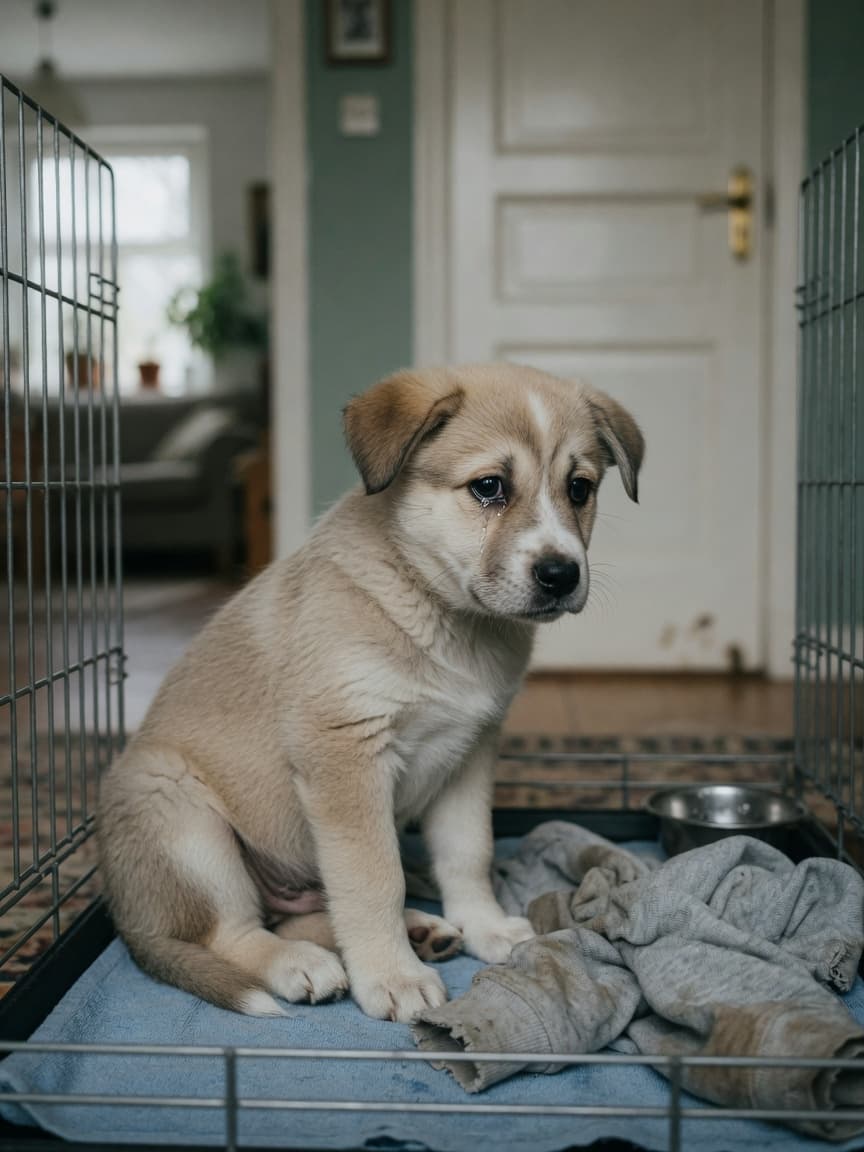
For the first weeks of their lives, puppies are never truly alone. They sleep in a pile with their littermates, they nurse alongside siblings, and they are rarely out of their mother's sensory range. When a puppy arrives in a new home and is then left by themselves for the first time, it represents a level of social isolation they have never previously encountered. Understanding this helps explain why so many puppies respond to being left alone with vocalisation, destruction, or house soiling — it is not naughtiness, it is distress.
The General Rule on Time Limits
There is a widely used guideline in veterinary behaviour circles: a puppy can typically hold their bladder for roughly one hour per month of age, plus one. So an eight-week-old puppy (two months) can manage approximately three hours before needing to toilet. A four-month-old puppy might manage around five hours. These are rough maximums, not targets — regularly pushing to the limit increases the likelihood of toileting accidents and teaches the puppy that the crate or room is a place where they must soil their sleeping area, which undermines toilet training.
Beyond the physical capacity to hold a bladder, there is the question of emotional tolerance. Research in canine behaviour, including studies from the Dog Welfare Programme at the University of Lincoln, suggests that dogs left alone for more than four hours begin to show measurable signs of stress, regardless of age. For puppies still forming their attachment to the household, this threshold is likely lower.
The First Few Days at Home
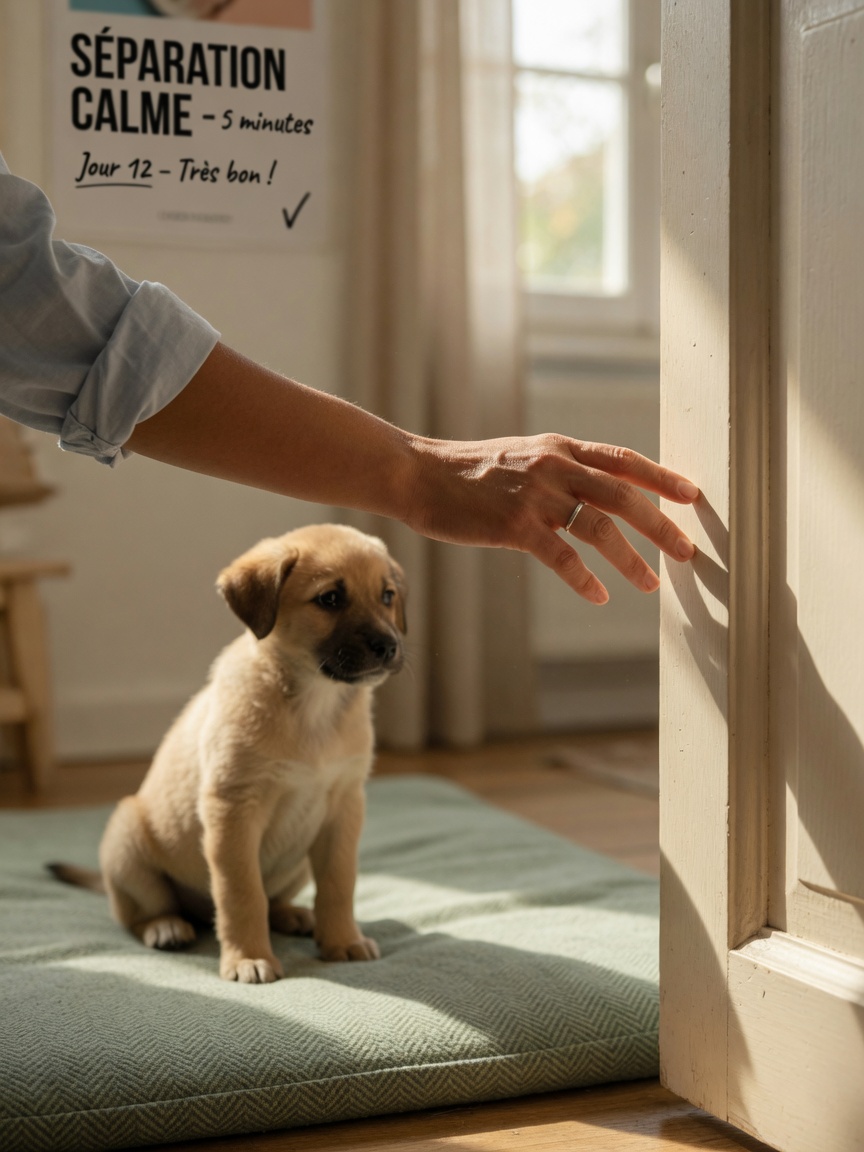
The first separation should be very brief — ideally just a few minutes. Leave the room your puppy is in, stay nearby, and return before any distress escalates. Gradually extending the time teaches your puppy two things: that your departure is not permanent, and that calm behaviour results in your return. Returning to a puppy who is in the middle of crying or barking inadvertently rewards that behaviour, so aim to return during moments of quiet.
Many experienced trainers recommend what is sometimes called a "departure cue" — a word or phrase you say before leaving that, over time, your puppy learns to associate with a predictable and short absence. This kind of predictability is reassuring to dogs, whose stress responses are partly rooted in uncertainty.
Crates, Pens, and Safe Spaces
Confinement to a crate or puppy pen when left alone is not cruel — in fact, it can significantly reduce anxiety by giving a puppy a clearly defined, safe area rather than leaving them to roam a potentially overwhelming space. Crates should be introduced positively and gradually, never used as punishment, and should be large enough for the puppy to stand, turn around, and lie down comfortably. Adding a worn item of your clothing can provide olfactory comfort in your absence.
For puppies that find the crate too confining, a puppy pen set up in a quiet, familiar room with water, appropriate chew toys, and ideally a camera so you can monitor them remotely is a reasonable alternative.
Signs Your Puppy Is Struggling With Alone Time
Excessive vocalisation (barking, howling, whining) that continues for more than a few minutes after you leave is a signal worth taking seriously. Other indicators of distress include destructive behaviour focused on exit points such as doors and windows, inappropriate toileting in dogs that are otherwise well toilet-trained, excessive salivation, and what is sometimes described as a frantic or over-the-top greeting when you return. If you are using a camera to monitor your puppy, look for pacing, panting without physical exertion, and inability to settle.
These signs may indicate separation-related behaviour, which exists on a spectrum from mild anxiety to clinical separation anxiety. The latter is a recognised condition that responds well to structured behaviour modification programmes, sometimes alongside short-term medication prescribed by a vet or veterinary behaviourist. Catching and addressing it early is far easier than dealing with an entrenched pattern in an adult dog.
Building Up Gradually
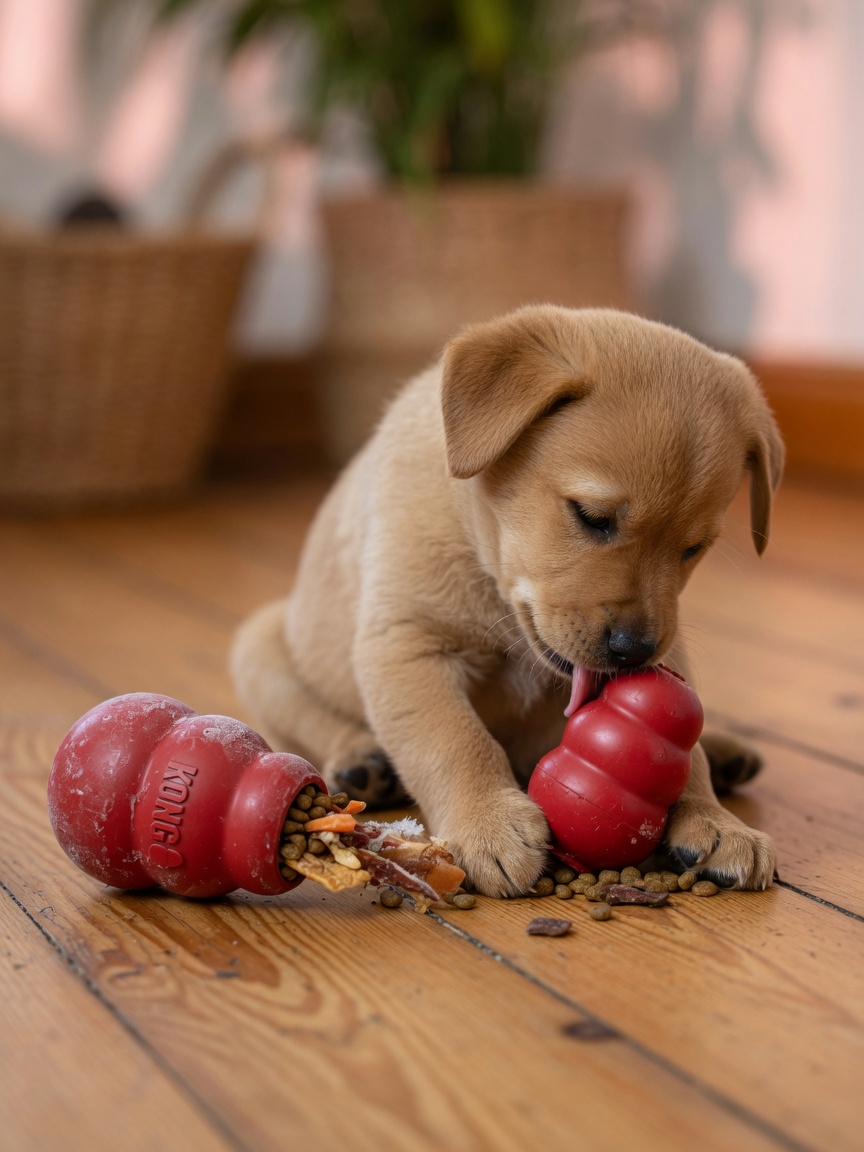
The process of teaching a puppy to be comfortable alone is called absence training or independence training, and it is best approached methodically. Start with absences of under five minutes. If your puppy remains calm, return, reward, and try again slightly longer. Over days and weeks, work up to longer periods. The goal is to never progress faster than your puppy's comfort allows.
Enrichment during absences helps significantly. A Kong stuffed with food and frozen overnight gives a puppy something absorbing to focus on that also carries a positive association with your departure. Puzzle feeders, appropriate chew items such as raw bones or bully sticks (given under supervision initially), and calming music or species-specific audio tracks designed for dogs have all shown some evidence of reducing stress during alone time.
Practical Arrangements for Working Owners
If your lifestyle requires you to be away from home for a full working day, a puppy is genuinely incompatible with that routine without external support. Options worth considering include a dog sitter who comes to your home, a puppy day care facility (though these should be chosen carefully and are not suitable for all temperaments), or a friend or family member who can be present during the day. Splitting the day with a midday visit is the minimum that most veterinary and behaviour organisations would recommend for any puppy under six months of age.
Planning for this before bringing a puppy home, rather than after, is strongly advisable. The first few months set a template for the dog's relationship with alone time for the rest of their life — investing in this properly from the start is one of the most meaningful things you can do for your puppy's long-term welfare.