

Golden Retriever Health: Understanding the Risks
The Golden Retriever is one of Britain's most cherished breeds — intelligent, biddable, and affectionate. They excel as family pets, assistance dogs, and working gundogs. Yet behind that sunny disposition lies a breed with a particularly heavy inherited disease burden. Studies have consistently shown that around 60 per cent of Golden Retrievers die of cancer, a rate that is substantially higher than in most other breeds. Alongside this, Goldens are prone to heart disease, joint problems, and several hereditary eye and skin conditions. Knowing what to look for — and what questions to ask breeders — can make a real difference.
Cancer: The Biggest Threat to the Breed

The statistics around cancer in Golden Retrievers are sobering. The Morris Animal Foundation's Golden Retriever Lifetime Study, one of the largest canine health studies ever conducted, has been tracking thousands of dogs to better understand why this breed is so disproportionately affected. The cancers most commonly implicated in Golden Retriever deaths include:
- Haemangiosarcoma — an aggressive cancer of blood vessel walls, most often affecting the spleen and heart.
- Lymphoma — cancer of the lymphatic system, which can present as swollen lymph nodes, lethargy, and weight loss.
- Osteosarcoma — primary bone cancer, typically affecting the long bones of the limbs, causing lameness and severe pain.
- Mast cell tumours — skin tumours that vary widely in behaviour, from benign to highly aggressive.
There is currently no single genetic test that predicts cancer risk in individual dogs. The best approach is vigilant monitoring: check for lumps regularly, report any unexplained weight loss or lethargy to your vet promptly, and maintain annual or biannual veterinary health examinations.
Dilated Cardiomyopathy and Taurine Deficiency
Dilated cardiomyopathy (DCM) is a condition in which the heart muscle becomes weakened and enlarged, reducing its ability to pump blood effectively. Whilst DCM has historically been associated with certain large breeds, Golden Retrievers received particular attention following a US Food and Drug Administration investigation that identified a potential link between grain-free diets and an increased incidence of DCM — including in dogs not otherwise predisposed to the condition. The proposed mechanism involves taurine deficiency: certain grain-free and legume-heavy diets may interfere with taurine synthesis or absorption. The relationship is still under active investigation, but many cardiologists currently advise caution with grain-free diets in Goldens. Annual cardiac auscultation is advisable, and owners who are concerned should discuss diet with their vet.
Hip and Elbow Dysplasia
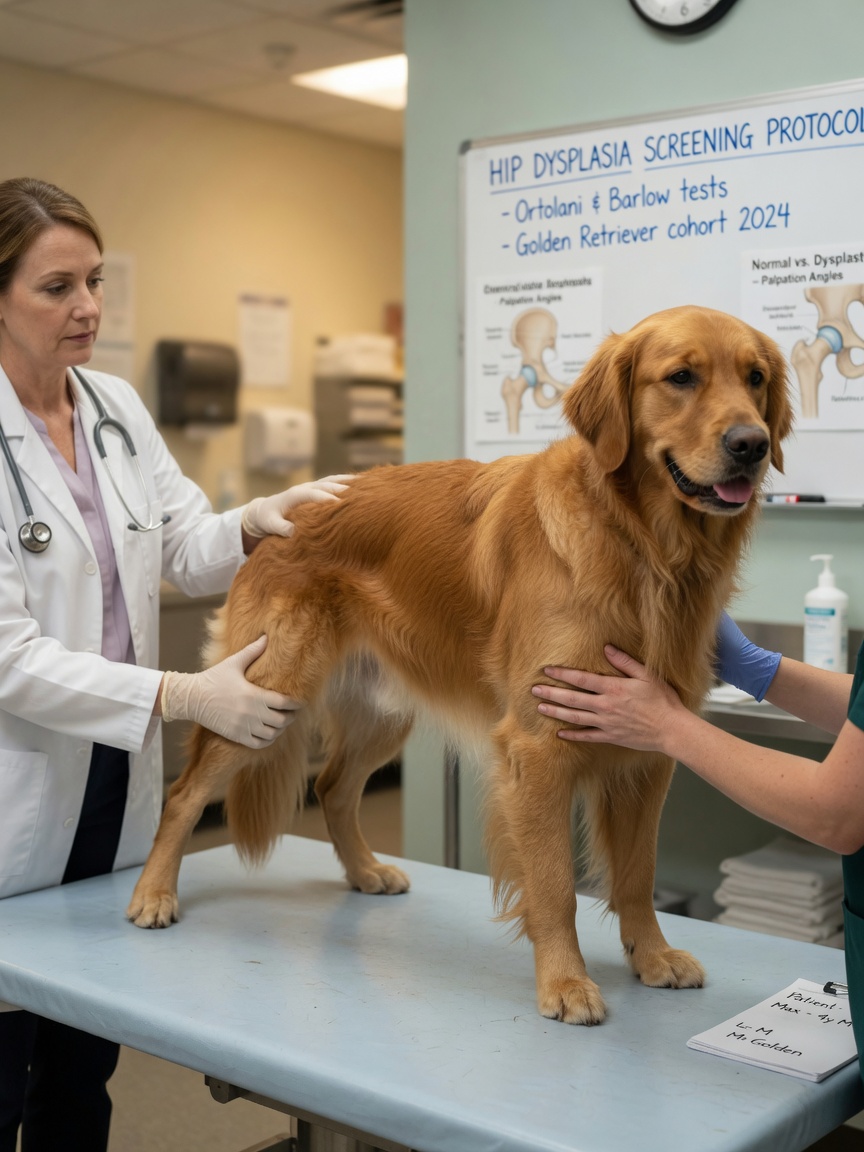
Hip dysplasia, in which the hip joint develops abnormally, is common in Golden Retrievers and can lead to pain, reduced mobility, and eventually osteoarthritis. The British Veterinary Association (BVA) runs a hip scoring scheme in conjunction with the Kennel Club. Each hip is scored from 0 to 53, giving a combined total of 0 to 106 — the lower the score, the better the hip conformation. Responsible breeders will only use dogs whose combined score is below the breed median, which for Golden Retrievers currently sits at around 10-12. Elbow dysplasia, graded 0 to 3, should also be screened in both parents. Do not buy a Golden Retriever puppy from a litter where the parents have not been scored under the BVA scheme.
Progressive Retinal Atrophy (PRA)
Progressive retinal atrophy is a group of inherited diseases that cause the light-sensitive cells of the retina to degenerate over time, eventually leading to blindness. In Golden Retrievers, the most relevant form is prcd-PRA (progressive rod-cone degeneration), for which a DNA test is available. Dogs can be identified as clear, carrier, or affected. Two carrier parents can produce affected offspring, so responsible breeders test all breeding animals and only mate clear dogs together, or clear with carrier (which produces no affected puppies). Ask to see the DNA test certificates for both parents before purchasing a puppy.
Ichthyosis
Ichthyosis is a skin condition caused by a mutation in the PNPLA1 gene that is particularly prevalent in Golden Retrievers. Affected dogs have skin that produces excess scale and flaking, giving a rough, almost fish-scale appearance. The condition is not life-threatening but is lifelong and can cause discomfort and odour. A DNA test is available. As with PRA, responsible breeders test their dogs and aim to avoid producing affected offspring.
Subvalvular Aortic Stenosis (SAS)
Subvalvular aortic stenosis is a congenital heart condition in which a band of fibrous tissue forms just below the aortic valve, obstructing blood flow out of the heart. It ranges from mild to severe; severely affected dogs are at risk of sudden death. SAS is detected as a heart murmur during auscultation, though confirmation requires echocardiography. The Kennel Club recommends that Golden Retrievers used for breeding are examined by a cardiologist and found free of clinically significant murmurs. Prospective puppy buyers should ask whether the parents have been cardiac-tested.
Pigmentary Uveitis
Pigmentary uveitis is an eye condition specific to Golden Retrievers, characterised by inflammation within the eye and the formation of pigmented cysts on the lens and ciliary body. Left untreated, it can lead to secondary glaucoma, cataract formation, and blindness. The condition tends to develop in middle-aged to older dogs. The Golden Retriever Pigmentary Uveitis (GRuPV) study group has been researching the genetic basis of the disease. Annual eye examinations are recommended from the age of two, and breeders should ideally present evidence of eye screening under the BVA or equivalent scheme.
Choosing a Healthy Puppy
Given the number of health conditions prevalent in the breed, choosing a Golden Retriever puppy from a breeder who undertakes comprehensive health testing is essential. At a minimum, prospective buyers should expect to see BVA hip and elbow scores, DNA test results for prcd-PRA and ichthyosis, and a cardiac clearance certificate for both parents. A reputable breeder will welcome these questions and have paperwork ready to share.
Written by Sarah Bennett for ForPetsHealthcare.com