
Why Dog Sports Matter
Dogs are problem-solving, physically active animals that have evolved alongside humans in working roles. For many breeds, daily walks alone are insufficient to meet their mental and physical needs. Dog sports offer a structured way to provide the kind of purposeful activity that keeps dogs healthy, well-behaved, and genuinely content. Beyond the benefits to the dog, canine sports are increasingly popular among owners as a way to build a deeper partnership with their pet and to connect with a wider community of like-minded enthusiasts.
Agility
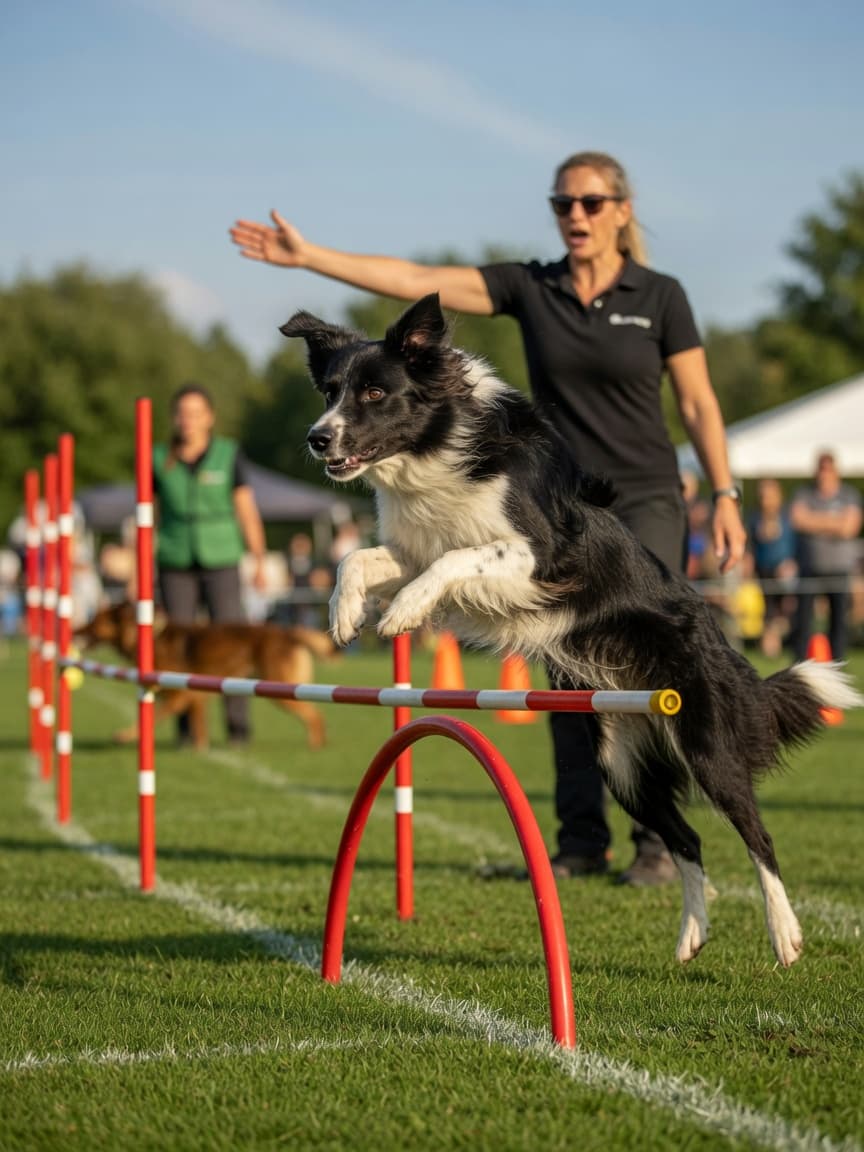
Agility is arguably the most popular dog sport in the UK. Dogs navigate a timed obstacle course under the direction of their handler, clearing jumps, weaving through poles, crossing an A-frame, running through a tunnel, and walking along a seesaw. Speed and accuracy both matter — faults are incurred for knocked poles, refused obstacles, or missed contact zones.
The sport is governed in the UK primarily by the Kennel Club, which runs a grading system that allows dogs and handlers to progress from entry-level to championship level as they improve. Dogs must be at least 18 months old to compete. Most areas of the UK have agility clubs that offer training for beginners, and no previous experience is required to get started. Agility suits active, motivated breeds but can be adapted for dogs of many sizes and types.
Flyball
Flyball is a team relay sport in which two teams of four dogs race side by side over a line of hurdles. Each dog must trigger a spring-loaded box that releases a tennis ball, catch the ball, and return over the hurdles. The hurdle height is set according to the smallest dog in the team, which means that small, fast dogs are highly valued even in teams of larger breeds.
The sport is fast, noisy, and intensely exciting for dogs with high prey drive. It is also deeply social — flyball teams tend to have a strong community spirit, and competitions are lively events. The British Flyball Association oversees the sport in the UK and registers clubs across the country. Flyball is not suitable for dogs with joint problems given the repeated jumping and turning involved.
Canicross
Canicross is cross-country running with your dog. The dog runs in a harness attached by a bungee line to a waist belt worn by the runner. The dog runs in front, and with encouragement and directional commands, the pair work together to cover terrain as efficiently as possible. Races are held across off-road courses, and there is a growing competition calendar in the UK.
Canicross is suitable for most active dog breeds and is an excellent way to increase a dog's daily exercise without placing additional load on the owner's joints, as the bungee line absorbs much of the pulling force. Dogs should not participate in canicross until they are skeletally mature, typically around 12 to 18 months depending on the breed. The sport is governed by Canicross UK and has both competitive and recreational participants.
Heelwork to Music and Canine Freestyle
Heelwork to music, sometimes called canine freestyle, is a discipline that combines precise obedience work with choreography set to music. Dogs and handlers perform routines that showcase the dog's ability to move in close formation with the handler, perform tricks, and respond to subtle directional cues. The discipline rewards creativity, precision, and the quality of the relationship between dog and handler.
It is accessible to dogs of any breed, size, or age, and because there is no jumping or strenuous physical exertion required, it is one of the most suitable sports for older dogs or those with physical limitations. The Canine Freestyle Federation and the Musical Dog Sport Association both hold competitions in the UK.
Dock Diving
Dock diving involves a dog running along a dock and jumping into a pool of water. Dogs are judged either on the distance of their jump or, in another discipline, the height they can reach to grab a target suspended above the water. The sport originated in the United States but has a growing following in the UK.
It is ideally suited to water-loving breeds such as Labradors, Spaniels, and Portuguese Water Dogs, but any dog that enjoys water and has sufficient drive can participate. Dock diving is considered low-impact compared to jumping sports because landing in water places minimal stress on joints.
Lure Coursing
Lure coursing simulates the chase of prey using a mechanical lure — typically a white plastic bag — that is pulled along a course by a motor-driven line. It is designed primarily for sighthounds, including Greyhounds, Whippets, Salukis, and Afghan Hounds, though open lure coursing events accept other breeds. The sport satisfies the deep-rooted prey drive of sighthounds in a safe and controlled environment.
Scent Work and Nosework
Scent work, sometimes called nosework, is a sport based on the detection skills used by working sniffer dogs. Dogs are taught to search for a specific target odour — typically birch, anise, or clove — hidden within a defined search area such as a room, a row of boxes, or a vehicle. When the dog locates the odour, it indicates to the handler, who calls it to the judge.
Scent work is one of the most mentally tiring activities available to a dog. A 20-minute scent work session can tire a dog more effectively than an hour of physical exercise. This makes it an excellent option for dogs with physical limitations or for days when the weather prevents outdoor activity. It is also a brilliant starting point for owners new to dog sports, as dogs take to it naturally and there is no equipment to learn beyond a treat pouch.
IPO and Schutzhund
IPO — now formally known as IGP — is a demanding three-part sport encompassing tracking, obedience, and protection work. Originally developed to test the working ability of German Shepherd Dogs, it is now open to all breeds. Competition is governed internationally by the Fédération Cynologique Internationale and in the UK by affiliated clubs. IPO is a serious commitment requiring considerable time investment from both dog and handler and is best approached with experienced guidance from an established club.
Conformation Showing
Conformation showing — Crufts being the most famous example — assesses how closely a dog conforms to the written breed standard. While it is not a performance sport, showing requires a dog to be physically well-conditioned, well-socialised, and trained to move and stand in specific ways. For many owners, showing is a gateway to the wider world of canine sports and breeds. Dogs must be Kennel Club registered to compete in KC-licensed shows.
Getting Started
The best starting point for any canine sport is to find a local club and attend as a spectator before committing to training. Most clubs welcome newcomers and are happy to offer guidance on whether a particular sport suits a specific dog and owner combination. Starting young is beneficial but not essential, and many dogs take up a new sport successfully in middle age with the right motivation and a patient handler.