
What Is Resource Guarding?
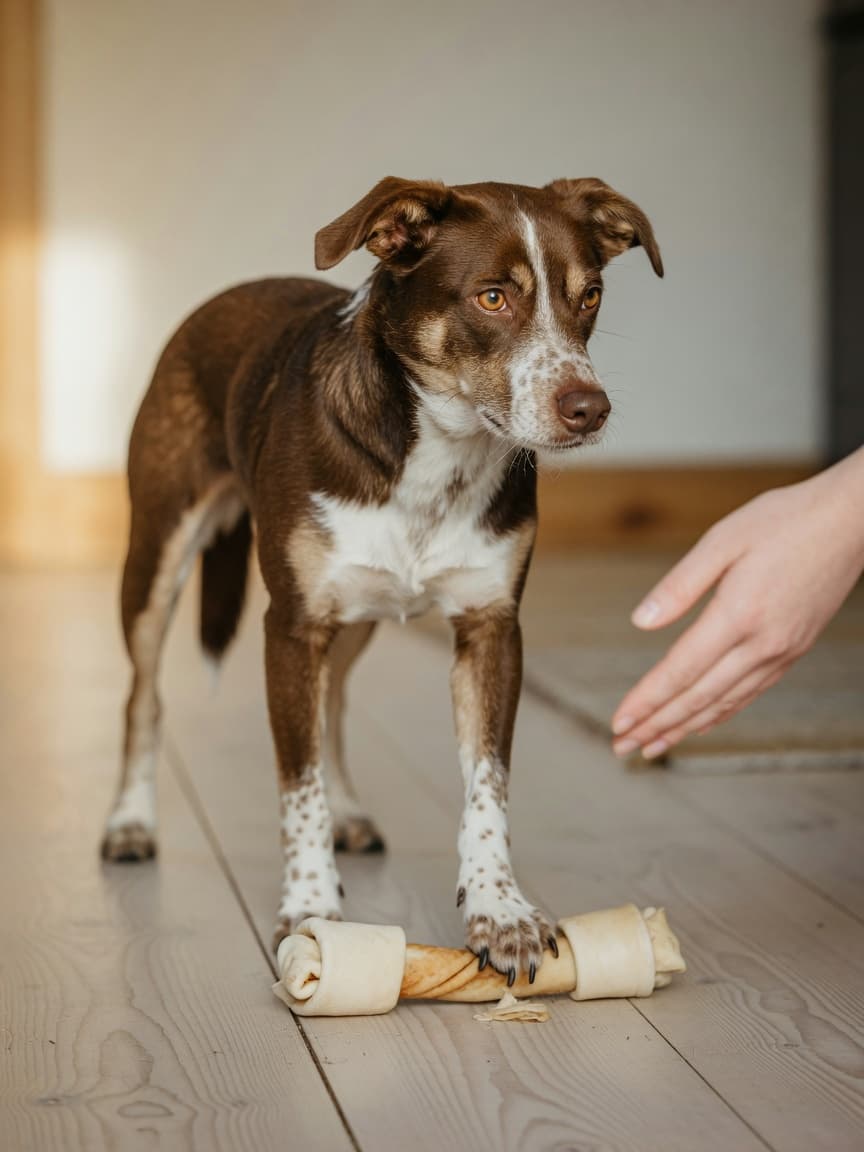
Resource guarding is the behaviour a dog displays when it attempts to retain control of something it values. The resource in question might be food, a chew, a toy, a resting spot, a person, or even an empty food bowl. Guarding behaviour exists on a wide spectrum — from a mild body stiffening over a bone to a full bite delivered with little warning.
It is important to understand from the outset that resource guarding is a normal canine behaviour. Dogs are opportunistic animals and in the wild, defending access to food or valued objects has genuine survival value. The goal is not to eliminate a behaviour that is rooted in normal dog psychology, but to manage it safely and, where possible, modify its intensity through appropriate training.
The Escalation Ladder

Resource guarding rarely appears suddenly at full intensity. Most dogs move through a recognisable sequence of warning signals before escalating to a bite. Understanding this ladder is critical for safety:
- Freeze — the dog becomes very still, often over the resource. This is frequently the first and most subtle signal.
- Hard stare — the dog fixes its gaze on the approaching person or animal, often with a tense, forward body posture
- Growl — a direct warning that the dog is uncomfortable and asking for space
- Air snap — snapping near but not making contact, an escalated warning
- Bite — contact is made; severity can range from a soft inhibited bite to a serious puncture wound
Owners who punish growling — often with the understandable but mistaken aim of stopping it — inadvertently remove a critical warning signal. A dog that has been repeatedly punished for growling may skip the early stages and proceed to a bite with very little prior warning. Growling must never be punished; instead, it should be recognised as important communication and the situation managed to reduce the dog's need to guard.
The Trade-Up Protocol
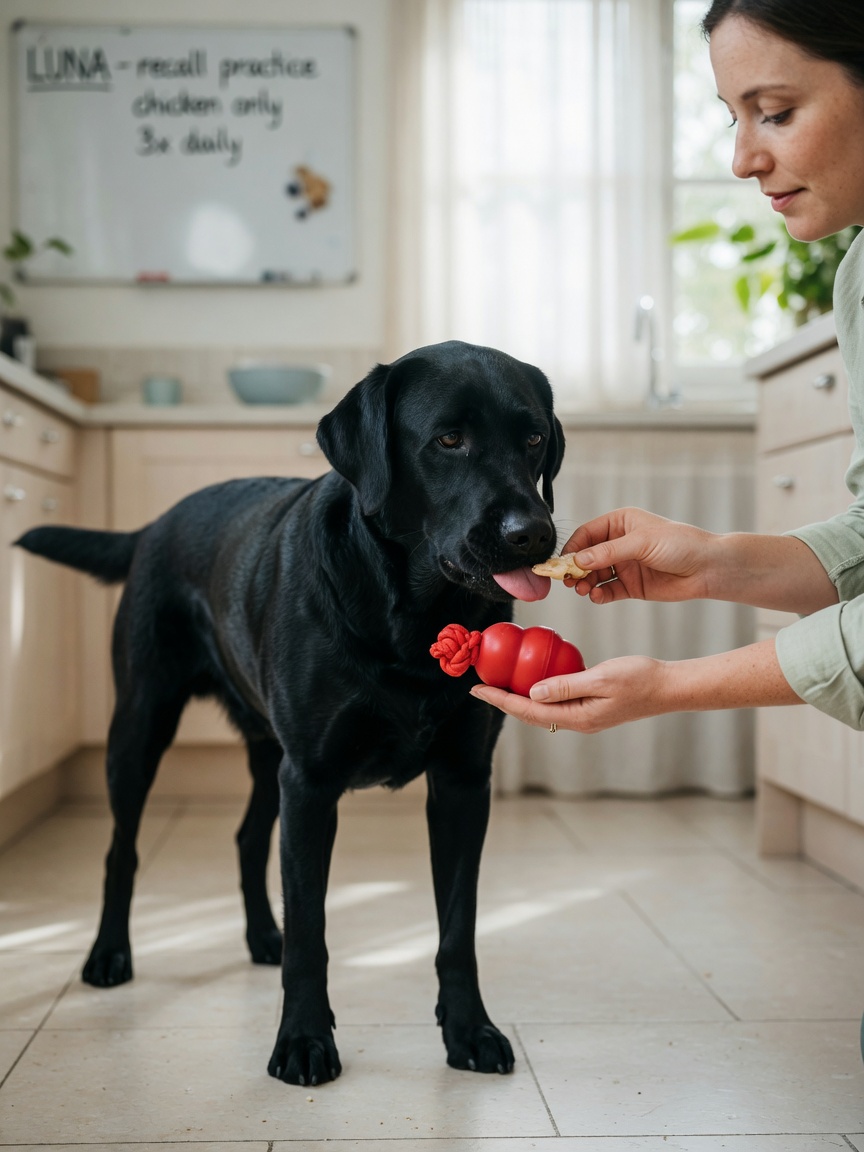
The trade-up protocol is one of the most effective and widely recommended approaches for managing resource guarding safely. The principle is straightforward: when you need to take something from your dog, approach calmly and offer something of higher value in exchange.
The process works as follows:
- Approach from the side rather than head-on, which the dog may interpret as confrontational
- Show the dog that you have something more desirable — a piece of high-value food, a favourite toy, or a particularly appealing chew
- Allow the dog to approach the offered item and take it willingly
- Retrieve or move the original resource calmly while the dog is engaged with the trade
- Where possible, return the original resource to the dog shortly afterwards — this teaches the dog that your approach does not mean permanent loss
Over time, this protocol can change the dog's association with an approaching hand from one of threat to one of opportunity. However, it should be approached carefully and should not be practised repeatedly in quick succession, as this can feel confrontational to the dog.
Basket Muzzle Conditioning for Safety
In households where resource guarding is severe, or where there is a risk of bite during the management process, a basket muzzle is an important safety tool. A basket muzzle (as opposed to a fabric or cloth muzzle) allows the dog to pant, drink, and take treats while wearing it, and can be worn for extended periods safely.
The key is to condition the dog to the muzzle gradually so that wearing it becomes a neutral or even positive experience rather than a source of additional stress. This is done by introducing the muzzle in tiny steps — first simply placing treats inside it for the dog to take, then rewarding the dog for voluntarily putting its nose in, and eventually fastening it briefly during positive activities such as feeding or play. This process takes days to weeks depending on the individual dog.
A muzzle used correctly is a safety net that allows training to proceed without risk. It is not a solution in itself and should always be paired with a behaviour modification programme.
Resource Guarding and Children: Specific Risk Considerations
Resource guarding around children deserves particular attention. Children are disproportionately represented in dog bite statistics, and several features of child behaviour increase the risk in a guarding situation:
- Children approach resources at ground level, placing their faces close to the dog's
- They often do not recognise or respond appropriately to early warning signals such as freezing or hard staring
- They may inadvertently approach a guarding dog quickly and directly
- They are less able to read or respond to the dog's body language than adults
In any household with children, a dog displaying resource guarding behaviour should be managed proactively. This means feeding the dog in a separate room with a closed door, removing high-value chews when children are present, and ensuring the dog always has safe resting spots it cannot be disturbed in. Children should never be tasked with retrieving items from a dog that has a history of guarding.
When to Seek Professional Help
Resource guarding that involves biting, that is escalating in frequency or intensity, or that occurs in a household with children or other vulnerable individuals should be assessed by a qualified behaviourist as a priority. Look for a practitioner with a recognised qualification such as:
- CCAB (Certificated Clinical Animal Behaviourist) awarded by the Association for the Study of Animal Behaviour
- CAAB (Chartered Animal Behaviourist)
- A full member of the Association of Pet Behaviour Counsellors (APBC)
Avoid practitioners who recommend confrontational methods such as alpha rolls, forceful item removal, or punishment for growling. These approaches have been demonstrated to increase aggression and bite risk rather than resolve the underlying problem.
Long-Term Management
Resource guarding is rarely fully eliminated, but with consistent management it can be reduced to a level that poses no meaningful risk to the household. The most successful outcomes involve a combination of environmental management to prevent triggers, systematic desensitisation and counter-conditioning with a professional behaviourist, and clear household rules applied consistently by all family members. With commitment and the right support, most dogs with resource guarding can live safely and happily as family pets.