
It Is Not Just About Sex
Mounting and humping is one of those behaviours that causes considerable embarrassment for dog owners but is widely misunderstood. The most common assumption is that it is a purely sexual behaviour and that neutering will eliminate it. The reality is considerably more nuanced. Humping occurs regularly in neutered dogs of both sexes, in very young puppies long before sexual maturity, and in a wide range of contexts that have nothing to do with reproduction. Understanding what your dog is actually communicating — or reacting to — makes the behaviour far easier to address.
The Different Reasons Dogs Mount and Hump
Over-Arousal and Excitement
One of the most common drivers of humping is simply over-arousal. When a dog becomes highly excited — at the start of a walk, during energetic play, or when visitors arrive — they sometimes have no effective way to manage that arousal level. Humping can be a displacement behaviour, a way of expressing excitement that has nowhere else to go. Dogs that mount other dogs during play are frequently doing so because the play has escalated beyond what they can manage calmly.
Play Initiation
In some dogs, particularly those with limited socialisation, mounting is used as an attempt to initiate play. It is not an effective strategy — most dogs find it rude and some will respond with aggression — but the dog using it genuinely does not know a better way to say "I want to interact with you." This is particularly common in dogs that did not have adequate opportunity to learn appropriate play signals during puppyhood.
Stress and Conflict
Mounting can also be a stress response. In situations that a dog finds overwhelming — a crowded environment, an unfamiliar social grouping, an interaction that is making them anxious — humping may appear as a displacement behaviour. It is the canine equivalent of nervous laughter. Rather than addressing the underlying anxiety, many owners focus on the humping itself, which does nothing to reduce the dog's stress levels.
Attention-Seeking
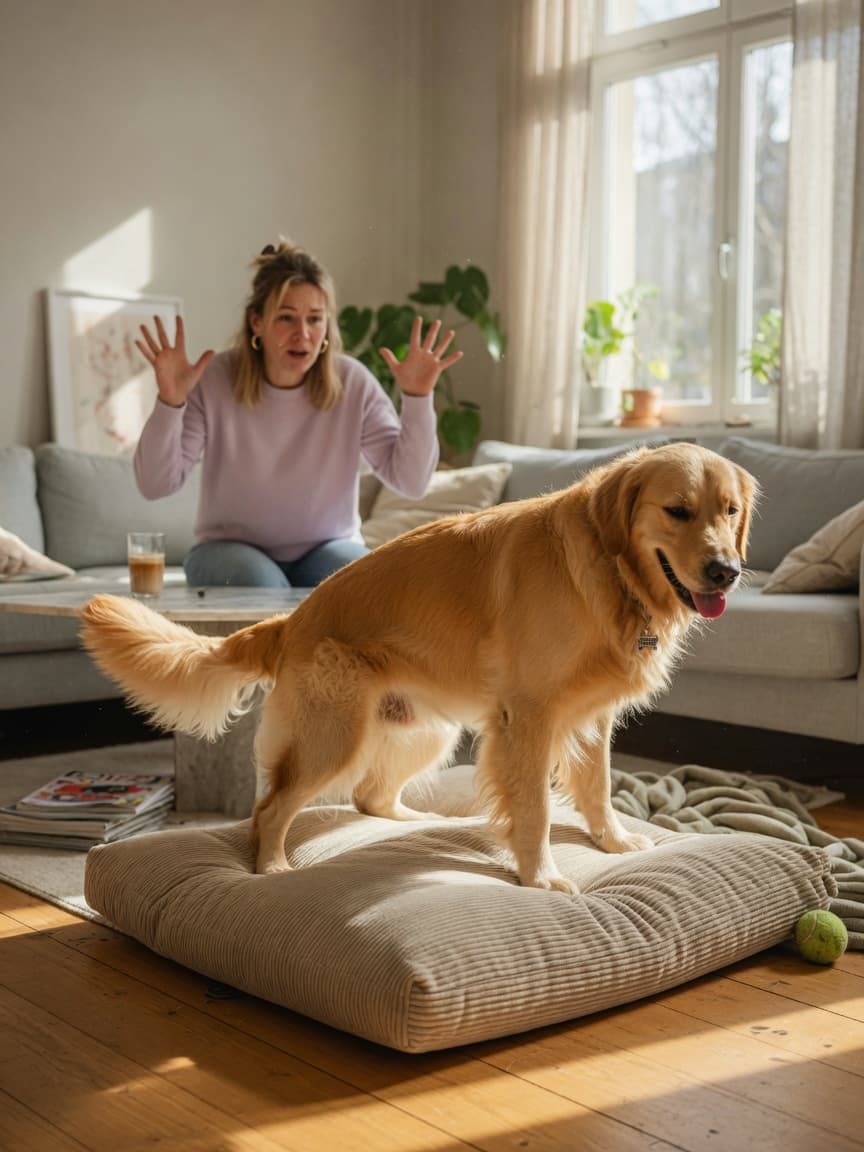
This is where owner responses matter enormously. The first time a puppy or dog mounts a human leg, the most common reactions are laughter, animated protests, or attempts to physically push the dog away. From the dog's perspective, all of these responses are attention — and attention is rewarding. A behaviour that reliably produces a response from humans, even a negative one, will be repeated. Many dogs that persistently hump people have been inadvertently trained to do so through exactly this process.
When Humping Becomes a Problem That Needs Addressing
Not all humping needs to be actively managed. The contexts in which it is worth addressing include:
- When it causes social problems with other dogs — mounting is offensive to most dogs, and a dog that mounts persistently during play is at risk of triggering defensive aggression from the dog being mounted
- When it is directed at humans, particularly children — regardless of the reason, this is socially unacceptable and children in particular may be frightened or knocked over
- When it is occurring at high frequency, suggesting a generalised anxiety or arousal problem that needs addressing in its own right
- When it has become a fixed attention-seeking routine that is reinforced every time it occurs
What Does Not Work
Punishment is not an effective approach to humping. Physical correction, shouting, or pushing the dog away does not address the underlying motivation — and as noted above, for dogs motivated by attention-seeking, any response at all may be reinforcing. Punishment can also increase stress levels in a dog that is already humping as a stress response, which tends to make the behaviour worse rather than better.
What Does Work
Redirection
The most practical immediate response is calm, quiet redirection. Before the dog has begun mounting — the moment you notice the raised arousal or intent — redirect to an incompatible behaviour. Asking for a sit or a down, offering a toy, or simply moving the dog gently away and then asking for calm behaviour removes the opportunity to practise the unwanted behaviour and gives the dog something else to do. The key is to intervene early and calmly, not after the mounting has begun.
Reducing Arousal
For dogs that hump as a result of over-arousal, managing the situation before arousal peaks is more effective than responding after the fact. This might mean shortening play sessions before they escalate, introducing calm breaks during play, or practising calm greetings with visitors rather than allowing excitement to build unchecked.
Ignoring Attention-Seeking Mounting
For dogs that have learned that mounting produces an entertaining response, the most effective intervention is complete withdrawal of attention. Turn away, fold your arms, look at the ceiling, and wait. When the dog stops and has four feet on the floor, reward with calm praise. This requires consistency from everyone in the household — a single person who still laughs or pushes the dog away will undo the training of everyone else.
What About Neutering?
Neutering reduces mounting behaviour in some dogs, particularly those in which the behaviour is hormonally driven. However, it does not eliminate it in all dogs, and in dogs where humping is primarily a learned behaviour, an anxiety response, or an excitement response, the effect of neutering may be minimal. Neutering is not a substitute for behaviour management — it is at best an adjunct to it.
Links to Generalised Anxiety
In some dogs, frequent and persistent humping — particularly when occurring in multiple contexts and alongside other anxiety-related behaviours such as excessive licking, panting, or restlessness — may be a sign of generalised anxiety that warrants a more comprehensive assessment. A veterinary behaviourist or a clinical animal behaviourist registered with the Animal Behaviour and Training Council (ABTC) can assess whether anxiety is a significant contributing factor and whether additional support, including medication, might be appropriate.
--- Author: Julia Wrenfield