
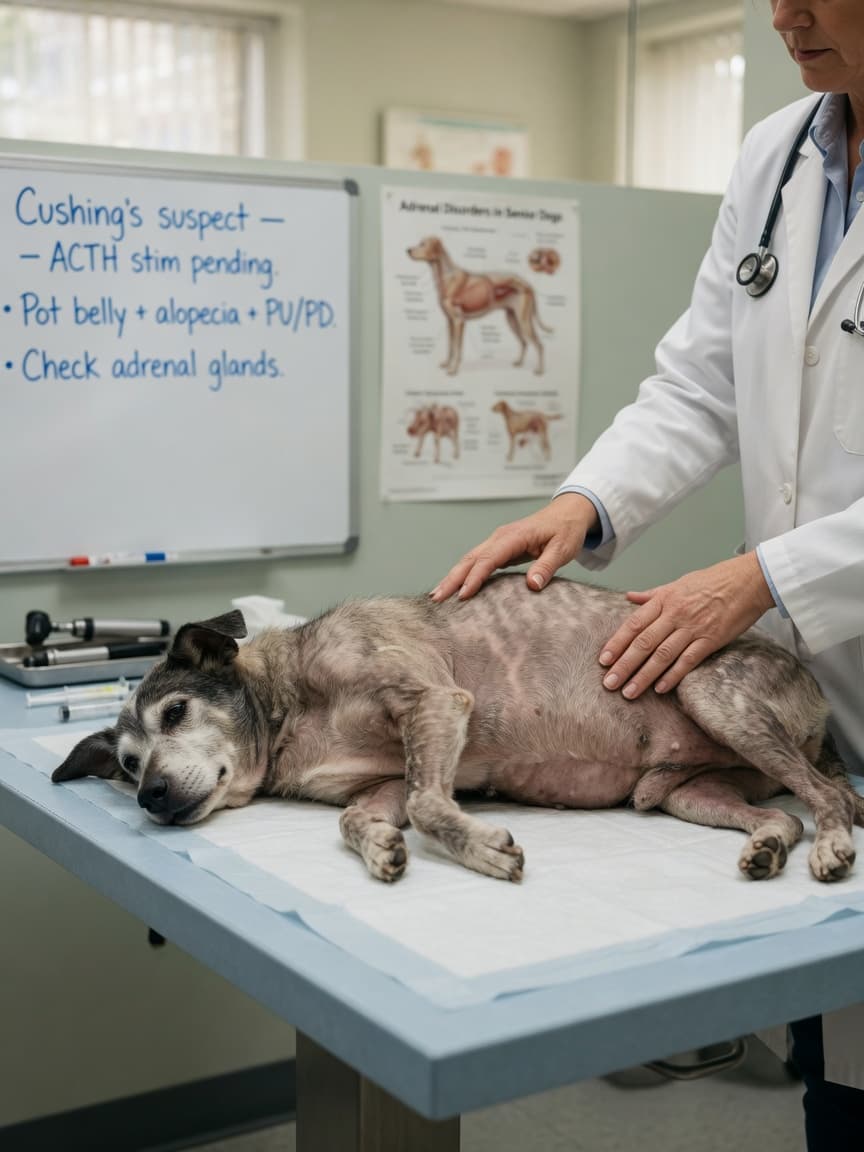
What Is Cushing's Disease in Dogs?
Cushing's disease, medically known as hyperadrenocorticism, is one of the most common hormonal disorders seen in dogs across Europe. It occurs when the body produces excessive amounts of cortisol, a steroid hormone made by the adrenal glands. Cortisol plays a vital role in regulating metabolism, immune function, and the stress response — but too much of it causes a cascade of problems throughout the body. The condition typically affects middle-aged to older dogs and can be challenging to diagnose because its symptoms develop gradually and can mimic other conditions.
Types of Cushing's Disease: Pituitary vs Adrenal-Dependent
There are two main forms of naturally occurring Cushing's disease in dogs, distinguished by where the excess cortisol production originates.
Pituitary-Dependent Hyperadrenocorticism (PDH)
This is by far the most common form, accounting for approximately 80 to 85 per cent of all cases in Europe. PDH is caused by a benign tumour (adenoma) or, less commonly, a malignant tumour of the pituitary gland at the base of the brain. This tumour secretes excessive amounts of adrenocorticotrophic hormone (ACTH), which in turn over-stimulates both adrenal glands to produce too much cortisol. Dogs with PDH typically have symmetrically enlarged adrenal glands visible on abdominal ultrasound.
Adrenal-Dependent Hyperadrenocorticism (ADH)
In 15 to 20 per cent of cases, a tumour — either benign (adenoma) or malignant (carcinoma) — develops directly on one adrenal gland. This tumour autonomously produces cortisol independently of pituitary control. Unlike PDH, ADH typically causes one enlarged adrenal gland and one shrunken gland on ultrasound.
Iatrogenic Cushing's Disease
A third, non-naturally occurring form can arise from prolonged administration of corticosteroid medications (such as prednisolone) used to treat other conditions. Iatrogenic Cushing's resolves when the steroid medication is gradually withdrawn under veterinary supervision.
Which Dog Breeds Are Most at Risk?
While any dog can develop Cushing's disease, certain breeds appear to have a significantly higher predisposition. In European veterinary clinics, the breeds most frequently diagnosed include:
- Poodles (Miniature and Toy varieties in particular)
- Dachshunds
- Boxers
- Beagles
- Yorkshire Terriers
- Staffordshire Bull Terriers
- Cavalier King Charles Spaniels
The condition is rarely seen in dogs under six years of age. Most affected dogs are between eight and twelve years old, making it a key consideration in routine health monitoring of older dogs.
Recognising the Symptoms of Cushing's Disease
Because cortisol affects virtually every system in the body, the clinical signs of Cushing's disease are numerous and wide-ranging. They tend to develop slowly over months or even years, which means owners may initially dismiss them as signs of normal ageing. Key symptoms to watch for include:
- Pot-bellied appearance due to muscle wasting and fat redistribution
- Polydipsia (excessive thirst) and polyuria (frequent, large volumes of urination)
- Polyphagia (increased or insatiable appetite)
- Symmetrical hair loss (alopecia), usually sparing the head and legs
- Skin thinning, bruising easily, or developing calcium deposits under the skin (calcinosis cutis)
- Increased panting, even at rest or in cool temperatures
- Lethargy and generalised muscle weakness
- Susceptibility to recurrent skin or urinary tract infections
- Failure to come into season in intact females, or testicular atrophy in males
If your dog shows several of these signs, particularly in combination, a veterinary assessment is strongly recommended. EU veterinary guidelines emphasise early diagnosis to prevent secondary complications such as hypertension, diabetes mellitus, and pulmonary thromboembolism.
Diagnosing Cushing's Disease in Dogs
Diagnosing Cushing's disease requires specific hormonal tests, as routine blood panels and urinalysis can only suggest the possibility — they cannot confirm it. Two key diagnostic tests are used across European veterinary practices.
ACTH Stimulation Test
This test measures how the adrenal glands respond to a synthetic injection of ACTH. A blood sample is taken before the injection and again one hour afterwards. In a healthy dog, cortisol rises moderately. In a dog with Cushing's disease, the rise is exaggerated. This test is particularly useful for diagnosing iatrogenic Cushing's and for monitoring treatment response.
Low-Dose Dexamethasone Suppression Test (LDDS)
The LDDS test is considered more sensitive for naturally occurring Cushing's disease. A small dose of dexamethasone is given, and blood samples are collected at the time of injection, at four hours, and at eight hours. In a healthy dog, cortisol is suppressed by dexamethasone. In a dog with Cushing's, suppression does not occur as expected. This test can also help differentiate between pituitary and adrenal forms.
Additional diagnostics typically include a full biochemistry panel, urinalysis (often showing a very dilute urine with a specific gravity below 1.020), abdominal ultrasound to assess adrenal gland size, and blood pressure measurement.
Treatment Options for Cushing's Disease
The treatment approach depends on the type of Cushing's disease identified.
Trilostane
Trilostane (brand name Vetoryl) is the most widely used medical treatment for both pituitary and adrenal-dependent Cushing's disease in European dogs. It works by blocking an enzyme in the adrenal gland that is essential for cortisol synthesis. It is given orally, typically once or twice daily with food. Trilostane is generally well tolerated but requires careful dose titration and regular monitoring.
Mitotane
Mitotane (o,p'-DDD) selectively destroys the cortisol-producing cells of the adrenal cortex. It is used less commonly in Europe due to a narrower safety margin compared to trilostane, but it remains an effective option in some cases. It requires an induction phase followed by lifelong maintenance dosing.
Surgical Options
Adrenalectomy (surgical removal of the affected adrenal gland) is an option for adrenal-dependent Cushing's, particularly when the tumour is benign and localised. Hypophysectomy (pituitary surgery) is performed at specialist centres in Europe and can be curative for PDH, though it is technically demanding and not widely available.
Monitoring and Long-Term Management
Dogs receiving medical treatment for Cushing's disease require regular monitoring, including ACTH stimulation tests, typically at 10 days, four weeks, and then every three to six months once stabilised. Owners should watch for signs of over-treatment, which can cause Addison's disease (hypoadrenocorticism) — a dangerous drop in cortisol. Signs of over-treatment include sudden lethargy, loss of appetite, vomiting, and weakness.
With appropriate management, many dogs with Cushing's disease enjoy a good quality of life for several years. Providing high-quality nutrition, appropriate exercise, and regular veterinary care is essential. Retailers such as Zooplus offer a range of senior dog foods and supplements that support the metabolic needs of older dogs managing chronic conditions.