
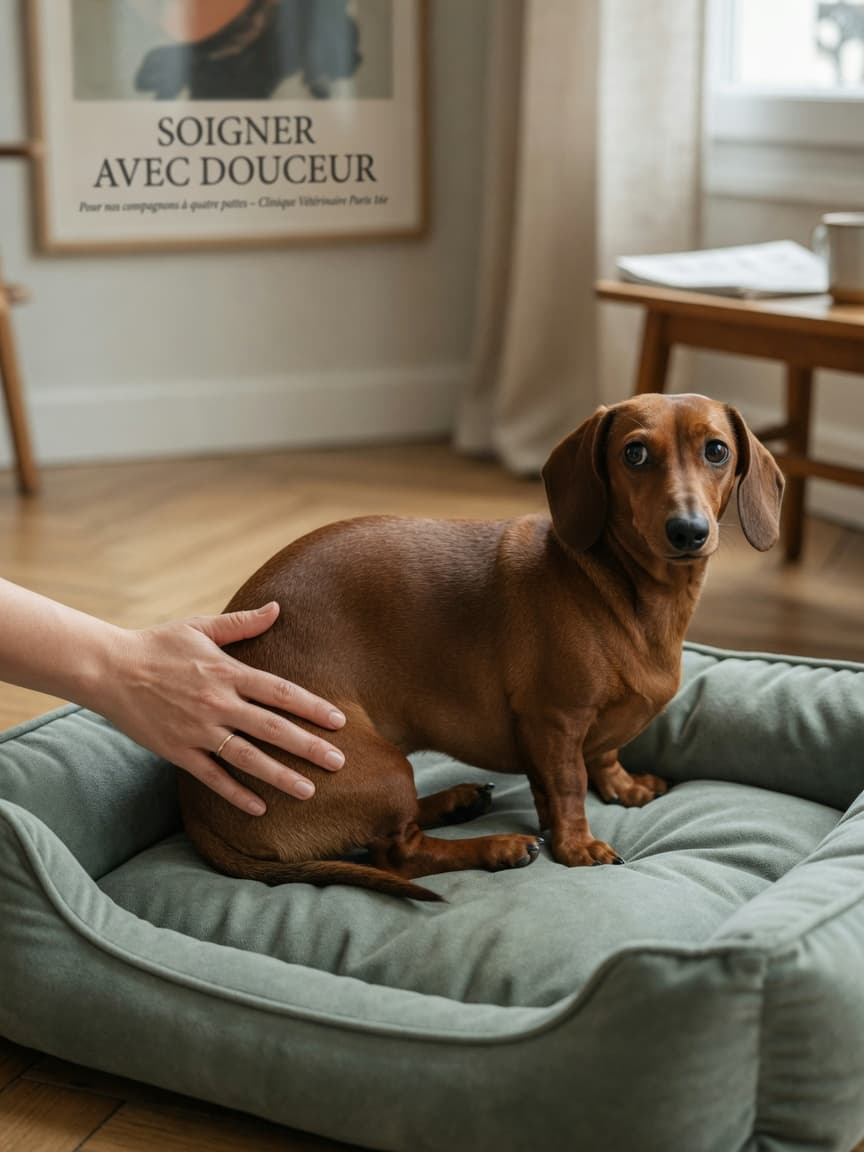
Why Dachshunds Are So Vulnerable to Back Problems
No breed is more closely associated with spinal disease than the Dachshund. This beloved sausage dog carries a genetic mutation — chondrodystrophy — that causes premature mineralisation of the intervertebral discs throughout the spine. Where a healthy disc acts like a shock-absorbing gel cushion between vertebrae, a mineralised Dachshund disc becomes brittle and prone to sudden rupture. The statistics are stark: studies suggest that approximately one in four Dachshunds will develop clinically significant intervertebral disc disease (IVDD) during their lifetime, and Dachshunds account for roughly 45–70% of all IVDD cases seen in veterinary neurology referral centres — despite being far from the most common breed overall.
Their elongated spine combined with short, disproportionate limbs means the vertebral column is under constant and uneven mechanical stress. Every jump from a sofa, descent of a staircase, or energetic bound off a kerb transmits forces that a Golden Retriever's more proportionate skeleton would absorb with ease. For the Dachshund, these seemingly ordinary movements can tip a compromised disc over the edge.
Understanding the Risk: More Than 10 Times Higher Than Other Breeds
Research consistently finds that chondrodystrophic breeds are at least 10 times more likely to develop IVDD than non-chondrodystrophic breeds, with Dachshunds sitting at the extreme end of this spectrum. Both miniature and standard Dachshunds are affected, and there is no significant difference in risk between wire-haired, long-haired, and smooth-haired varieties — the genetic mutation is present across all coat types.
Most Dachshunds that develop IVDD do so between the ages of three and seven years, though cases can occur from as young as two or as late as ten. The thoracolumbar junction (the region where the ribcage ends and the lower back begins, roughly at the T11–L3 level) is by far the most common site of disc herniation, accounting for around 85% of cases in Dachshunds. Cervical (neck) herniations also occur, causing front-limb weakness or neck pain.
Preventive Measures Every Dachshund Owner Should Take
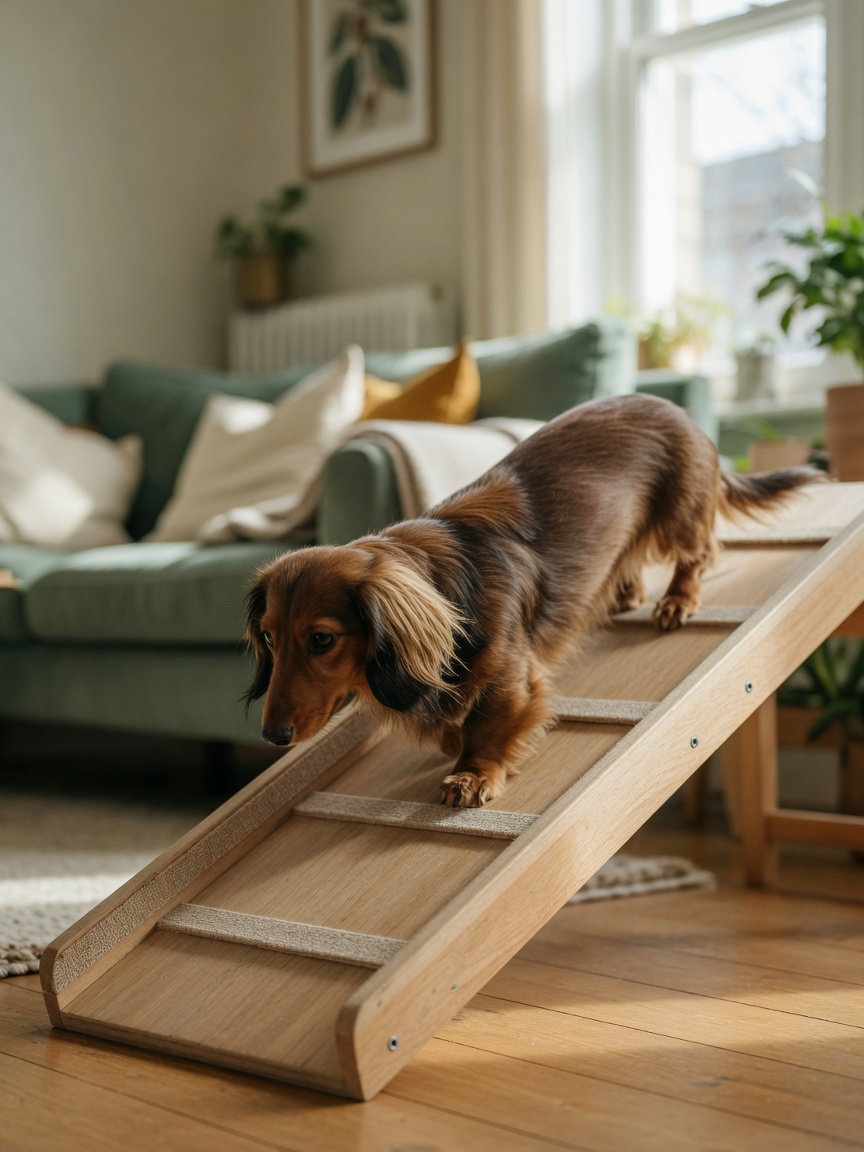
While you cannot change your Dachshund's genetics, there is strong evidence that lifestyle modifications reduce the risk and frequency of IVDD episodes.
Use Ramps and Steps
Install ramps or steps to allow your dog to access sofas, beds, and car boots without jumping. The force of landing from a jump can be three to five times your dog's body weight — that landing force travels directly up through the spine. Ramps with a gentle gradient are preferable to steps, which still involve an element of impact at the bottom. Once the ramp is in place, actively train your dog to use it consistently and discourage jumping at all times.
Maintain a Healthy Weight
Obesity dramatically worsens the mechanical load on an already vulnerable spine. A Dachshund at a healthy weight carries less stress through every disc with every movement. Use body condition scoring to assess your dog regularly — you should be able to feel the ribs easily without pressing hard, and there should be a visible waist when viewed from above. Avoid overfeeding and limit high-calorie treats.
Support the Spine When Carrying
When picking up a Dachshund, always support the full length of the body — one hand under the chest, one under the hindquarters. Never pick them up under the front legs alone, which allows the heavy hindquarters to dangle and places acute stress on the lumbar spine.
Controlled, Low-Impact Exercise
Lead walks on flat surfaces are preferable to off-lead running in rough terrain. Swimming is an excellent low-impact option. Avoid activities that involve repetitive jumping, twisting, or sudden directional changes.
Recognising the Signs of IVDD
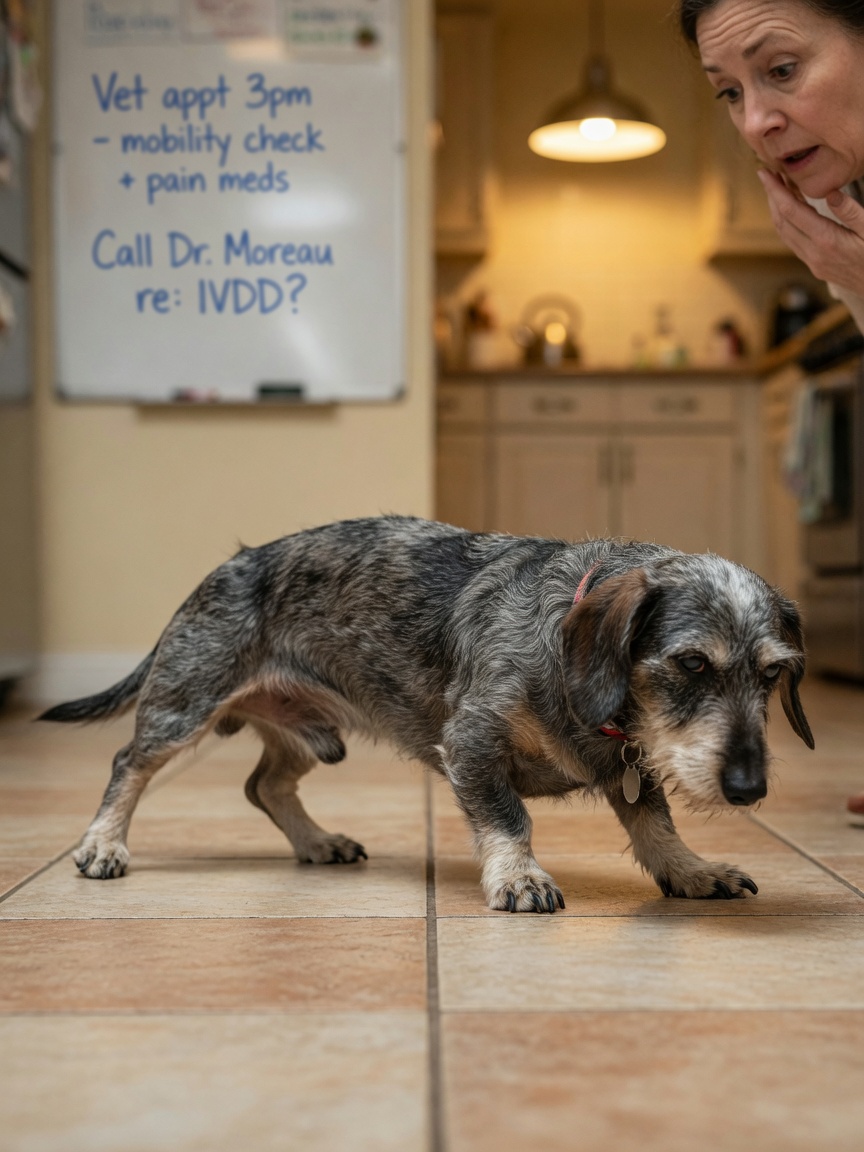
Early recognition is critical. Symptoms vary depending on which part of the spine is affected and how severe the compression is, but common signs include:
- Sudden yelping or crying out, particularly when moving, being touched along the back, or jumping
- Reluctance to move, go up stairs, or jump onto familiar surfaces
- An arched or hunched back posture
- Wobbly or uncoordinated walking in the hindlimbs (ataxia)
- Dragging one or both back legs
- Loss of bladder or bowel control
- Complete inability to use the hindlimbs
Any of these signs — particularly sudden onset — warrants an immediate call to your vet. Do not give it a day to see whether things improve.
IVDD Grading and When Surgery Becomes Urgent
Veterinary neurologists grade IVDD from 1 to 5 based on the dog's neurological status. Grade 1 involves spinal pain only; Grade 2 adds mild weakness; Grade 3 means the dog cannot walk but has some voluntary movement; Grade 4 means paralysis with deep pain still present; and Grade 5 means paralysis with loss of deep pain perception.
Grade 3 and above should be considered a surgical emergency. The goal of surgery — typically a hemilaminectomy to remove the herniated disc material — is to decompress the spinal cord before irreversible damage sets in. For Grade 4 and 5 dogs, the 48-hour window from the onset of paralysis is critical: surgery within this period gives the best chance of recovery. Dogs that have lost deep pain perception for more than 48–72 hours face a significantly worse prognosis, and a proportion will not recover ambulation even with surgery.
Do not attempt to manage a paralysed Dachshund at home with rest and painkillers while waiting to see if they improve. Contact your vet immediately and request urgent referral to a veterinary neurologist.
Life After Paralysis: Wheelchairs and Rehabilitation
For Dachshunds that do not regain the ability to walk — whether due to delayed treatment, severity of injury, or unsuccessful surgery — quality of life need not be poor. Mobility carts (canine wheelchairs) are custom-fitted devices that support the hindquarters and allow dogs to move freely on their front legs. Many paralysed Dachshunds adapt to carts remarkably quickly and go on to lead happy, active lives.
Alongside or in place of a cart, physiotherapy and hydrotherapy are valuable for maintaining muscle mass, managing bladder function, and preserving joint health. Bladder expression — manually emptying the bladder — may be required for dogs that lose urinary control, and owners can be taught to do this at home by their veterinary team.
MRI Screening in Breed Health Schemes
A significant development in Dachshund health management is the availability of IVDD screening MRI. The Dachshund Health UK scheme, supported by the British Veterinary Association, allows Dachshunds aged two years and over to be assessed under sedation for the number of calcified (mineralised) discs visible on MRI. Dogs with fewer calcified discs are considered lower risk, and breeders are encouraged to use screened dogs to reduce the incidence of IVDD across future generations.
If you are purchasing a Dachshund puppy, ask breeders whether their dogs have been MRI screened and for the results. Choosing puppies from lower-risk parents does not guarantee a IVDD-free life, but it meaningfully shifts the odds in your favour.
Written by Julia Wrenfield